These days, I write whenever I want to – or when I’m not busy exploring the world with my wife or kids or grandkids. I write and read constantly. Then I discovered that I was writing longer and longer pieces. My new focus is to write shorter; and to write HUMOR. On purpose. Maybe I can still irritate people while being funny. It works pretty well for John Scalzi! We’ll see what happens.

While it’s not listed or advertised, or even acknowledged as such, this book is true Science Fiction – because it extrapolates from what we KNOW to what MIGHT BE…
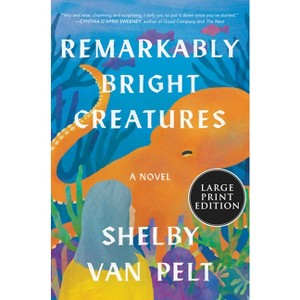
Tova and Cameron are the main characters – or at least that’s what a typical Human would regard as the main ones. The drama comes through them (and a small cast of “lesser” characters) – and the true main character: Marcellus, a giant Pacific octopus.
You read that right: he’s a giant Pacific octopus. A photo of one – interacting with a Human is up above. In the book, Marcellus has his own voice and is ironically commenting on the Human animal. Wikipedia defines SF in part this way, “Science fiction [the] genre of speculative, science-based fiction [and] most lately, to… transhumanism, posthumanism, and environmental challenges. Science fiction often specifically explores human responses to the consequences of these types of projected or imagined scientific advances…including hard science fiction, which emphasizes scientific accuracy...”
While the novel is very much more complex than the premise above suggests, it remains at its heart an exploration not ONLY of Human interaction, but of interaction between a Human and not-human intelligence. Poking around at the definitions of “sentient” and “sapient” (and myself using the two words interchangeably (WHICH IS A SERIOUS MISTAKE!), I discovered that while they are similar words, “sentient” is a SUBSET of “sapience”.
In fact, I only yesterday discovered that the second is a part of Human’s technical name: Homo sapiens sapiens. The double is NOT a mistake: Homo sapiens is a species that INCLUDES Neanderthal humans, and Heidelberg humans, (that came from near Herto, Ethiopia) (though the discussion is ongoing to decide if it actually IS a subspecies). And that Cro-Magnon humans are now considered a CULTURE of H. s. sapiens. I did NOT know that!
At any rate, back to Marcellus – he is an elderly octopus captured out of Puget Sound. I discovered also, that the Sound is a “complex estuarine system of interconnected marine waterways and basins located on the northwest coast of Washington state. It has one major and two minor connections to the Strait of Juan de Fuca, which in turn connects to the open Pacific Ocean. He was captured and “imprisoned” in a huge aquarium at the Sowell Bay Aquarium. He eventually not only learns what happened to him (his entries are titled “Day XXXX of My Captivity”, but that he is increasingly witness to not only Human drama -- but Human secrets.
So, why isn’t this just a cute story using a neat trick of taking the point of view of an octopus? Because it’s well documented that octopi, especially the “Giant Pacific Octopus [who are] renowned for solving puzzles, opening jars, and escaping aquarium enclosures.”
“Oh, an octopus isn’t going to be able to think like a Human!” you’d be tempted to say. But, perhaps pause your “Humanocentric” point of view. What makes us think that Human thinking is the epitome of intelligent thought? If you’d pause for an instant, consider that Humans are master of only ONE FOURTH of the surface of Earth, where Octopi are conceivably masters of the OTHER three fourths of the planet (ie: the continents, aka above-surface dirt).
I’d point out that while Marcellus may not be smart as a Human, perhaps, in actual terms, he’s smarter than me or maybe even smart AS AN OCTOPUS, which would be intrinsically DIFFERENT than being as smart as me. Or you. Or any other Human around in absolute intelligence. Maybe he can’t drive a car…(though I wouldn’t put it past him now that I think about it…), but his kind manipulate their environment, and (given their environment) have avoided inventing electric power…
So, the idea that Van Pelt used an octopus, well known for its intelligence, and she wasn’t ridiculous with inventing starships, and laser guns, and other Human technology for them, instead played with the idea that their powers of observation and intellect might be far beyond our own – in other words, taking a scientific fact and twisting it around to give it a new appearance and inspire a serious consideration of the possibility that there might not be just intelligent life on Other Worlds, but not only INTELLIGENT life here on Earth (besides…well at least SOME of us!), but intelligent life whose perception of the planet we live on is no LESS accurate than those of Humanity…
THAT, I propose is exactly what the best science fiction is supposed to be doing, and not merely entertaining us with more and more and more iterations of STAR TREK and STAR WARS, and WAR OF THE WORLDS...
Inspiration: https://faithandsciencefiction.blogspot.com/2019/02/possibly-irritating-essays.html, https://www.nhm.ac.uk/discover/octopuses-keep-surprising-us-here-are-eight-examples-how.html, https://www.anmlzone.com/10-most-intelligent-octopuses/ Image: https://target.scene7.com/is/image/Target/GUEST_6ab40c16-61a5-4850-a34a-9abe333dafdc?wid=300&hei=300&fmt=pjpeg


No comments:
Post a Comment