Showing posts with label DISCON III. Show all posts

August 6, 2022

Slice of PIE: DISCON III – #10: Expanding Stories into Longer Pieces


Using the Programme Guide of the 2021 World Science Fiction Convention, DisCON III, which I WOULD have been attending in person if I felt safe enough to do so in person AND it hadn’t been changed to the week before the Christmas Holidays…I will jump off, jump on, rail against, and shamelessly agree with the BRIEF DESCRIPTION given in the Program Guide. I will be using the events to drive me to distraction or revelation – as the case may be. The link is provided below where this appeared!

Panelists:
Howard A Jones: Award-winning fantasy author
Jenny Rae Rappaport: author of short fiction
Mary Turzillo: prolific poet, award-winning author
Michael Swanwick: Hugo, Nebula, and Locus author of short stories, novels, and essays
AC Wise: prolific author

Howard A Jones:

- in a short story, everything is known and plotted out; in a longer piece, you have to scaffold to get to the end and it takes a long time.
- you have to be in love with your characters.
- in a short piece, the villain isn’t well defined. Even there, you have to find what your character wants and KEEP it from them.
- in a long story, I can do whatever I want to do.
- finding your way in that “whatever I want” is what makes the story happen.
- I’m an outliner rather than a pantster – but do both. Whatever works. Write your way through to the mountain.
- use the old with completely new, like TODAY’S episodic television.
- I ask myself, “Am I going to enjoy working with the characters.
- keep the important stuff, then change whatever I want to, though be consistent. I can EXPAND the story.
- in DESERT OF SOULS, I took Arabian Nights fantasies, that sort of worked. Then I asked if [something else] would work if I just slide it in. It did.
- sometimes, I get a surprise!

Jenny Rae Rappaport:

- sometimes you CAN feel what the characters want to do.
- every secondary character is a hero in their own life!
- return to your work often.
- if it’s NOT working, rewrite it.
- when reading slush, I try an see what makes the story go.
- a pantster DISCOVERS the story, plotting kills the story.
- I don’t personal have to “like” my characters.
- there ARE no rules about changing a short story into a novel.
- your story HAS to have a finish. How is the problem solved? Resolutions change the character.
- the reader needs to know everything that happens.
- research makes the story richer

Mary Turzillo:

- if you have a short story and want to make it longer, expand PAST the climax.
- you can also add a subplot.
- try to make her lovable, weak on the villain, in trouble every ten pages – that what makes it a PAGE-TURNER.
- give up when I hit a brick wall???
- every writer works in different ways.
- “red line of death” is somewhere in the middle of the title [I’d never heard the phrase before, so I poked around and found this: “…a top sci-fi magazine editor…puts a red line on the manuscript at the moment where he or she loses interest in the story. Because it’s focused on losing instead of catching a reader, this sort of exercise makes it easier for a piece with solid writing to do well vs. one with a distinctive action hook.” (https://alphawritersworkshop.org/beginnings/)
- a likeable character with undeserved misfortune…HOWEVER: “walking is controlled falling”.
- our story is in another universe.
- Poems are ads for short stories; short stories are ads for novels; novels externally…
- Anne McCaffery [in her Dragonriders of Pern series] started with short stories and ended up with numerous novels with few discrepancies. She kept what was in the short stories.
- Jeff Landis said, “I don’t sell exclusive rights for two years. The editors seem to be fair.”
- a novel has to be RICH. That richness is what it needs to BE a novel.

Michael Swanwick:

- fix-up novels never get respect.
- it can take as much time to write a short story as a novel, but short stories go away and novels stay with it.
- when you consider expanding a short story, you get an idea of how long it “should” be.
- a novel 100,000 words (20 chapters, 5000 words per chapter; but a short story has a “certain SHAPE”. It could be a first chapter or an inspiration for a novel.
- in a novel, you can explain what’s happening and WHY. You can’t in a short story.
- a short story about time travel; plopped it in the middle of a novel – then changed it all until it WORKS.
- The Gardner Dozois Slush Pile Anecdote: https://www.asimovs.com/current-issue/in-memoriam-gardner-dozois/
- EXPAND YOUR STORY, regardless of the method – meticulous, pantster, daydreamer…
- cut stories out of your novel. “The Man That Melted” – cut out, reworked with different stories; like the character who lives in one, dies in the other.
- how does your editor FEEL about you?
- THE ENDING AND EVERY WORD HAS TO BE USEFUL

AC Wise:

- when you see “what characters want to do”, ask yourself: is this a trick?
- you can insert more details to make is seem “real”.
- if you already have a published story [in that “universe”] where do you pick up?
- in a short story, you create a “tone”, in a novel, the character is CHANGED.
- when you expand a story, you have to change it – but how MANT changes do you make?

I’ve underlined above which comments left an impression on me – now all I need to do is study them and apply them!

Program Schedule: https://discon3.org/schedule/
Image: https://encrypted-tbn0.gstatic.com/images?q=tbn:ANd9GcQY860vAI2izm2g2mUgxzT14fGVmoGh66B51g&usqp=CAU


 

July 3, 2022

Slice of PIE: DISCON III – #9: Writing Short Fiction


Using the Programme Guide of the 2021 World Science Fiction Convention, DisCON III, which I WOULD have been attending in person if I felt safe enough to do so in person AND it hadn’t been changed to the week before the Christmas Holidays…I will jump off, jump on, rail against, and shamelessly agree with the BRIEF DESCRIPTION given in the Program Guide. I will be using the events to drive me to distraction or revelation – as the case may be. The link is provided below where this appeared!


This was one of the two sessions I awaited with bated breath. What makes a good short story? How do you know it’s ready? Where should you send it and how should you respond to comments? This is your chance to ask burning questions to a panel of respected short fiction editors. HERE, I would discover the SECRET of breaking into ASIMOV’S, F&SF, CLARKESWORLD, and countless Anthologies…by hearing the secret advice of these fabulous writers:

José Pablo Iriarte
(JI)– lots of stories, several awards!
AT Greenblatt(ATG) – lots of stories!
Michael Swanwick (MS) – numerous stories, novels, and awards!
Rebeca Roanhorse (RR) – numerous stories, novel, and awards!
Kel Coleman (KC) – several stories, they are a new light in the SF sky!

From my notes of the session, I’ll summarize the most salient points each writer made.

Advice from JI:
“Focus on emotional PUNCH”, “I’m a plotter”; “You need SCENES”; “A novel is vignettes with characters”; “Life In Stone Glass and Plastic” – one of the first places I learned to ‘gut punch’ [with] an inevitable surprise ending.”; “Artwork that you really interact with.”; “Analyze the stories of others”; “‘Perfect’ is the ENEMY of good.”

Advice from RR:
“A short story is ONE IDEA I want to communicate. In a novel, I discover what the book is about”; “Write quickly and EXPERIMENT”; “Anthologies make money, sell reprints”; “Option your stories. Be strategic.”; “In ‘Welcome To Your Authentic Indian’, I wondered ‘what if a white person made a better Indian that the character is?’ I wanted to pull the reader into the story, so I used second person to explore ‘what is culpability?’ (read it here: https://apex-magazine.com/short-fiction/welcome-to-your-authentic-indian-experience/); “Write the story only you can write. DON’T copy or write to the market. Let the MARKET decide [if it wants you].”

Advice from ATG:
“Spark an image in your short story, the weirder the idea, the better”; “Check The Grinder and Ralan for anthologies”; “‘__________’ family in a mineshaft. Told by courses of a meal . Tension microaggressions. Visceral.”; “Read other genres – try something new.”

Advice from KC:
“How do you plot?”; “When you’re done, what do you do?”; “Demonstrating is best”; “What about chapters in a short story? JI: “Doesn’t seem to damage. Generally CAN’T stand on itself.”; “I’ve worked years on stories – seven years missing the skill set to TELL the story. Had to trunk it.”; “You need resources.”

Advice from MS:
“A short story should be THE most important incident in a character’s life. In a novel, it should be the most important PERIOD in the character’s life.”; “KNOW something – the story is shaped by your research. It’s a race between what the story and the research.”; “I laid in a parking lot to see what I could see. LOOK at things.”; “Ideas are NOT precious. They should be used!”; “SF writers don’t get paid much. Get the novel FIRST to support your short fiction. Poverty is your choice.”; “SF writers can ask questions – ‘Foresight’ in which consciousness is reversed.”; “Gardner Dozois: ‘Start the story, stick the ending.’”; “Publishing a part of a novel is hard to do. I have published the opening; then cannibalized the novel for a short story.”; “Write a story you HAVE to write; do it; send it.”

In brief:

José Pablo Iriarte: “Focus on emotional PUNCH…one of the first places I learned to ‘gut punch’ [with] an inevitable surprise ending.”
Rebeca Roanhorse: “A short story is ONE IDEA I want to communicate.”; “Write quickly and EXPERIMENT”
AT Greenblatt: “Spark an image in your short story, the weirder the idea, the better”
Michael Swanwick: “A short story should be THE most important incident in a character’s life. In a novel, it should be the most important PERIOD in the character’s life.”, “Write a story you HAVE to write; do it; send it.”

I learned and I’m applying this collection of wisdom. I hope you can use it as well. Good luck!

Program Schedule: https://discon3.org/schedule/
Image: https://encrypted-tbn0.gstatic.com/images?q=tbn:ANd9GcQY860vAI2izm2g2mUgxzT14fGVmoGh66B51g&usqp=CAU

May 21, 2022

Slice of PIE POSSIBLY IRRITATING ESSAY: DISCON III – #8 Crafting the Elevator Pitch: Pho, Irriarte, Bilmes, Bruto, Avery


Using the Programme Guide of the 2021 World Science Fiction Convention, DisCON III, which I WOULD have been attending in person if I felt safe enough to do so in person AND it hadn’t been changed to the week before the Christmas Holidays…I will jump off, jump on, rail against, and shamelessly agree with the BRIEF DESCRIPTION given in the Program Guide. I will be using the events to drive me to distraction or revelation – as the case may be. The link is provided below where this appeared!


"Success is equal parts preparation and luck—so be prepared when luck puts you in the right place at the right time! How do you get ready for a pitch opportunity with an editor or producer, when you may have less than a minute to sell your dream project?"

Diana M. Pho: Editor at Tor.com
José Pablo Iriarte: Writer
Joshua Bilmes: Owner of JABbberwocky Agency
Patrick LoBrutto: Former ACE Books editor, currently Editorial Consultant (with connections and project far too numerous to list, go here: https://patrickjlobrutto.net/)
Sarah Avery: Moderator

OK! So there was quite a lineup there! Everyone had something good to say. It was less organized than the others, but they all agreed on one thing: the pitch was “A way you approach an editor in order to get your foot in the door, or to interest them. BREVITY is key. You can get down to details later.”

Without further ado:

Diana M. Pho:
1) 30-45-60 sec0nds. You want to talk longer, arrange a meeting.
2) Title; word length; genre (but DON”T GET MARRIED TO the genre you choose – roughly!); plot; how big is the cast is; the protagonist, antagonist, and main supporting character for the protagonist; the FOCUS of the piece. Make it one, 60 second-long sentence.
3) Be EXCITED about your story. Passionate, knowledgeable, confident…Your enthusiasm can carry the pitch.
4) Respect the agent’s BOUNDARIES – don’t touch them, and be light. Respect their seconds and arrange a time later.
5) What kind of expertise do you have?
6) DO NOT SAY: “It’s difficult to describe”, or “It’s just like [current best seller]”. How do you want to envision the book? Open the doorway to how to POSITION it.
7) Hollywood Log Line: “Dinosaurs now live and hunt alongside humans. This fragile balance will determine once and for all, whether humans remain apex predators or share it with history's most fearsome creatures.” [Jurassic World: Dominion] Like this.
8) “Adjectives an author uses to describe their work [to an agent], go in one ear and out the other.”

Joshua Bilmes:
1) You elevator pitch should be like a press release – interesting stuff first, boring stuff last.
2) Title and first line – YOU NEED MORE THAN THAT! The pitch doesn’t matter without the rest.
3) Give the agent CONTEXT – where does it fit at B&N or on Amazon.
4) The agent should WANT to know more. Don’t give a boring pitch!
5) Be caught up in the pitch, but not ready for the follow up!
6) Give the CONTEXT of where your book fits! What books inspired you?
7) If you make a mistake, don’t kill yourself over it!

Sarah Avery
1) Don’t pitch what you haven’t finished!
2) Give me a map: PIXAR Pictures: “Once there was A…”, every day, one day, stuff happens, and FINALLY…
3) The pitch is in person. What are the social customs where you’re at.
4) It’s like “author-agent speed dating”. How much SHOULD you share?
5) Agents are gatekeepers; but don’t wave YOUR OWN red flag!
6) “I made my students read it and they all loved it!” is not a glowing endorsement.

Patrick LoBrutto
1) What have you had published?
2) The pitch isn’t working if the person doesn’t pay attention! You have to bring them with you with your words.
3) A casual approach works better. Aggressive approaches DON’T WORK! It’s not the ONLY time you can ever pitch!
4) Know what your novel is LIKE: (DAVINCI CODE meets JAWS). You have to be current and useful to the editor. What the characters like. Have a 1 page, 10 page, the whole novel WITH you…in case.
5) Best ones have never been published. IT’S ALL IMPOSSIBLE – I do it because I have to.
6) What the agent/editor already have – USE IT TO GIVE THEM TO COMPARISON.

José Pablo Iriarte

1) Manage your anxiety – the pitch is daunting! But don’t deliver a memorized…
2) Communicate! You understand the story’s structure – “I know what the story IS”.
3) There are many ways/opportunities to meet an agent/editor. You can put yourself in the way of opportunity.
4) Florida Writers – breakfast, genre “So, what is everyone reading?” You are a reader, too!
5) No misfortunes, lots of publishers. “Won’t work with SFWA” is a red flag.
6) ONE paragraph: Before – life is fine – then it’s NOT fine – what is the INCITING incident? – what’s the solution?
7) It’s not personal – it’s like the drug industry. You have to help yourself. Practice on your friends – but know that THEY ARE NOT PROFESSIONALS.
8) Creating the pitch is also a good way to help revise and rewrite the book. Your pitch is the first bit of advertising/marketing you write. It should be MEMORABLE; then REPEATABLE, and you should be willing to share it with LOTS of people at the drop of a hat!

Program Schedule: https://discon3.org/schedule/
Image: https://encrypted-tbn0.gstatic.com/images?q=tbn:ANd9GcQY860vAI2izm2g2mUgxzT14fGVmoGh66B51g&usqp=CAU
April 16, 2022

Slice of PIE: DISCON III – #7 Wisdom From Editors: (long form) Crighton, Wolfe, Quachri, PLUS Bilmes and Jreije

Using the Programme Guide of the 2021 World Science Fiction Convention, DisCON III, which I WOULD have been attending in person if I felt safe enough to do so in person AND it hadn’t been changed to the week before the Christmas Holidays…I will jump off, jump on, rail against, and shamelessly agree with the BRIEF DESCRIPTION given in the Program Guide. I will be using the events to drive me to distraction or revelation – as the case may be. The link is provided below where this appeared!


Ask An Editor: Long-Form Writing
What makes a good novel? How do you know it’s ready? Where should you send it and how should you respond to comments? This is your chance to ask burning questions to a panel of respected agents and editors.

George Jreije: writer
Katherine Crighton: slush reader for Tor Books
Narah Wolfe: anthology editor, Simon and Schuster, Saga Press, Subterranean Press
Trevor Quachri: Analog (!!!!!)
Joshua Bilmes: (Mod), agent Jabberwocky

I’ll confess my main reason for attending this one was because Trevor Quachri, editor of ANALOG Science Fiction and Fact (where I’ll have placed nine stories in the past quarter century!) was one of the panelists. I’ll arrange this session the way I arranged the last one – I’m going to gather all the comments of each participant into a whole so that we, as writers, can maybe get a sense of how the editors work and how we can work with them when we deal with the long form – novel, novelette, and novella (in the magazines).

Katherine Crighton, slush reader for Tor Books and also writes review of SF/F for Publisher’s Weekly had this to say about writing for her: One thing she looks for in the long form is that there’s an IDEA she wants to follow; an idea that would make it worth her time to pursue. In that story, she has ONE book to give them, so he needs to know immediately, “What is the question I NEED TO KNOW THE ANSWER TO?” She also wants to know what else is the writing saying? She’s trusting the author to really explore the problem. She wants to have a sense of “Tune in NEXT time…” when she stops reading. Then [with mock dismay] says, “Well, there goes another two hours!” She wants to be left THINKING about the piece. When asked, “How do editors read for fun?”, she quipped, “They don’t!” If she reads it all the way through, then she’s enjoying it; so that she can say, “I like this and here’s why.” How does an author even get to the slush pile? “Just send it. Everyone can do that. It’s hard, but if you have something amazing, send it! However, DON’T carry your manuscript with you to something like this.” Last bit of advice: “It’s PEOPLE all the way down. [Editors] know it could be US…”

Narah Wolfe, anthology editor, Simon and Schuster, Saga Press, Subterranean Press had this to say about writing for her: “More than anything, I need a character I want to follow. [When I read a manuscript, I need to feel] “This is incredible! Wonderful! But [as an editor], how can I make it BETTER. Every book has to have a vision. [When working with an author], “They need to be easy to work with. Buying a SERIES is a risk. A stand-alone I can take beyond.” She IS interested in our book, “I WANT to work with you, but the writer needs to be willing to have a frank conversation. The author can’t be adamant about not making changes! Know what you CAN change and what you WANT to change.” She believes that an author needs an agent because hey take the “emotion” out of making a deal. She also suggests that writers read outside of their genre. When she can’t read, she goes back and re-reads books she loves.

Trevor Quachri, editor at the magazine, ANALOG Science Fiction and Fact had this to say about writing for him: “Does the story deliver an idea and then gets out of there?” A stand-alone novel you CAN expand on is the sweet spot of a story. It leans toward being self-contained, but is the “book in the back of their head” or a “Back Door Serial”. A series is different from the “secret novel”. The series has to be self-contained, each part has to be a complete story in itself. Such a serial novel has to have a high readability level, [and at ANALOG] has to have a hard science core, with science appearing on each page. Make sure your novel KEEPS UP THE PACE.

George Jreije, writer had this to say about writing: “Character and voice go hand-in-hand with their internal world-view and how they react.” Also, he believes the cast of characters is important – not just your main character. How do they round him – and each other – out. When looking for an agent, find someone who likes YOUR vision, and if you’re looking to write a series, make sure that each novel IS AS GOOD AS POSSIBLE AS A NOVEL!

Joshua Bilmes, moderator and agent Jabberwocky had this to say about writing: The story needs to be the best you can make it! [I expect] great magic in a story, but plot can be fixed. It’s never the best it can be – but the author should know, once they hear the problem, exactly how to fix it. The editor “…will be a pro and we’ll just work together.” “Agent vs Editor are two different kinds of opinions.

So, there we go -- more grist for the mill in order to better target our writing when we send them out into the world!

Program Schedule: https://discon3.org/schedule/
Image: https://encrypted-tbn0.gstatic.com/images?q=tbn:ANd9GcQY860vAI2izm2g2mUgxzT14fGVmoGh66B51g&usqp=CAU

March 26, 2022

Slice of PIE: DISCON III – #6: Wisdom From Editors…Williams, Datlow, Thomas, and Clarke


Using the Programme Guide of the 2021 World Science Fiction Convention, DisCON III, which I WOULD have been attending in person if I felt safe enough to do so in person AND it hadn’t been changed to the week before the Christmas Holidays…I will jump off, jump on, rail against, and shamelessly agree with the BRIEF DESCRIPTION given in the Program Guide. I will be using the events to drive me to distraction or revelation – as the case may be. The link is provided below where this appeared!

This was one of the two sessions I awaited with bated breath. They were the sessions where I would discover the SECRET of breaking into ASIMOV’S, F&SF, CLARKESWORLD, and countless Anthologies…by hearing the secret advice of these fabulous editors: Sheila Williams (ASIMOV’S), Ellen Datlow (countless anthologies), Sheree Renée Thomas (F&SF), and Neil Clarke (CLARKESWORLD)


Perhaps the most memorable quote from the session came from Ellen Datlow: “Most stories aren’t terrible – they sit there like dead fish.”

Ouch! I confess that that’s the kind of rejection I get most often these days. I’ve had seven stories in ANALOG Science Fiction and Fact, I’ve been podcast twice on CAST OF WONDERS, I’ve had four stories in CRICKET The Magazine for Children and CICADA, I’m a slush reader and columnist for STUPEFYING STORIES…I KNOW I can write professionally…but I don’t often enough to satisfy myself. So, what’s my problem? [Recent Discovery: Pete Wood wrote, “Characters [come] first. I come up with a germ of an idea, set it aside and then create the characters…[then] throw them into the story and see [where] their personalities…takes me.”] and from F&SF: “[When you get a rejection that says “It didn’t quite work for me]…usually the ending. I know, endings are hard. But the emotional payoff, what you remember most about a story, is how it makes you feel at the end. So you have to be an Olympic gymnast and nail that dismount.”

Some more wisdom from the stars (the editors AND science fiction and fantasy!), grouped by editor.

One odd comment someone said before I start: “An ANALOG story is about solutions. An ASIMOV’S story is about consequences.”

Sheila Williams (ASIMOV’S)

“I read the story first, [looking for something to] catch my attention. I’ll put it aside for a deeper, longer read. I’m looking for new ideas.”
“Themes? There are none; but I like themes for seasons.”
“If the characters are bored or boring, then the reader and editor will be bored.”
“Who CARES if you wrote a novel.”
“Figure out what I HATE.”
“[You need] compassion [in your story.”
“Each story should be NEW, not dependent on another story. It has to stand on itself.”

Neil Clarke (CLARKSWORLD)

“Don’t worry about what you subbed before. We don’t remember them. We’re more interested in the story than you.”
“I buy what I like. [I’m a] period data junkie – where, first time, what’s happening, new, new to the magazine?”
“[I dislike a story] being predictable; or not paying attention to consequences of the technology or magic.”
“Once a novel is published, you’ll never see it as a short story.”
“[I like] a moving target, [the character] changes. Pleasantly surprised [with] different perspectives.”
“The wider your audience, the more successful the story. Where can you find your readers?”
“[If you] get a rejection in a day or two, you were WAY off the mark.”

Sheree Renée Thomas (F&SF)

“[I like] updated ideas. I don’t read your cover letter, I read the story. DON’T STAND OUT IN A NEGATIVE WAY! [You have] a fresh shot every time. [If you] get a rejection in a day or two, you were WAY off the mark.”
“Weird stories, well-written ones, make me read on. [I ask myself] Do I care?”
“NO rape, misogynistic language, objectifying women. The CHARACTER is flawed, not the writer. DON’T PLAGIARIZE! You have to being something NEW!
“Where’s your novel? [Short stories are] a special skill, harder to craft well. [A short story set in your novel’s world] is a respectable tradition. It’s ground for new writers to emerge in mastery.”
“[When I read, I have a rubric in my mind]: Do I care? What about your biggest hater? Is the pacing on point? What are the challenges? NOT BORING! What do I think of feel when I reach the last sentence? You have to make me think or feel, like, “Is this something I want to have a conversation about?”

Ellen Datlow (Anthology editor)

“I read stories as I get them for anthologies.”
“[I dislike] boring language.”
“Why did you write this story?”
“I have no idea what I like [until I read it].”
“When a writer writes, ‘This is the best story I ever wrote!’, it’s the WORST.”
“Compassion is important for me as an editor.”

JUST REMEMBER: “Most stories aren’t terrible – they sit there like dead fish.”

I’m going to have to start writing stories that are like FLOPPING fish!

Program Schedule: https://discon3.org/schedule/
Image: https://encrypted-tbn0.gstatic.com/images?q=tbn:ANd9GcQY860vAI2izm2g2mUgxzT14fGVmoGh66B51g&usqp=CAU

February 26, 2022

POSSIBLY IRRITATING ESSAY: DISCON III – #5: The Logistics of Off-World Disasters


Using the Programme Guide of the 2021 World Science Fiction Convention, DisCON III, which I WOULD have been attending in person if I felt safe enough to do so in person AND it hadn’t been changed to the week before the Christmas Holidays…I will jump off, jump on, rail against, and shamelessly agree with the BRIEF DESCRIPTION given in the Program Guide. I will be using the events to drive me to distraction or revelation – as the case may be. The link is provided below where this appeared!


“Complex logistics are required to respond to mundane natural disasters. How could we handle a natural disaster occurring on another planet or in space? What additional political and diplomatic complications arise when working on an interplanetary scale?”

Jennifer Rohrer: Moderator (that’s all I could find)
Sandy Manning: math teacher from Alaska (she DID mention Diomede, AK in her introduction…)
Katherine Crichton: writer of SF/F, reviewer, SFWA
Malka Older: author of novels and short SF, futurist, savior of the world (or “…one of the reasons why we still have a planet at all, even if we still don’t always know what to do with it.” – Fran Wilder

The groups assumes that Humanity will move off of Earth – and may (or may not) need to help each other in the event of a disaster.

Most people have seen the movie “Apollo 13”. If I may be so bold, I would classify this as the first off-Earth disaster flick. I would consider it a disaster for two reasons. First is that three astronauts would die if the combined forces of NASA and the astronauts themselves couldn’t figure out a way to overcome the obstacles presented by “something” that happened in space, completely out of reach of every kind of expert Humanity had at that time.

Secondly, however, is that the event prompted the epithet, a “successful failure in space”. IF the astronauts had died instead of overcoming incredible odds to survive, Humanity would have suffered a greater disaster than the Challenger on January 28, 1986 and Columbia on February 1, 2003 – not because of the loss of space explorers, but because Apollo 13 was, I think, a cusp event. As depicted in the movie, going to the Moon was about as “exciting as going to Pittsburgh.”

Had they died, either there would have been a cover up…or the space program would have ground to a halt. Apollo 1, while it happened because of the space program, didn’t have that effect. It WAS accidental, but it happened because really, Humans didn’t know what the heck they were doing.

So, the panelists looked at what WOULD we do if there was a disaster in space or worse, on a distant colony world.

They generated a series of questions initially: whose responsibility was it to respond? Was it someone’s fault? What could the decision-makers DO? Certainly they begin by interpreting what happened by gathering as much information as possible. The information is then passed on to “the Deciders”, the ones with enough information to actually figure out what can be DONE.

Once they did that – both in space and by going over what happened on the ground (which, in the case of Challenger, looked like it was someone’s actual FAULT, which caused endless litigation and the shifting of the space industry – they could move on to the Executers. They would take the plan that the Deciders came up with and put it into practice.

With that, the next most important thing was COMMUNICATION. They had to be in touch in order to first comfort, and second, gather as much information as possible.

So let’s say the Lunar Colony has an outbreak of influenza – which seems like it would probably happen. There would be lots of questions. I would think the first would be, “Is this JUST the flu, or is it, say, The Andromeda Strain? Or WORSE, COVID-19 Double Iota!!!!!” Then what? [Hey, Gray Rinehart, how about a second book in the WALKING ON THE SEA OF CLOUDS (http://graymanwrites.com/index.html) universe?]

How can we help? My guess: we would NOT send a rescue mission. There would be too many unknowns. So then what? We COULD send help – a portable infectious disease lab and vaccine synthesis pod? Certainly volunteers could be solicited…By the way, this could just as easily happen on the ISS. What if we went to call them and no one answered and the video feed showed no one there?

Hmmm, seems that might make an interesting story. Anyone know of someone has already done it?

One of the participants noted that in Alaska, where she lives and works, ALL school have back-up generators. Plus, people COULD be cross-trained. Elementary children could be certified in Basic First Aid. High school seniors could all be certified in Advanced First Aid. All biology teachers could be certified Emergency Room Technicians. School nurses could have preliminary training in Emergency Surgical Technique or could BE licensed EMTs (our school had did; he moonlighted as a Fire Fighter, too!) Doctors couldn’t be “specialists” any more. They’d have to general practitioners. In his SECTOR GENERAL books, James White allowed his Human surgeons to assume the skills of non-Human surgeons. One even kept the “minds” of six surgeons all tucked away. We wouldn’t QUITE need that yet…

What if it’s WORSE than that? What if it’s an international disaster? We need to assume that Russia and China will be players if Americans put a real base on the Moon – just as we would go if one of THEM landed a base there first, simply because such a base would present an unprecedented ability to strike other countries AND their satellites stealthily and silently. So, the settling of space, besides creating new medical challenges, will also require DIPLOMACY.

What if an American child, with her mother, who is working with Chinese and Russian radio telescope astronomers is orphaned when her mother is killed in an accident that maroons her and he rest of the kids and a few adults, underground? The Far Side is protected from colonization because Humans continue to search for Someone Out There…so communication is difficult. Who helps the child? Who does she “belong to” in the interval until her legal guardians can be contacted? We will have SOME need of Diplomatic Trees…

Do people off Earth have only their respective militaries to rely on? What if an international crew on a mission to Titan discovers what might be an abandoned facility clearly left by an intelligence not from Earth – and the Nigerian leader claims it all for Nigeria, then dies of something horrible when he opens the door to the control room?

One of the participants mentioned something called a Cajun Navy, an “informal ad hoc volunteer groups comprising private boat owners who assist in search and rescue efforts” . Is that how search and rescue, ambulance, hospital, disaster relief will work – at least until someone creates and staffs a REAL “sector general”? Will all colonies, of necessity, need to be totally self-sufficient?

What about Doctors Without Borders? Missionary doctors? Training programs? And as long as we’re talking about the future, I’m re-reading Joan Slonczewski’s THE CHILDREN STAR. There are medical programs; artificial intelligence doctors; artificial humanoid doctors; and hologram doctors (“Please state the nature of the medical emergency.”—USS Voyager, Emergency Medical Hologram, “Dr. Zimmerman”).

Last of all, “People will always be there for each other. This is supported by the literature as well as the news that reports this kind of “being there” incidents. There is little evidence for looters in the community after disaster. It’s just how people ‘are’. Most people are self-sufficient as well – where I live, there was a woman who had a TANK in order to get to tough-to-reach places. The same neighborhood had ‘the knife guy’…such a society creates a self-sufficiency; what might be called “isolated-interconnectedness with skills to make what is needed.”

Program Schedule: https://discon3.org/schedule/
Image: https://encrypted-tbn0.gstatic.com/images?q=tbn:ANd9GcQY860vAI2izm2g2mUgxzT14fGVmoGh66B51g&usqp=CAU

February 5, 2022

Slice of PIE: DISCON III – #4 Balancing Story and Scientific Authenticity


Using the Programme Guide of the 2021 World Science Fiction Convention, DisCON III, which I WOULD have been attending in person if I felt safe enough to do so in person AND it hadn’t been changed to the week before the Christmas Holidays…I will jump off, jump on, rail against, and shamelessly agree with the BRIEF DESCRIPTION given in the Program Guide. I will be using the events to drive me to distraction or revelation – as the case may be. The link is provided below where this appeared!


Many readers love real science, or just the appearance of real science, in their science fiction. It is no small challenge to create compelling literature that also triggers a scientific sense of wonder. Panelists discuss how to do it right.

Panelists:
Catherine Asaro: best-selling science fiction writer
Lezli Robyn: Editor, writer, Essayist, Galaxy’s Edge magazine
John Ashmead: editor, Moderator
Eva L. Elasigue: no idea
Derek Künsken: SF writer
Maquel A Jacob: new SF writer

I love real science – it’s why I taught it for the first thirty years of my career as an educator and why I’ve taught classes such as “Writing in Science, Science in Writing”.

My love is biology, and among my favorite current SF writers are Julie Czerneda (herself a research biologist at one time); but I also love David Brin’s work (an astrophysicist who has an uncanny ability to create weird and believable aliens); as well as others too numerous to name who write scientifically.

The group also pointed out some of the pitfalls of what is sometimes called a “hard science fiction” story.

Included on this list are things like, “Future science is fun!” (I just finished a short SF story that utilizes a type of space travel suggested to me by the physics of “Miguel Alcubierre Moya, a Mexican theoretical physicist known for the proposed Alcubierre drive, a speculative warp drive by which a spacecraft could achieve faster-than-light travel.” I postulated that it might allow Humans to reach into something called Anchorspace by changing the geometry of space by creating a wave that would cause the fabric of space ahead of a spacecraft to contract and the space behind it to expand. This allows the ship to “anchor” briefly, to extend a “sail” into real space to aim the ship using stellar winds in real space to turn and aim for the destination in real space.)

Other comments suggest you “need to have a sense of what the editor is like”. As well, know your target market. Lezli Robyn noted, “ANALOG stories are solution oriented; ASIMOV’S are consequences oriented.” She had also mentioned that writers need to THINK about the implications of their science. For example, she is unable to see, but points out, “Does my mind see more than my eyes?” That is a fascinating question, certainly one that a writer could seek to deal with in a unique – and sensitive – way. And if you are afraid of writing about a character who is unable to see, keep in mind the blog I posted here: https://faithandsciencefiction.blogspot.com/2020/07/possibly-irritating-essay-its-mistake.html

She went on to iterate that to create an effective hard science story, you needed a “big objective goal; the materials the characters need to requisition or have on hand – and if there’s no catalogue handy to order the parts from, the characters need to create NEW mechanisms to get the job done.

Finally, make sure to weave the science into the story – “Hard science fiction has LEGENDARY infodumps!” There was quite a bit of laughter, but if you write hard SF, you know how easy it is to get sucked into the world-building part of the writing…and forget the characters and their plight!

Recommendations of science-based fiction from the group: A MEMORY CALLED EMPIRE by Arkady Martine; PERIHELION SUMMER by Greg Egan; THE QUANTUM ROSE by panelist Derek Künsken; THE ALGEBRAIST by Iain M. Banks. They offered another by Steven Barnes, but I would highly recommend LION’S BLOOD, and ZULU HEART, the first two novels of an incomplete series. The classics DUNE by Frank Herbert, and ENDER’S GAME by Orson Scott Card were also included. I’d also recommend the meticulous world building of Peter F. Hamilton’s several worlds…

Program Schedule: https://discon3.org/schedule/
Image: https://encrypted-tbn0.gstatic.com/images?q=tbn:ANd9GcQY860vAI2izm2g2mUgxzT14fGVmoGh66B51g&usqp=CAU

January 22, 2022

POSSIBLY IRRITATING ESSAY: DISCON III – #3 How Speculative Fiction Magazines Are CHANGING


Using the Programme Guide of the 2021 World Science Fiction Convention, DisCON III, which I WOULD have been attending in person if I felt safe enough to do so in person AND it hadn’t been changed to the week before the Christmas Holidays…I will jump off, jump on, rail against, and shamelessly agree with the BRIEF DESCRIPTION given in the Program Guide. I will be using the events to drive me to distraction or revelation – as the case may be. The link is provided below where this appeared!


How Magazines Are Changing:

Twenty years ago, a new age of internet magazines started rising alongside the print favorites. Now there are so many different ways to broadcast, produce, and consume short fiction. How are magazines changing to reflect that? We’ll look at how everything has changed over time, from what stories are popular to delivery methods to submissions rules and processes, and speculate about what may be coming next.

Participants
Brandon O’Brien: FIYAH Poetry Editor (2017-2020)
Jed Hartman: Editor of STRANGE HORIZONS, a weekly magazine of and about speculative fiction
Scott H. Andrews: Editor of BENEATH CEASELESS SKIES (Fantasy)
Vida Cruz: Asst editor of MERMAIDS MONTHLY (Fantasy)
Gautam Bhatia: STRANGE HORIZONS

Fascinating discussion looking at the radical changes from the clear Science Fiction and Fantasy division to what we consider today and call the broad field Speculative Fiction. When did that start? (WARNING: I’m a “hard SF”/traditional Fantasy” reader. It’s not that I haven’t read today’s SpecFic writers – I LOVE Rebecca Roanhorse’ fiction! Ada Palmer…I’m pretty sure I’m not smart enough to understand her writing…Hannu Rajaniemi (Finnish hard SF writer) and relative newcomer, Canadian Derek Künsken, Cory Doctorow (Canadian-British); Peter F. Hamilton (British); and Adrian Tchaikovsky (British).

I DO read David Brin, Octavia Butler, Julie Czerneda (also Canadian), Lois McMaster Bujold (from Minnesota, where I live), Tolkien, Lewis, Donaldson as well as ancient science fiction by Heinlein, Asimov, Herbert, Clifford D. Simak and others.

I also read YA SpecFic, too: Suzanne Collins (of HUNGER GAMES fame); JK Rowling; SKYHUNTER and STEELSTRIKER by Marie Lu and others as my kids and grandkids direct me.

At any rate, I have a clear bias, so take that into consideration as you read my comments!

A few key things they brought up:

“There are more niche magazines today because the limitations of paper magazines have vanished.”

“As a result, BIPOC get to see stories about them…seeing people in stories written about them BY people like them…HOWEVER, those same people need encouragement to submit when they do see themselves.” [I taught in a high school where the population was 65% non-white. I AM a big-old-fat-white-guy (a BOFWhiG), and I asked my students to teach me to be a better listener and to stand against racism. I worked to listen and learn from the students, teachers, and administrators around me. You have no real reason to believe that I was a midwife for several careers of BIPOC (Black/Indigenous People of Color) students; but if you like, I can connect you with some of them. Leave a note in the comments section.]

My biggest problem is that I rarely read online SpecFic…Of COURSE, I read Dark Matter: A Century of Speculative Fiction from the African Diaspora Hardcover edited by Sheree Renée Thomas. I wanted to see my students and friends in the future as well, but until I found this book, I didn’t know HOW to do it. Dark Matter led naturally to Tananarive Due, Nalo Hopkinson, and Nisi Shawl, and I’d discovered Samuel R. Delany and Steven Barnes myself (I SO wish Barnes would complete the cycle he began with LION’S BLOOD and ZULU HEART…I somehow thought that world was ready for the first step into space. I would have loved to have read future history! Nnedi Okorafor enticed me into BINTI’s world and I will willingly go there again (right after I reread the novella’s – but I have to buy it again ‘cause I gave my copy to the school’s library.)

The discussion raised a specific question in my mind: “How would I write about the colonization of new worlds by Humans that is NOT rooted in colonialism?”

What did the Zulu do to create their kingdom? “Shaka created a stratified society based on a combination of subtle socialisation and ‘reasonable degree’ of force. At the apex were the king and aristocracy, which consisted of the Zulu ruling house and the groups that were incorporated into the Zulu state during the early stages of its expansion. Closely linked to Zulu royalty and its aristocracy were the more important amakhosi (chiefs) and notables, iziphakanyiswa, who were drawn from the chiefdoms that were subjugated in the early stages of Zulu expansion.”

In Liberia, “Liberia is a country in West Africa which was founded by free people of color from the United States. The emigration of free people of color, and later former slaves, was funded and organized by the American Colonization Society….In 1847, the ACS encouraged Liberia to declare independence…The US…intervened when European powers threatened its territory or sovereignty.[6] As a result, eleven signatories established the Republic of Liberia on July 26, 1847…Liberia retained its independence throughout the Scramble for Africa by European colonial powers during the late 19th century, while remaining in the American sphere of influence…Until 1980, Liberia was controlled politically by descendants of the original African-American settlers, known collectively as Americo-Liberians, who were a small minority of the population. From 1980 to 2006, the violent overthrow of the Americo-Liberian regime led to years of civil war…”

When I was there, I spoke with a few bilingual Kpelle and Lorma Lutherans who spoke both their birth language and English. They said that the first thing the freed American slaves did…was enslave those who did NOT come from the US…

During World War II, the Japanese launched a brutal invasion of China. The Chinese in turn attempted to crush the Hmong people (as they are currently doing to the Uyghur as the rest of us celebrate the 2022 Beijing Olympics…), who were chased to Vietnam, Laos, and finally Thailand. Today, nearly a million Hmong live in Laos; another 152,000 in Thailand…but the second largest population of Hmong people – 260,000 – live in the US. 100,000 of them live in California, and the second largest population is in Minnesota…with several families on my block in the most diverse city in Minnesota: Brooklyn Center (NOT Brooklyn, New York, thank-you-very-much!)

How do I write a different future when so many Humans behave alike? We seem to follow certain patterns no matter our race, religion, or the continent we live on. Near the end, one participant noted that, “Everybody should be able to do what they want to – autocracy, or no kind of government at all!”

Indeed, I DO need to read more of the new magazines to see how they solve the problems inherent in feeding, clothing, and serving a population of (as of January 2022) 7.9 billion. Indeed, yes! (BTW, just for the dystopians: this is the year that the movie, “Soylent Green” takes place. In it, “…Roth brings two volumes of ‘Soylent Oceanographic Survey Report, 2015–2019’…the Books confirm that the oceanographic report reveals that the oceans are dying…[and] also reveal that ‘Soylent Green’ is being produced from the remains of the dead and the imprisoned, obtained from heavily guarded waste disposal plants outside the city.” Would the Earth of this dark future REALLY be able to support the 50 billion people posited by this story, with NO GOVERMENT AT ALL?)

I’m not at all certain it could…but I MIGHT be able to write about it, and write BIPOC characters into my own fiction. I highly recommend the book WRITING THE OTHER by Cynthia Ward and Nisi Shawl (https://www.amazon.com/Writing-Other-Conversation-Pieces-8/dp/193350000X) Using it to guide me, and the quote I’ve got hanging over my desk: “One of our classmates opined that it was a mistake to write about people of different ethnicities: you might get it wrong. Horribly, offensively wrong. Better not to even try.” (1992, Clarion West Writers Workshop). 

Shawl and Ward's response: "...the lawn chair must have sagged visibly with the weight of my disbelief. My own classmate, excluding all other ethnic types from her creative universe! I think this sort of misguided caution is the source of a lot of sf’s monochrome futures."

January 1, 2022

POSSIBLY IRRITATING ESSAY: DISCON III #2 – Assistive Technologies


Using the Programme Guide of the 2021 World Science Fiction Convention, DisCON III, which I WOULD have been attending in person if I felt safe enough to do so in person AND it hadn’t been changed to the week before the Christmas Holidays…I will jump off, jump on, rail against, and shamelessly agree with the BRIEF DESCRIPTION given in the Program Guide. I will be using the events to drive me to distraction or revelation – as the case may be. The link is provided below where this appeared!


Assistive Technologies: The vast majority of the world’s population uses some kind of prosthetic or assistive device, from glasses, to mobility aids, to those jar-opening doohickies. How should they change our conceptions of disability and what using a prosthetic device really means? What bleeding-edge assistive technologies are out there right now that may seem like science fiction? Do engineers overthink it, and are some technologies impositions. And when is simpler, better?

“Hey, Siri?” “OK, Google”…those are the two this family uses. Assistive technologies help us do things we do more efficiently. They are a technological solution to a problem SOMEONE perceived and created an answer to.

Of course, the assistance can’t POSSIBLY come for free, can it? Do we invite these technologies into our lives while surrendering privacy – while surrender protection against an intimate invasion into our lives and unconsciously supply information about our lives? Lastly, who decided what technology we needed?

This session was specifically designed to talk about people who have life challenges (aka disabilities or a bit less insulting, are differently abled) and the technologies that have been invented to “help” them.

First of all, it seemed the most important thing to this panel was to: ASK PEPOLE WHAT THEY NEED!

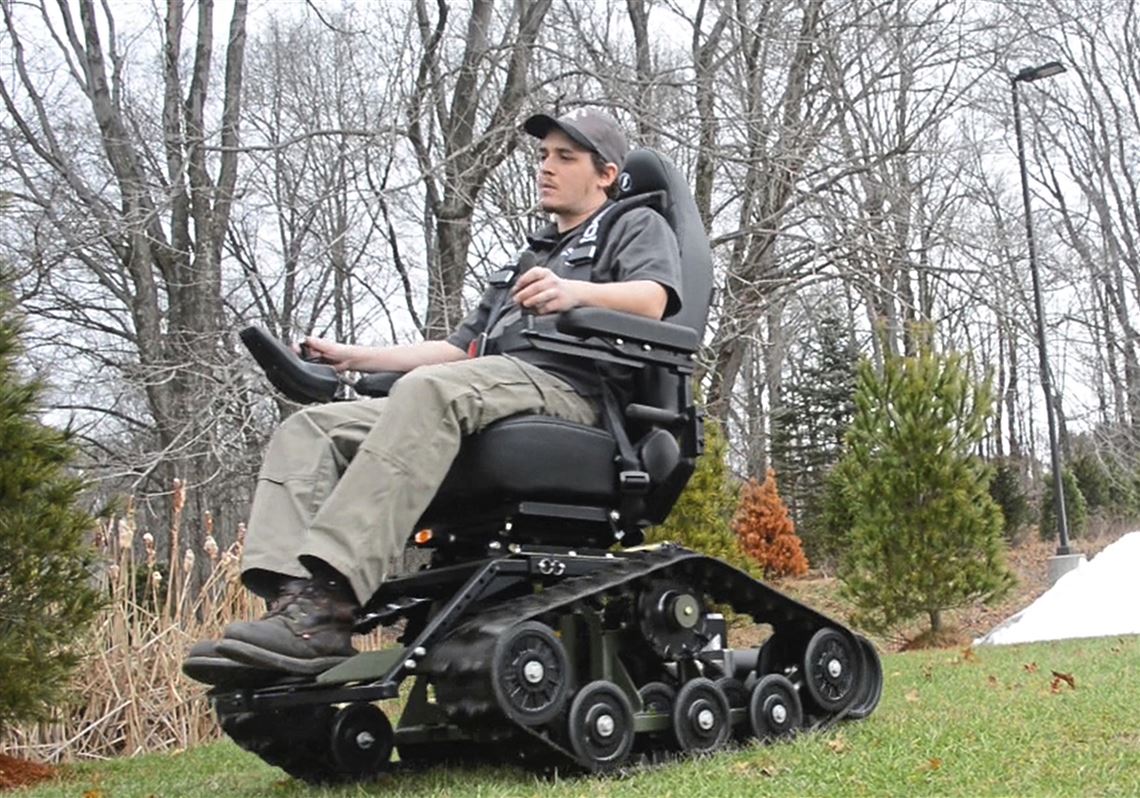
The way the assistive technology world works today is that some brilliant geek invents something and then says, “OK, what problem is this going to solve?” Companies work the same way, coming up with this tech or that tech, then marketing it for a perceived need; rarely asking their target consumer, “Is this something you need?”

The example one of them gave was that someone had invented a wheelchair with treads: https://9b16f79ca967fd0708d1-2713572fef44aa49ec323e813b06d2d9.ssl.cf2.rackcdn.com/1140x_a10-7_cTC/20180123lf-Wheelchair03-1569211736.jpg That’s all fine and good, BUT…they have a tendency to tip (narrow wheelbase) and they suck the batteries dry in very short order. Nice try, but no one seemed to ask the operators what they wanted…

It's a case of what one the panelists called, “Cool Tech vs Needs of the Users”. One of them noted that the CYBERPUNK genre was about AUGMENTING people rather than “fixing” them. Compensating for a disability and not the ableist attitude that someone with a disability has to be “fixed” or that the condition is a problem that demands a solution.

Another example is deafness. There are individuals who wish to remain deaf: the deaf community has its own language, traditions, and leaders: just as ANY community on EARTH has its language, traditions, and leaders. I live in Minnesota about fifteen miles out of downtown Minneapolis and St Paul. To someone who lives in Los Angeles or New York or Tokyo, my life might seem stunted, bereft of REAL entertainment, convenience, and opportunity. Surely no where near as rich as if I lived in one of THOSE cities. It’s a matter of perspective.

One of the panelists asked the question, “If you want to jump like an Olympic high jumper and have your legs removed and replaced with biocybernetics legs, are you disabled? What kind of impact will augmentations have on the Olympics themselves? Is a world record still a world record if it’s achieved by someone who has, say, springs for legs?

Another problem the panel saw was the common practice of “magical healing” in fantasy fiction and in science fiction, the limbs are replaced and “make them better”. What’s wrong with how they ARE? One panelist noted that Dr. Xavier of the X-Men never walks again, using his wheelchair as an extension of himself rather than something made to “fix him”. This of course, highlights another issue for people with disabilities: for the most part, they are INVISIBLE, which people are happy to do. It’s easier to not think about someone with a disability rather than look forward to expanding their relationships.

Last of all, “Ableism colors what ‘solvers’ come up with.” The assumption by someone with legs or someone who can hear, is that someone who has no legs or who is deaf WANTS THOSE THINGS BACK. So the ableist solver blazes on ahead, and then presents a person with a disability with their AMAZING solution, then step back and wait for the accolades and praise. When it doesn’t come, they’re angry and figure the person they worked so hard to fix is an ungrateful slob…

Moving back to cyberpunk, brain chip implants, like the “memory chip” in Lois McMaster Bujold’s novel, MEMORY. “Miles Vorkosigan is appointed Imperial Auditor so he can penetrate Barrayar’s intelligence and security operations. The head of it is Miles’ former boss, and he is failing physically and mentally. Miles sets out to find out why -- and who, if anyone, is behind his rapid decline. The discovery that the man’s memory chip is degrading creates problems on galactic, local, planetary, political, and personal scale.”

That “chip” is something technology is exploring today. Bruce Bethke raised this question here: https://stupefyingstories.blogspot.com/2021/12/todays-free-story-idea.html?fbclid=IwAR3Ijk87lQtPEU1ARhPD4pc3Q3u88jAmZsCOJuYSOHIO9pqCof-Tzp17sro at STUPEFYNG STORIES…

“By 2041 most good subjects citizens will have a tiny real-time streaming editor—let’s call it a ‘SED’ chip—implanted in their brain, probably in the arcuate fasciculus, between Wernicke’s area and Broca’s area. Thanks to this wonderful little invention our citizen of the future will be completely unable to either intentionally or inadvertently blurt out any career- or life-destroying BadThink, or even to understand any such words, if somehow heard.”

If you don’t have the chip, will you be considered disabled? What’s the solution for people who are unable to have the chip, or worse, just can get used to using it? One thing all the participants agreed on, is that while Star Wars and Star Trek have made the disabled vanish, WE as writers can include them in our stories; with the caveat: IF YOU NOT DISABLED, DO NOT WRITE A "DISABLED STORY". If I may interpolate "Don't tell a disabled story", maybe this would do: "You cannot imagine what it's like, so don't try to 'be disabled' in your work."

Consider your average senior citizen who is 80 years old or older. Born in 1942, their young lives saw the use of the first nuclear weapon. The end of a world war, the invention of…well, countless things. Here are 66: https://www.popularmechanics.com/technology/g24668233/best-inventions/

So, what exactly constitutes a disability today. WHAT WILL CONSTITUTE A DISABILITY IN FORTY YEARS? Something to think about; something to inspire you…though possibly something to depress you!

Program Schedule: https://discon3.org/schedule/
Image: https://encrypted-tbn0.gstatic.com/images?q=tbn:ANd9GcQY860vAI2izm2g2mUgxzT14fGVmoGh66B51g&usqp=CAU

December 18, 2021

Slice of PIE: DISCON III #1 Comments on the 79th World Science Fiction Convention, Opening Ceremonies!


Using the Programme Guide of the 2021 World Science Fiction Convention, DisCON which I" WOULD have been attending in person if I felt safe enough to do so in person AND it hadn’t been changed to the week before the Christmas Holidays… I’m not sure someone outside of DISCON III can actually see the program, but I’ll make an attempt to link it below. THIS YEAR FOR THE FIRST TIME, I have been attending VIRTUAL DISCON! So, I’ll be talking about sessions I have ACTUALLY attended! From that, I will jump off, jump on, rail against, and shamelessly agree with the BRIEF DESCRIPTION given in the Program Guide! I hope the link provided below works for those who are not able to be there. Even so, I’ll be copying the event description and then dig into it!


"Welcome to the convention."

We will present the First Fandom and Big Heart awards, as well as remarks from the Chair.
Your Hosts will be: Ben Yalow, Mary Robinette Kowal, Nancy Kress, Sheree Renée Thomas, and Greykell Dutton

So, all in all, this was a very nice presentation. The evening host, Ben Yalow welcomed everyone, then read a proclamation from the Mayor of Washington, DC.

Then Mr. Yalow informed us that the land the WSF Convention was currently on landhad been  taken from “…the Nacotchtank [who had] maintained settlements around the Anacostia River within the present-day District of Columbia. Conflicts with European colonists and neighboring tribes forced the relocation of the Piscataway people, some of whom established a new settlement in 1699 near Point of Rocks, Maryland.”

I confess I winced. I myself live on land stolen from the Dakota and the Ojibwe of Minnesota. But until I can travel through time, there's nothing I can do about it except educate myself and hope we can do better in the future. (I DO live in a state where all of the casino gambling was turned over to various tribes...you have NO idea how much some of the white people I know piss-and-moan about how it's not fair...(What -- it's not fair that the Mille Lacs Band of the Chippewa (= Ojibwe (Europeans mispronounced this name so that it became "Chippewa"), they are an Anishinaabe people) the White Man's money to build hospitals, schools, roads, water, electricity, buildings, homes and other infrastructure LONG neglected by the white government of this state of Minnesota...))

So, aware that they enjoyed the fruits of stolen land, the convention moved on to announcements. One of the announcements was the naming of a pair of important sponsors of DISCON III, one of which was Raytheon. Nothing else was said, so I’ll add my two bits.

My son is in the Army. He is a Patriot [the acronym of the missile’s technical name: Phased Array Tracking Radar to Intercept On Target] technician and has spent the majority of the past eight years maintaining a specific part of this surface-to-air missile. While it is ABSOLUTELY NOT DROPPED ON OR AIMED AT ANYTHING ON THE GROUND, it is designed to shoot down various kinds of missiles, including ballistic missiles (conceivably ICBMs). The Patriot is designed and made by the Raytheon Corporation. Knowing who some of the people are who attend these events made me wonder if anyone else caught the irony in this sponsorship.

Also, the Duke Ellington School of the Performing Arts Show Choir performed several numbers. They were brilliant! There’s a preview here: https://discon3.org/news/duke-ellington-school-of-the-arts-show-choir-performs-during-opening-ceremonies-at-discon-iii/, and I can say that I enjoyed their music TREMENDOUSLY and it touched my heart.

However, knowing the kinds of people SF fans in Minnesota are from my experiences at the Minnesota Science Fiction Convention (MiniCon – event number 55 has been postponed twice due to COVID concerns, but there’s a good chance it will happen THIS Spring!), I was surprised at the music choices the Show Choir made…despite the fact that there are an ever-increasing number of Christmas – or should I substitute Xmas? – songs, THIS show choir chose NONE of them.

https://i.ytimg.com/vi/Cv8aJHFc2oQ/maxresdefault.jpg

No ”Rudolf the Red-Nosed Reindeer”, no “White Christmas”, no “Jingle Bells” and certainly no “Grandma Got Run Over by a Reindeer” here! The music they did was all SACRED Christmas music – “O Holy Night”, “Silent Night”, “O Come, O Come Emmanuel” (not sure about the last one). I have a friend who’s actually ON THE GROUND there. He reports that there wasn’t a single grumble or negative comment on the decidedly religious performance. None. No grousing, just rounds of endless applause! I find that curious, to say the least.

While I personally found the Opening Ceremonies inspiring and delightful, I’m simply curious about the unexpected non-response to the convention being bankrolled by a technology company that is heavily invested in military applications (https://en.wikipedia.org/wiki/Raytheon_Technologies). I don’t have anything against Raytheon Technologies – my son has a truly wonderful job because of them. They also continually hound him to join the company once he musters out of the Army, tempting him with astounding pay packages! – and that an African American show choir performed sacred Christmas music that reflected the actual “reason for the season” without even the mildest protest.

Or has there been a protest?

I don’t know.

So much for my curmudgeonly commentary on the Opening Ceremonies of the 79th World Science Fiction Convention! I'll get back to comments on the delightful sessions I've attended over the next few posts and weeks!

Program Book: https://discon3.org/schedule/
Image: https://encrypted-tbn0.gstatic.com/images?q=tbn:ANd9GcQY860vAI2izm2g2mUgxzT14fGVmoGh66B51g&usqp=CAU