Showing posts sorted by date for query siphonophores. Sort by relevance Show all posts

September 21, 2024

CREATING ALIEN ALIENS Part 38: Talking To A Sapient Apartment Building

Five decades ago, I started my college career with the intent of becoming a marine biologist. I found out I had to get a BS in biology before I could even begin work on MARINE biology; especially because there WEREN'T any marine biology programs in Minnesota.

Along the way, the science fiction stories I'd been writing since I was 13 began to grow more believable. With my BS in biology and a fascination with genetics, I started to use more science in my fiction.

After reading hard SF for the past 50 years, and writing hard SF successfully for the past 20, I've started to dig deeper into what it takes to create realistic alien life forms. In the following series, I'll be sharing some of what I've learned. I've had some of those stories published, some not...I teach a class to GT young people every summer called ALIEN WORLDS. I've learned a lot preparing for that class for the past 25 years...so...I have the opportunity to share with you what I've learned thus far. Take what you can use, leave the rest. Let me know what YOU'VE learned. Without further ado...

You can check out the Wikipedia article linked below as well as a POSSIBLY IRRITATING ESSAY I wrote a couple of years ago when I first started poking around the idea of “intelligent jellyfish”. First thing I found out was that jellyfish are single organisms – like Humans. But the siphonophores are COLONIAL organisms are made up of thousands – and potentially millions of individual creatures working together but still separate. One way to look at it is that Humans are individually identified; and Le Lignon in Switzerland is considered the largest apartment building on Earth with 6000 full-time residents. A jellyfish would be a Human; the apartment a siphonophore.

In the event of a first contact, the Siphon (I’m calling them that for the sake of brevity and admitting that, like every other long word, Americans would shorten names to nicknames; but not all cultures do it so, it’s my blog and I’ll do it how I want to! ;-)…Sorry, let me pick up the statement before I wandered off…wouldn’t be speaking to a Human as an individual, but as if it were a…I suppose “city” or “town” would be closer as the siphonophore is a co-dependent colonial organism. While distantly related, they are NOT jellyfish.

OK – enough biology.

How would I communicate with a sapient apartment building? Unlike talking to an individual Human, talking to a Siphon would of necessity be like talking to each resident of the apartment building alone. A decision made by one of the residents would be completely independent of every other resident.

That’s how it would go with a non-sapient creature. While incredibly tedious, it could, I suppose, be done. “A siphonophore is much more than the sum of its parts. In fact, none of its parts could function on their own. Each siphonophore is actually a colony of individual parts, called “zooids”, which are produced as the siphonophore grows, and stay connected together. Some form rope-like chains that can grow longer than a whale. Each zooid has a distinct job in this colony: some catch prey, while others digest it, and still others reproduce, swim, and keep the colony upright. The result is a biological marvel that makes us wonder just what it means to be an ‘individual’!”

But if a Siphon were to evolve to Human-equivalent intelligence there would be other types of organisms – probably brain-type cells as well as electrical communication-type cells. These would link up with the light-emitting cells, and while the Siphon would NOT have a brain or a mouth or one voice…hmmm…

Siphonophores live (at least on Earth) in the oceans, so if an alien Siphon came to Earth, we would likely be speaking to them in the open ocean. Probably the best way to work this is to bring a large submarine with Humans who serve all kinds of capacities. And once we made contact, the Siphon should be able to understand that while we appeared as they do – a huge massive “creature”, they would instead be a colony serving individuals. Maybe something like this:

The entire Contact team gathered in the forward Light Emitter of the Contact Ship. A disk of transparent plastic, each Human lay in a tube with a light disk facing outward – something like a giant, circular honeycomb.

The Siphon alien drifted across from them. Each Human Emitter was linked with the others via headset. At the back of the disk, Control was made of a cluster of Human monitors. Still others controlled the buoyancy and forward and reverse motion of the Contact Ship. They were banking on the probability that the Siphon would use light to communicate. As far as Humanity was concerned, if they were going to contact them via mental telepathy…well, it could be argued that if it WERE possible, some Human, somewhere would have heard the Siphon already.

WHAT they would have heard was a complete unknown. They had proceeded under the belief that “psionic powers” continued to remain fictional. Light seemed the most logical.

Control sent out a message from each console – scripted, but allowing for slightly different expressions. They had decided to initially use the ten most common languages on Earth, including JavaScript: Mandarin Chinese, Spanish, English, Bengali, Hindi, Portuguese, Russian, Japanese, and German. The language was transcribed into electromagnetic pulses and translated into the same frequency of light the Siphon was emitting in and appeared on multiple light emitting disks of different intensities.

The first message: “Do you wish to speak to us?”

The response was nothing less that powerful and stunningly beautiful. Rather than a simple disk of light, messages flashed back to the Human Contact Ship from many parts of the Siphon. Not every message was identical, which the Humans had expected, but sometimes the response was radically different, not just in frequency, but in content.

At least that’s what appeared after that first flash of communication…

Sources: https://en.wikipedia.org/wiki/Siphonophorae, Youtube: https://www.google.com/search?sca_esv=566487c1e8374dca&sca_upv=1&hl=en&authuser=0&q=flashing+siphonophores&tbm=vid&source=lnms&fbs=AEQNm0AiWqXpwpi4y_F8VDYetL6Dlnkps_EIKkohBFm2lDUsiBepNBjmASBr9uelbUYBbgOgSinKnsikOw8eX0WEsCCwGvOIvfwleINDrjuVTRluMTv3nX8Frtmxn4Qe_W2QKK1dJN5mLvfVGYgDzBpTcFZ4qRW9sb2H-dwGidyfFM4hXfFGP2K7PF0m3LKNusD786nNUaJGQIHCM3Az9G-LUbh-I4FUCw&sa=X&ved=2ahUKEwjb_-yiiNKIAxX7nokEHbhUM1gQ0pQJegQIEhAB&biw=1528&bih=704&dpr=1.25#fpstate=ive&vld=cid:bbefe8ba,vid:OeflgYWxyVI,st:0;
https://faithandsciencefiction.blogspot.com/search?q=siphonophores; https://www.youtube.com/watch?v=aPUF40j47-o, https://twilightzone.whoi.edu/explore-the-otz/creature-features/siphonophore/
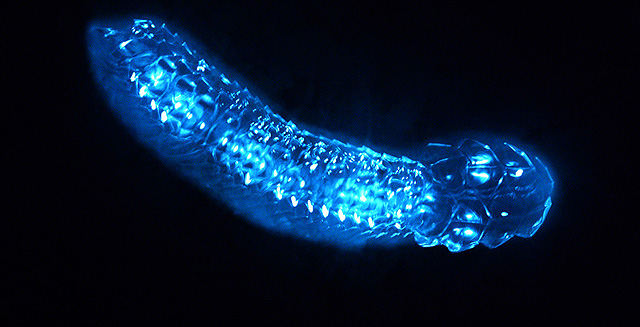
Image: https://www.mbari.org/wp-content/uploads/2017/04/blue-siph-glow-640b.jpg (
Frillagalma vityazi)

May 28, 2022

WRITING ADVICE: Creating Alien Aliens, Part 15: A VERY Alien Alien – Stretching My Imagination

In September of 2007, I started this blog with a bit of writing advice. A little over a year later, I discovered how little I knew about writing after hearing children’s writer, Lin Oliver speak at a convention hosted by the Minnesota Society of Children’s Book Writers and Illustrators. Since then, I have shared (with their permission) and applied the writing wisdom of Lin Oliver, Jack McDevitt, Nathan Bransford, Mike Duran, Kristine Kathryn Rusch, SL Veihl, Bruce Bethke, and Julie Czerneda. Together they write in genres broad and deep, and have acted as agents, editors, publishers, columnists, and teachers. Since then, I figured I’ve got enough publications now that I can share some of the things I did “right”.

While I don’t write full-time, nor do I make enough money with my writing to live off of it...neither do all of the professional writers above...someone pays for and publishes ten percent of what I write. When I started this blog, that was NOT true, so I may have reached a point where my own advice is reasonably good. We shall see! Hemingway’s quote above will now remain unchanged as I work to increase my writing output and sales! As always, your comments are welcome! (UPDATED 9/21/24)

The editor at Stupefying Stories sent an email about a month ago with the following “bullet point”, discovered by his granddaughter: “…Portuguese man o' wars aren't individual animals, properly, they're siphonophorae…a colony of animals.”

He thought it would make a moderately interesting column post…

I think he understated (or deliberately intended to spark the wild flight of sorta-fancy you’re about to read…) the effect the simple video and article referenced below would have on me!

So, first of all, I did a bit of reading about Order Siphonophorae in which there are about 150 species. Condensing the article on Wikipedia regarding the order’s Morphology – in other words “…the form of living creatures, and how all their pieces are put together and related to each other.” Our morphology would point out that we have two arms and two legs. The arms are divided into to joints and hands. The legs are divided into joints and feet. The hands and feet are further divided into fingers and toes which are used to pick things up…”

The morphology of the Siphonophore in general is this:

Siphonophores exhibit one of the three standard body plans.

One group has a long stem with individual animals that have tentacles. One kind captures and digests food. One kind lays eggs. Another makes gas to fill a float and they mainly drift at the surface of the water. The second group give the siphonophore the ability to push water, making them sort of jet propelled, pumping water back in order to move forward.

They are made up of a number of types of animals. A zooid is a single animal that is part of a colony. Siphonophores can have zooids that either stick to stuff or swim around. Zooids can develop to have different functions.

For example, nectophore zooids can move, and working as a group, help the entire siphonophore move in water. When nectophores are located in one part of the siphonophore, they can coordinate the swimming of colonies. They can also work with reproductive structures in order to provide propulsion during the colony breaks up for form “baby siphons”. (I'm gonna go with siphons because siphonophores is a long word to type!)

Bracts are zooids that are made to protect the siphonophore as well as make sure the 
siphonophore doesn’t float too high or sink too far down. Gastrozooids stay in one place and digest food for the siphon, and palpons are gastrozooids that make sure digested food gets circulated.

There are dozens of kinds of zooids in your average – or even monstrously-sized 
siphonophore. Pneumatophores are gas-filled floats that help the colonies stay upright in the water. Some pneumatophores have an additional function of assisting with flotation and can even sense pressure changes in the water.

So now you have a general idea of the makeup of a siphon.

Now here’s where I take it a step further and create the possibility of a sapient siphon.

Siphons are not animals – they are a COLONY of thousands or millions, and in the case of the “beautiful *giant* siphonophore Apolemia recorded during the Ningaloo Canyons expedition, perhaps more than the 86 billion neurons that make up a Human brain.

But there’s nothing like it that that we know of.

What if an alien creature had “neuroids”, individual animals that behave like neurons…

Let’s just say that the creature in the video formed an immense spiral for a reason. To bring not only the various creatures of the colony together, but to bring the neuroids into closer contact. What if the number went beyond 86 billion?

For example, as it is in the image, nerve impulses would have to travel from the tail to the head of the siphon. That’s stated to be about 118 meters long (390 feet!), stretched out, it would be as long as the US Bank Stadium in Minneapolis, where I live.

Say an impulse travels 100 meters in a second. That means if I stomp on the siphon’s tail, it would take a second (literally) before it knew it in its head. That’s not too long. A siphon could easily survive in its “strung out” state without being intelligent. But if it somehow NEEDED to be intelligent, it could begin to coil, bringing the neuroids into contact.

OK – the next big problem I’ve recently realized and talked about a bit here: https://faithandsciencefiction.blogspot.com/2022/04/writing-advice-creating-alien-aliens.html. I have the same problem now, HOW WOULD A SAPIENT SIPHON THINK? Not just what would they think about, but HOW would they think?

It’s a siphon for heaven’s sake! What would it think?

Let’s start with what would it FEEL.

Water temperature, pressure, salinity, chemical components; maybe it could sense sound – but rather than with ears, along the entire length of its body. Probably it can sense light, though “seeing” as we do wouldn’t be that important. We already know it can sense water pressure, and it can move. It can hunt, it can reproduce, and now it can think -- and given the number of neuroids it has, it can probably think just as deep of thoughts as we can.

How much of the world would it be able to sense? We’re tempted to say, “It’s stuck in the water! How far can it go?” I’d have to point out that if you’re being perfectly honest, WE are the ones who are limited to the land – Earth is 71 percent water. That means our entire Human civilization is limited (at the MOST) to 29 percent of the Earth’s surface. Our Sapient Siphon can go pretty much wherever it wants to on the planet…

But see what I’m doing? I’m avoiding thinking about how would my intelligent siphon would think? WHAT would it think about? Beyond the same things we do regarding survival, what would it need to think about? Getting food. It might never see the stars, but Humans have never been into the depths of the ocean – and we developed intelligence. We would both have faced predators. We would both have developed ways of protecting ourselves…but…

The biggest difference between Humans and Sapient Siphon is that one Siphon is an entire world. The parts of the Siphon ARE NEVER ALONE! They are always together; always experiencing each other. Would they even understand the IDEA of the alien? I think Humans get it because anyone outside of us is an alien. You don’t know what I’m thinking; I don’t know what you’re thinking. And even with my very dearest friend, my wife…I truly have no idea what she is thinking.

An Intelligent Siphon would never be alone because it would be aware of all of its parts…

Now isn’t THAT an alien thought?

More on this later…

Resources: https://en.wikipedia.org/wiki/Siphonophorae (basic background on the lifeforms and their characteristics); https://www.syfy.com/syfy-wire/deep-sea-predator-millions-clones (article is more informative on the Siphonophore discovered a bit over a year ago off the coast of Australia), the larger YouTube on the bottom is a more general survey of the creatures (colony????), the Tweet is just a 30 second clip from the larger video…); https://theconversation.com/it-feels-instantaneous-but-how-long-does-it-really-take-to-think-a-thought-42392 (how fast does a nerve impulse travel?)
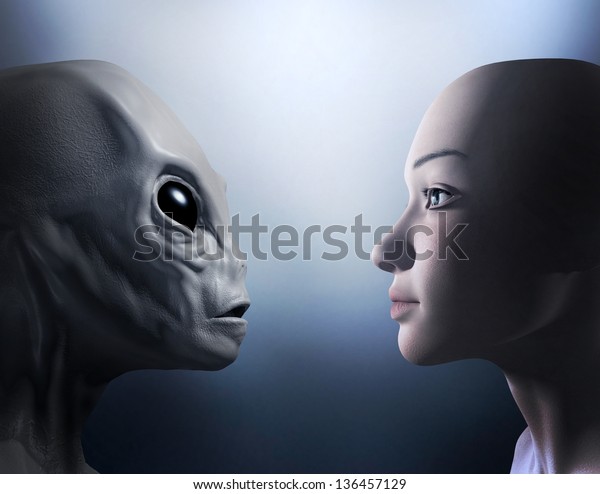
Image: https://image.shutterstock.com/image-illustration/alien-human-600w-136457129.jpg