Today’s Source: https://www.forbes.com/sites/jamiecartereurope/2026/07/01/why-the-spacex-ipo-brings-a-new-era-of-asteroid-mining-closer/ (“An IPO is when a company issues shares to new investors & gets admitted to a stock exchange. Public can now apply for shares in more IPOs.”)
Foundational Resource: (A general Wikipedia post detailing what the authors currently know about asteroid mining: https://en.wikipedia.org/wiki/Asteroid_mining)
Noted Resources: https://en.wikipedia.org/wiki/List_of_asteroid_close_approaches_to_Earth, https://www.pharostribune.com/news/local_news/article_7fcd3ea5-3c14-533f-a8d5-9bf629922f34.html, https://www.fool.com/investing/2022/04/29/like-asteroid-mining-be-careful-what-you-wish-for/, https://www.nps.gov/wrbr/learn/historyculture/theroadtothefirstflight.htm, https://hackaday.com/2019/03/27/extraterrestrial-excavation-digging-holes-on-other-worlds/, https://www.planetary.org/space-missions/every-small-worlds-mission
Interesting Stuff That Might Apply To Mining Asteroids: https://www.bbc.com/news/articles/cgej7gzg8l0o
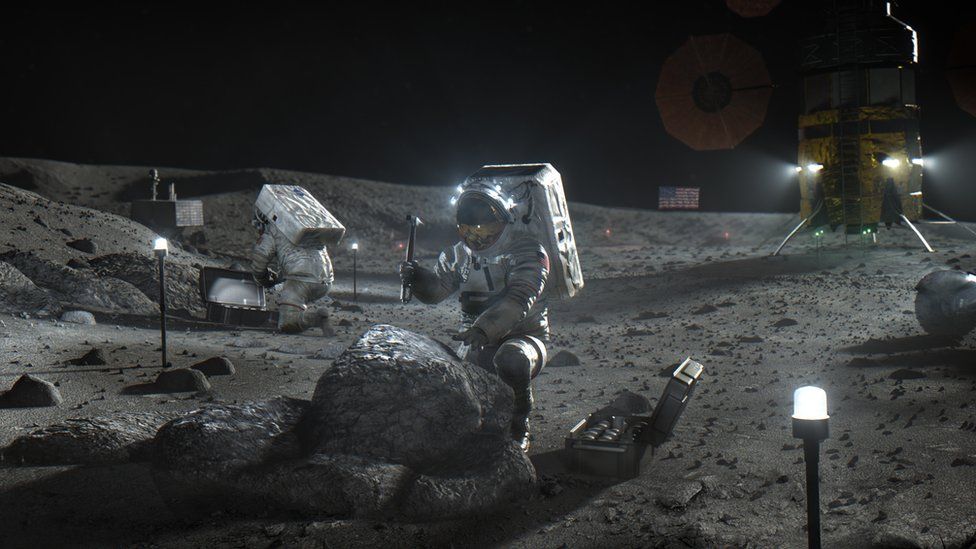
Mining the asteroids has hit the next obvious milestone. Expected to happen later this year: public issue of stock in an asteroid mining company! I can DO IT NOW! Not, of course that it will actually involve me…
My wife and I have safe investments. It seems that investing in asteroid mining would be slightly more speculative than we’d be comfortable with! OTOH…what if we DID do something like invest in an asteroid mining start up?
“As mentioned in its IPO (had to look this one up: Initial Public Offering where a private company sells shares of stock to the general public for the first time to raise money). SpaceX (best known for building and launching re-useable rockets “Falcon 9 Family plus Falcon Heavy & Starship pushes overall successful mission counts past 700 holding an overall success rate of a bit more than 98%.” (https://spacexnow.com/stats). When I graduated from high school (1975), the total number of re-useable rockets launched ZERO with an overall success rate of 100% (of ZERO)… That’s because ANYONE launching a reuseable space craft was PURE SCIENCE FICTION the year I became a legal adult…
At any rate, SpaceX has moved far and beyond launching spacecraft to show off to the rest of the world. “The first rocket to reach outer space was a American Bumper 2 two-stage rocket launched on February 24, 1949.” Of course, you have to read a bit farther to find out that “we” used the bottom of a German V-2 with a topper of an American WAC Corporal (https://www.ebsco.com/research-starters/history/first-rocket-reach-outer-space-launched)
While the first thought that springs to mind is (of course) “Cities In Space” from which we might “leap to the STARS!” the facts will be much more mundane: “Water — found in carbonaceous asteroids — may matter before platinum-group metals. Water can support life support, oxygen production and rocket fuel, making it more useful in space than platinum shipped back to Earth.”
The main reason is because “Asteroid mining is expensive. Japanese Space Agency’s Hayabusa-2 mission returned samples from Ryugu in 2020, costing around $150 million, while NASA’s OSIRIS-REx mission, which returned samples from Bennu in 2023, cost around $1.16 billion.” I guess we’ll see about that…I can imagine more than one scenario where “evil billionaires bring back zillions of dollars in platinum and purchase Western Canada…”
While this seems more-or-less run-of-the-mill for most of you, I started reading SF when I was about 13. Books like HAVE SPACESUIT, WILL TRAVEL (Heinlein, 1958) were just a starry-eyed future for adolescent teen, me. Today? “Asteroid mining is currently being pursued more seriously than ever by several companies that are now moving beyond paper studies, with AstroForge having flown a deep-space asteroid-imaging mission and others developing or funding demonstration hardware for future asteroid-resource missions. The SpaceX filing does not make asteroid mining imminent, but it does put the idea inside the commercial strategy of the world’s most closely watched private space company.”
Other names that were attached to what we call North America, including several who have no real continent-wide concept, include hundreds of distinct Native American groups lived across the land, each speaking their own languages and having names for their specific homelands, local regions, or creation stories rather than the entire landmass. Some northeastern tribes, such as the Lenape and Iroquois called it "Turtle Island"; Cem Ānáhuac was the name used by the Aztec (Mexica) people; Norse explorers and Vikings called parts of coastal North America, “Vinland”: ; 1553 world map by Petrus Apianus, "Baccalearum" (aka Realm of the Codfish); 1569 map by Mercator “New India”; Abya-Yala was the name given by the Kuna people of Panama and has been adopted by modern Indigenous movements to refer to the American continent.
I guess it remains to be seen whether space becomes one more playground for the gargantuanly wealthy or a true “final frontier’. The diversion above made me think that when one culture “firmly names” something, it seems to be that it’s only a matter of time before another culture, with clearer goals and stronger craving is the one that will overshadow the others. Thus far, NASA and the other national space exploration bodies have had a virtual monopoly in space, picking and choosing what they wanted to do with it and discretely edging out their competition. Maybe the time has come for the “little gal” to move in a change the game.
Maybe space is about to go AMERICAN/CHINESE/JAPANESE commercial!


No comments:
Post a Comment