I have a post up at THE FRIDAY CHALLENGE at:
http://thefridaychallenge.blogspot.com/
about how I think the BACK TO THE FUTURE movies should become the archetype of ALL time travel movies!
October 21, 2009
Non-PIE blog up!

 Guy Stewart is a husband; father, father-in-law, grandfather, and retired teacher/school counselor who maintains POSSIBLY IRRITATING ESSAYS offering his writing up for comment. His new novel, MARTIAN HOLIDAY will be released on December 23, 2025 and takes place in a world 500 years in the future of his first novel, EMERALD OF EARTH (YA/MS, 2024! He also writes on other worlds that have touched his life: GUYS GOTTA TALK ABOUT DIABETES, ALZHEIMERS; BREAST CANCER. He has 70+ publications in Analog, Cast of Wonders, Shoreline of Infinity, Cricket, Stupefying Stories, Nanoism, an essay in The Writer, and has created experiments for episodes of the PBS science shows Newton’s Apple, and The New Explorers—for which he became the Science Museum of Minnesota’s Teacher of the Year in 1997. Really.
October 18, 2009
Slice of PIE: Editorial Slush Piles, the Disciples of Jesus and a Taste of Truth
Here’s one of the strange-association-train-of-thought I try to save for Slices of PIE…
Strangely, there are editors and writers who cry “Foul!”, decrying the anecdote as a myth worth busting.
*http://www.codexwriters.com/forum/discuss.asp?discussionid=1293&LastViewed=10%2F16%2F2009+9%3A17%3A02+AM#newposts (not accessible unless part of CODEX, for details re: membership, go to: www.codexwriters.com/ )
Guy Stewart is a husband; father, father-in-law, grandfather, and retired teacher/school counselor who maintains POSSIBLY IRRITATING ESSAYS offering his writing up for comment. His new novel, MARTIAN HOLIDAY will be released on December 23, 2025 and takes place in a world 500 years in the future of his first novel, EMERALD OF EARTH (YA/MS, 2024! He also writes on other worlds that have touched his life: GUYS GOTTA TALK ABOUT DIABETES, ALZHEIMERS; BREAST CANCER. He has 70+ publications in Analog, Cast of Wonders, Shoreline of Infinity, Cricket, Stupefying Stories, Nanoism, an essay in The Writer, and has created experiments for episodes of the PBS science shows Newton’s Apple, and The New Explorers—for which he became the Science Museum of Minnesota’s Teacher of the Year in 1997. Really.
October 11, 2009
POSSIBLY IRRITATING ESSAYS: Reflections On [not] Becoming An Astronaut

Picture in your mind the movie,
Except, if I didn’t actually try, I would never know for CERTAIN that I couldn’t be an astronaut. If I didn’t apply, I would never be able to say, unequivocally that “I can’t be an astronaut.”
I suppose though that I am in good company. They said that there were 3500 applicants for 9 positions. The fact that 3491 others had been turned down just like I had been sort of made me feel better. But my biggest comfort is that I knew that Will Smith wasn’t going into space any time soon, either.
image from: http://l.yimg.com/eb/ymv/us/img/hv/photo/movie_pix/twentieth_century_fox/independence_day/_group_photos/harry_connick_jr_1.jpg
Guy Stewart is a husband; father, father-in-law, grandfather, and retired teacher/school counselor who maintains POSSIBLY IRRITATING ESSAYS offering his writing up for comment. His new novel, MARTIAN HOLIDAY will be released on December 23, 2025 and takes place in a world 500 years in the future of his first novel, EMERALD OF EARTH (YA/MS, 2024! He also writes on other worlds that have touched his life: GUYS GOTTA TALK ABOUT DIABETES, ALZHEIMERS; BREAST CANCER. He has 70+ publications in Analog, Cast of Wonders, Shoreline of Infinity, Cricket, Stupefying Stories, Nanoism, an essay in The Writer, and has created experiments for episodes of the PBS science shows Newton’s Apple, and The New Explorers—for which he became the Science Museum of Minnesota’s Teacher of the Year in 1997. Really.
October 9, 2009
THE RECONSTRUCTION OF MAI LI HASTINGS 7: ELECTRICAL

CJ Hasting would have probably been creeped out by the sterile, pale-green walls and the odd, not-echoey hallway if he hadn’t fallen instantly in love with the lady who had picked them up from the lobby. She’d started talking the second the elevator doors had opened.
Mom scowled, pursed her lips then said, “Actually, she told me that I should ask you,” she paused. “So, that’s the truth? You’ve never done a complete brain reconstruction?”
Guy Stewart is a husband; father, father-in-law, grandfather, and retired teacher/school counselor who maintains POSSIBLY IRRITATING ESSAYS offering his writing up for comment. His new novel, MARTIAN HOLIDAY will be released on December 23, 2025 and takes place in a world 500 years in the future of his first novel, EMERALD OF EARTH (YA/MS, 2024! He also writes on other worlds that have touched his life: GUYS GOTTA TALK ABOUT DIABETES, ALZHEIMERS; BREAST CANCER. He has 70+ publications in Analog, Cast of Wonders, Shoreline of Infinity, Cricket, Stupefying Stories, Nanoism, an essay in The Writer, and has created experiments for episodes of the PBS science shows Newton’s Apple, and The New Explorers—for which he became the Science Museum of Minnesota’s Teacher of the Year in 1997. Really.
October 4, 2009
WRITING ADVICE: Jack McDevitt 4: Get the Narrative off to a Slow Start…
(The Twelve Blunders are used with permission of Jack McDevitt, from his webpage: http://jackmcdevitt.com/Writers.aspx)
This bit offers the subtitle: “But I have to introduce my characters first, set the scene, and establish the mood.”
Guy Stewart is a husband; father, father-in-law, grandfather, and retired teacher/school counselor who maintains POSSIBLY IRRITATING ESSAYS offering his writing up for comment. His new novel, MARTIAN HOLIDAY will be released on December 23, 2025 and takes place in a world 500 years in the future of his first novel, EMERALD OF EARTH (YA/MS, 2024! He also writes on other worlds that have touched his life: GUYS GOTTA TALK ABOUT DIABETES, ALZHEIMERS; BREAST CANCER. He has 70+ publications in Analog, Cast of Wonders, Shoreline of Infinity, Cricket, Stupefying Stories, Nanoism, an essay in The Writer, and has created experiments for episodes of the PBS science shows Newton’s Apple, and The New Explorers—for which he became the Science Museum of Minnesota’s Teacher of the Year in 1997. Really.
October 1, 2009
A SHORT LONG TRIP NORTH 2: July 2 – July 3, 1946

(This series is a little biography and a little imagination. The biography will detail a month long trip my dad took in the summer of 1946 when he and a friend hitchhiked from
“Nothin’s gonna happen if we go to Calhoun. Besides, your dad said he didn’t care if you went there, right?” asked Tommy Hastings.
Freddie Merrill shrugged, shoved his hands deeper into his pockets and kicked a rock on the sidewalk that ran alongside
“I thought you said that would be OK?” Tommy said.
“I didn’t say it was OK,” Freddie replied sullenly. “I said he wouldn’t say nothin’.”
“That’s practically like saying ‘yes’. Let’s get suits and towels.”
“I have to use yours. If Dad catches me, he’ll think of some reason for me to stay.”
Tommy shook his head, “Nothin’s gonna happen. Let’s go.”
It only took them a half hour to walk from Loring to Calhoun and they were both dripping in sweat. Dashing to the changing rooms, they shed their sweaty shirts and long pants and slid into cool pairs of bathing trunks and sleeveless, white T-shirts. Bundling their clothes, they raced out to the beach. “Last one in’s a rotten egg!” Tommy shouted, kicking sand on the backs and in the lunches of other swimmers and picknickers, he sprinted for the water and dove in.
Tommy was right behind him, though he stopped to apologize for his friend to a couple of red-headed, freckled girls who smiled and told him to not worry about it.
Tommy came up, water streaming from his water-dark hair. “What took you?”
“I had to tell some people you were a slob and to please excuse you,” Freddie said, shaking his head free of water. He waved at the girls on the beach who waved back enthusiastically.
Tommy’s angry come back changed into a leer as he saw the girls and looked at Freddie. He promptly dunked his friend and waved at the girls himself. His happy wave was cut short when he disappeared under water, his legs cut out from under him by a not-so-mysterious deep lake monster.
What followed was a free-for-all that pretty soon included all of the youngsters in Calhoun in a dunking spree that turned into two dozen chicken fights that eventually spilled everyone up on the beach panting, laughing, shrieking and exhausted to collapse on their towels and roll over in the sun.
When they finally plopped down, Freddie was pouting, “Why couldn’t we put our towels over by the girls?”
Tommy slugged him in the shoulder, “If you can find a square inch we could sit on, lead me to it! It figures you’d flirt with the prettiest girls on the beach!”
Freddie rolled over on to his belly, grinning. “Yeah, they are, aren’t they?”
An older boy strolling by in dark swim trunks and no shirt at all stopped nearby and said, “I know a better beach where there’s way better girls.”
Tommy shaded his eyes from the bright sun and looked up at the older boy – he looked like he was only a little younger than Earl. “Yeah? Even if there was a place, how’d we get there?”
The boy leaned over and held out his hand, “Leo Hartkopf, and I got a car.”
Tommy was on his feet, tugging at Freddie’s shirt. “What you got?”
“1938 Ford pick up,” Leo said proudly.
Freddie climbed to his feet, glanced at the redheads then back at Leo, saying, “That’s a piece a junk.”
Leo shrugged and said, “It runs. You game for a trip out to
Freddie exclaimed, “
“
Leo grinned and jerked his chin toward the parking lot, looking right at Tommy, “What say we leave your party pooper friend behind and head out to ‘Tonka?”
Tommy turned to Freddie, stricken. “You can’t stay here; we’ve never even been close to
“But it’s a million miles away! My dad would kill me if I went that far!” Freddie said, bending over to scoop up his towel and clothes, letting Tommy’s things fall free. “I’m gonna go home. See ya.” He started off on the walk back to
Tommy ran after him and grabbed his arm, lowering his voice, “Come on, Freddie. Please? It’d been keen to go out there. Besides, with Leo, we could be out there in ten minutes and back in ten after we had a great time! Maybe even pick up some girls cuter than your redheads!”
Freddie looked doubtful, but he wasn’t walking yet. Finally he said, “You sure we’d be back at the same time?”
Tommy crossed his heart, “Cross my heart and hope to die!”
Freddie held his breath and finally let it out. “OK.” He offered Tommy a little smirk, “I bet I can get a date before you do.”
Tommy slapped Freddie on the back. “I’ll take that bet! Besides, what can happen between then and now?”
Guy Stewart is a husband; father, father-in-law, grandfather, and retired teacher/school counselor who maintains POSSIBLY IRRITATING ESSAYS offering his writing up for comment. His new novel, MARTIAN HOLIDAY will be released on December 23, 2025 and takes place in a world 500 years in the future of his first novel, EMERALD OF EARTH (YA/MS, 2024! He also writes on other worlds that have touched his life: GUYS GOTTA TALK ABOUT DIABETES, ALZHEIMERS; BREAST CANCER. He has 70+ publications in Analog, Cast of Wonders, Shoreline of Infinity, Cricket, Stupefying Stories, Nanoism, an essay in The Writer, and has created experiments for episodes of the PBS science shows Newton’s Apple, and The New Explorers—for which he became the Science Museum of Minnesota’s Teacher of the Year in 1997. Really.
September 20, 2009
POSSIBLY IRRITATING ESSAY: The Unpredictive Nature of Science Fiction
It comes as no surprise to anyone, that the vast number of science fiction words written about the future have not come to pass. SF writers often claim that their work was never meant to predict. It’s just entertainment. It’s playing with the future.
Balderdash, I say!
Unless the men and women who get their work published are fundamentally different than I am, they don’t create worlds out of disposable tissue knowing that what they are writing is ridiculous and has no chance whatsoever of coming true. Every story written and published – at least every “hard science” story – is an attempt to look at a trend, invention or idea and ask the question, “If this goes on in a linear fashion, what will happen to my character, and thence, society as a whole?”
FRANKENSTEIN (increasingly, the original subtitle: “A Modern Prometheus”, is left out) was among the first to attempt this prediction. Mary Shelley’s futuristic (to her) tale warning about the dangers of the then new application of electricity (to cause the twitching of dead, exposed frog muscles) never came true.
Fortunately, for all of us the vast majority of SF stories never come true.
This idea of a writer’s painstakingly worked out future not coming true came home again to me when I picked up a library discard copy of Ben Bova’s collection of short stories, KINSMAN. Following the life of a 1950’s-style astronaut from his cadet years in the 60’s through his retirement, I have no doubt Bova meticulously worked out timelines, plausible technological developments and the reasonable metamorphosis of societal norms and behaviors.
I am sure he took the process very seriously. I have no doubt that in his heart-of-hearts he believed that some form of his future would come to pass someday. While it is absolutely entertaining, I have no doubt that Bova “lived” in this future over the thirteen years he wrote these stories.
Very little of his future happened, and some of the “predictions” are glaringly, even humorously…un…usual…
For example, his future has run out of gasoline and draconian governmental rationing brings the nighttime world of Washington, DC to a virtual standstill: “Looking around for a phone, Kinsman asked, ‘How do you get a cab around here?’ [Diane replied], ‘You don’t. Not at this hour. No trains, either.’” (“The Lieutenant and the Folksinger”, 1978*) and, “He rolled out of the sofabed and turned on the battery-powered lamp on the end table. The main electrical service was shut down for the night…” (“Build Me A Mountain”, 1974*)
Needless to say, few SF writers caught the digital revolution: “She turned on the tape recorder and watched the spools slowly turning as she fought the urge to cry.” (Probably from “Zero Gee”, 1972*), “Kinsman stood at the head of the darkened conference room, squinting into the solitary light of the slide projector, half-hypnotized by the clouds of blue smoke gliding through the light beam…” (“Build Me A Mountain”, 1974*)
Fewer still, for obvious reasons, realized that smoking indoors would become a crime in many states, “The old man walked slowly toward the bar, looking almost British in his tweed jacket and the pipe that he always had clamped between his teeth…He started reaming out the pipe and dumping the black soot into the ashtray.” (Probably also from “Zero Gee”, see above as well*)
Another glaringly missed development was the major stumble of communism, “…citing the growing cooperation between the Soviet and American space efforts as the reason.” (“Zero Gee”*)
Newspapers, magazines and other mail and broadcasting is also both prevalent and closely monitored by this (undisclosed political affiliation) government: “…spurred into compliance, perhaps, by the Government’s tough new laws regarding licensing for broadcasting stations and mailing permits for newspapers and magazines” and there is clearly no ACLU, “[Diane said], ‘There’s nothing left to protest about. Everything’s so well organized around the country that nobody can raise a crowd anymore. Public safety laws and all that.’” (“Build Me A Mountain” 1974*)
Of course, few male SF writers could even conceive of the possibility for the necessity of the invention of that little blue godsend, Viagra, “And it’s not a lie, either. Not completely. I’m not impotent…except when I’m with a woman.” (“Zero Gee”*)
Lastly, Bova created Kinsman’s most period-startling character flaw. Kinsman, a WASP who was wealthy to boot, intentionally chose a black man to be his ‘best friend’, “‘Who the hell do I want to team up with?’…Colt was the best man of their eight-officer squad…the best of the whole two dozen trainees…He looked down at the blank sheet of paper and wrote three names on it: Franklin Colt Franklin Colt Franklin Colt…[Kinsman said] ‘I wrote down your name.’ [Colt replied,] ‘Why the hell you wanna do that?’ [Kinsman], ‘Because you’re the best pilot in our group and I don’t want to wash out…’ [Colt] ‘Didn’t think anybody’d wanna get stuck with me.’ [Kinsman] ‘Because you’re black’…” It goes on from there. Colt plays a major role in later on in this story but fades into bit parts by the end. Nice try, but hard to carry through. ("Test In Orbit", 1965*)
My point? Perhaps SF writers have a natural dystopian view of the future? Maybe all governments, no matter their party, are inherently out for themselves and will do what it takes to quell dissent to achieve their goals? Maybe SF shouldn’t even bother to try to extrapolate the future?
Nah.
Let’s extrapolate away and in the meantime, let’s also continue to do what SF does best: create imaginary futures to ENCOURAGE the push to a real future where “The most important thing we’ll ever do is to set up permanent colonies in space.” (Chet Kinsman, KINSMAN, “Build Me A Mountain”*)
* The stories in the anthology I have (Dial Press, a Quantum Novel, 1979) are not titled with the story name but with Kinsman’s advancing ages. Based on content, I am postulating which story each “age” came from.
Balderdash, I say!
Unless the men and women who get their work published are fundamentally different than I am, they don’t create worlds out of disposable tissue knowing that what they are writing is ridiculous and has no chance whatsoever of coming true. Every story written and published – at least every “hard science” story – is an attempt to look at a trend, invention or idea and ask the question, “If this goes on in a linear fashion, what will happen to my character, and thence, society as a whole?”
FRANKENSTEIN (increasingly, the original subtitle: “A Modern Prometheus”, is left out) was among the first to attempt this prediction. Mary Shelley’s futuristic (to her) tale warning about the dangers of the then new application of electricity (to cause the twitching of dead, exposed frog muscles) never came true.
Fortunately, for all of us the vast majority of SF stories never come true.
This idea of a writer’s painstakingly worked out future not coming true came home again to me when I picked up a library discard copy of Ben Bova’s collection of short stories, KINSMAN. Following the life of a 1950’s-style astronaut from his cadet years in the 60’s through his retirement, I have no doubt Bova meticulously worked out timelines, plausible technological developments and the reasonable metamorphosis of societal norms and behaviors.
I am sure he took the process very seriously. I have no doubt that in his heart-of-hearts he believed that some form of his future would come to pass someday. While it is absolutely entertaining, I have no doubt that Bova “lived” in this future over the thirteen years he wrote these stories.
Very little of his future happened, and some of the “predictions” are glaringly, even humorously…un…usual…
For example, his future has run out of gasoline and draconian governmental rationing brings the nighttime world of Washington, DC to a virtual standstill: “Looking around for a phone, Kinsman asked, ‘How do you get a cab around here?’ [Diane replied], ‘You don’t. Not at this hour. No trains, either.’” (“The Lieutenant and the Folksinger”, 1978*) and, “He rolled out of the sofabed and turned on the battery-powered lamp on the end table. The main electrical service was shut down for the night…” (“Build Me A Mountain”, 1974*)
Needless to say, few SF writers caught the digital revolution: “She turned on the tape recorder and watched the spools slowly turning as she fought the urge to cry.” (Probably from “Zero Gee”, 1972*), “Kinsman stood at the head of the darkened conference room, squinting into the solitary light of the slide projector, half-hypnotized by the clouds of blue smoke gliding through the light beam…” (“Build Me A Mountain”, 1974*)
Fewer still, for obvious reasons, realized that smoking indoors would become a crime in many states, “The old man walked slowly toward the bar, looking almost British in his tweed jacket and the pipe that he always had clamped between his teeth…He started reaming out the pipe and dumping the black soot into the ashtray.” (Probably also from “Zero Gee”, see above as well*)
Another glaringly missed development was the major stumble of communism, “…citing the growing cooperation between the Soviet and American space efforts as the reason.” (“Zero Gee”*)
Newspapers, magazines and other mail and broadcasting is also both prevalent and closely monitored by this (undisclosed political affiliation) government: “…spurred into compliance, perhaps, by the Government’s tough new laws regarding licensing for broadcasting stations and mailing permits for newspapers and magazines” and there is clearly no ACLU, “[Diane said], ‘There’s nothing left to protest about. Everything’s so well organized around the country that nobody can raise a crowd anymore. Public safety laws and all that.’” (“Build Me A Mountain” 1974*)
Of course, few male SF writers could even conceive of the possibility for the necessity of the invention of that little blue godsend, Viagra, “And it’s not a lie, either. Not completely. I’m not impotent…except when I’m with a woman.” (“Zero Gee”*)
Lastly, Bova created Kinsman’s most period-startling character flaw. Kinsman, a WASP who was wealthy to boot, intentionally chose a black man to be his ‘best friend’, “‘Who the hell do I want to team up with?’…Colt was the best man of their eight-officer squad…the best of the whole two dozen trainees…He looked down at the blank sheet of paper and wrote three names on it: Franklin Colt Franklin Colt Franklin Colt…[Kinsman said] ‘I wrote down your name.’ [Colt replied,] ‘Why the hell you wanna do that?’ [Kinsman], ‘Because you’re the best pilot in our group and I don’t want to wash out…’ [Colt] ‘Didn’t think anybody’d wanna get stuck with me.’ [Kinsman] ‘Because you’re black’…” It goes on from there. Colt plays a major role in later on in this story but fades into bit parts by the end. Nice try, but hard to carry through. ("Test In Orbit", 1965*)
My point? Perhaps SF writers have a natural dystopian view of the future? Maybe all governments, no matter their party, are inherently out for themselves and will do what it takes to quell dissent to achieve their goals? Maybe SF shouldn’t even bother to try to extrapolate the future?
Nah.
Let’s extrapolate away and in the meantime, let’s also continue to do what SF does best: create imaginary futures to ENCOURAGE the push to a real future where “The most important thing we’ll ever do is to set up permanent colonies in space.” (Chet Kinsman, KINSMAN, “Build Me A Mountain”*)
* The stories in the anthology I have (Dial Press, a Quantum Novel, 1979) are not titled with the story name but with Kinsman’s advancing ages. Based on content, I am postulating which story each “age” came from.
Guy Stewart is a husband; father, father-in-law, grandfather, and retired teacher/school counselor who maintains POSSIBLY IRRITATING ESSAYS offering his writing up for comment. His new novel, MARTIAN HOLIDAY will be released on December 23, 2025 and takes place in a world 500 years in the future of his first novel, EMERALD OF EARTH (YA/MS, 2024! He also writes on other worlds that have touched his life: GUYS GOTTA TALK ABOUT DIABETES, ALZHEIMERS; BREAST CANCER. He has 70+ publications in Analog, Cast of Wonders, Shoreline of Infinity, Cricket, Stupefying Stories, Nanoism, an essay in The Writer, and has created experiments for episodes of the PBS science shows Newton’s Apple, and The New Explorers—for which he became the Science Museum of Minnesota’s Teacher of the Year in 1997. Really.
September 13, 2009
WRITING ADVICE: Jack McDevitt 3: “Ask for Criticism and Go Home Angry When You Get It.”
(The Twelve Blunders are used with permission of Jack McDevitt, and are taken from his webpage: http://jackmcdevitt.com/Writers.aspx )
I’ve mostly experienced this one from the giving end. While not to say that I haven’t had my fair share of critiques – some of them brutal! – I’ve always believed that critiques are the only way I can get to be a better writer. That’s what the books say and that has certainly been my experience.
But I’ve been the target of intense ire when I’ve GIVEN critiques with the best intent.
For example, many years ago, I was in a newly formed writing critique group. There were four of us – two went on to write several novels and one of us won a major SF award. You all know who I am and what I’ve written, so I’ll call the other person Number Three.
Number Three was a very intense person. They were SERIOUS about their work and SERIOUSLY wanted to get better. Number Three took a one-year leave-of-absence from their day job to focus on the writing of their novel and they churned out pages!
The critique group (which never went by any cute name) worked on the round robin precept – each month, one person hosted and another provided a manuscript to critique. Number Three wrote like crazy and when their turn came ‘round, presented the group with a manuscript. Which was really…not…um…very well…um…done…I can only speak for myself to say that I tried so hard to find good things about the novel – but it was too hard. It was…well, I’ll leave it at that. Number Three quit the group. They do still write, but from what I’ve seen it’s primarily been non-fiction.
Another incident occurred more recently, this time with a student who was referred to me through an on-line writing program that sought to match older writer mentors with younger writers. Once again, I received the manuscript and read it. I soon realized that even taking into account the fact that the individual was young and somewhat inexperienced, the manuscript lacked in many, many ways. I wrote a letter back, commenting on the MS – and received an angry letter back from the student writer’s parent informing me that I knew little if anything about ‘real writing’ and that my comments had devastated this parent’s student and that they hoped…well, I’ll leave it at that.
Not all of my experiences have been negative – I was pleased to be accepted as a volunteer “first reader” (along with several others) for James Maxey’s third novel, DRAGONFORGE ( http://www.amazon.com/Dragonforge-Novel-Dragon-James-Maxey/dp/1844165817 ). He happily perused any comments I made, responded promptly, thanked me profusely, included me on the “Thanks To…” page as well as sending me an autographed copy of the novel.
Lest you think that maturity is only a matter of age, I’ve had the privilege of coaching a young author who has been published now three times in STONE SOUP ( http://www.stonesoup.com/writing/701 ). I had nothing to do with this story, but I’ve commented endlessly on OTHER stories he’s written. The way he easily takes critiques of his work bodes well for his future.
All this to say that writers, in order to become the best writers they can be, have to have more than thick hides (you’ve heard that one, I’m sure!), they have to be able to take criticism.
Lest you think I’m immune, I leave you with this little anecdote: I’ve been hard at work on a series of short stories using a black, middle school girl as a CSI. I’ve churned out six of these ditties. I’ve gotten comments on them from a few members of the staff of an online magazine I submit to and while I took the advice they’d given on one story, I’d pretty much gone off in a huff about the rest. Then an individual whom I deeply respect took time from his busy schedule to comment that Jasmine Ward hadn’t faced any obstacles and basically solved the cases by telling everyone what had happened. I reread the story in question and found he was right.
Ouch.
So I’ve gone back to the drawing board and I’m currently revising NOT the story, but HOW I WRITE STORY. I’ll let you know how the experiment goes. In the meantime, if you ask for honest criticism, go home angry when you get it AND WRITE THE BEST DANG STORY YOU CAN!
That’s what I’m gonna do anyway.
I’ve mostly experienced this one from the giving end. While not to say that I haven’t had my fair share of critiques – some of them brutal! – I’ve always believed that critiques are the only way I can get to be a better writer. That’s what the books say and that has certainly been my experience.
But I’ve been the target of intense ire when I’ve GIVEN critiques with the best intent.
For example, many years ago, I was in a newly formed writing critique group. There were four of us – two went on to write several novels and one of us won a major SF award. You all know who I am and what I’ve written, so I’ll call the other person Number Three.
Number Three was a very intense person. They were SERIOUS about their work and SERIOUSLY wanted to get better. Number Three took a one-year leave-of-absence from their day job to focus on the writing of their novel and they churned out pages!
The critique group (which never went by any cute name) worked on the round robin precept – each month, one person hosted and another provided a manuscript to critique. Number Three wrote like crazy and when their turn came ‘round, presented the group with a manuscript. Which was really…not…um…very well…um…done…I can only speak for myself to say that I tried so hard to find good things about the novel – but it was too hard. It was…well, I’ll leave it at that. Number Three quit the group. They do still write, but from what I’ve seen it’s primarily been non-fiction.
Another incident occurred more recently, this time with a student who was referred to me through an on-line writing program that sought to match older writer mentors with younger writers. Once again, I received the manuscript and read it. I soon realized that even taking into account the fact that the individual was young and somewhat inexperienced, the manuscript lacked in many, many ways. I wrote a letter back, commenting on the MS – and received an angry letter back from the student writer’s parent informing me that I knew little if anything about ‘real writing’ and that my comments had devastated this parent’s student and that they hoped…well, I’ll leave it at that.
Not all of my experiences have been negative – I was pleased to be accepted as a volunteer “first reader” (along with several others) for James Maxey’s third novel, DRAGONFORGE ( http://www.amazon.com/Dragonforge-Novel-Dragon-James-Maxey/dp/1844165817 ). He happily perused any comments I made, responded promptly, thanked me profusely, included me on the “Thanks To…” page as well as sending me an autographed copy of the novel.
Lest you think that maturity is only a matter of age, I’ve had the privilege of coaching a young author who has been published now three times in STONE SOUP ( http://www.stonesoup.com/writing/701 ). I had nothing to do with this story, but I’ve commented endlessly on OTHER stories he’s written. The way he easily takes critiques of his work bodes well for his future.
All this to say that writers, in order to become the best writers they can be, have to have more than thick hides (you’ve heard that one, I’m sure!), they have to be able to take criticism.
Lest you think I’m immune, I leave you with this little anecdote: I’ve been hard at work on a series of short stories using a black, middle school girl as a CSI. I’ve churned out six of these ditties. I’ve gotten comments on them from a few members of the staff of an online magazine I submit to and while I took the advice they’d given on one story, I’d pretty much gone off in a huff about the rest. Then an individual whom I deeply respect took time from his busy schedule to comment that Jasmine Ward hadn’t faced any obstacles and basically solved the cases by telling everyone what had happened. I reread the story in question and found he was right.
Ouch.
So I’ve gone back to the drawing board and I’m currently revising NOT the story, but HOW I WRITE STORY. I’ll let you know how the experiment goes. In the meantime, if you ask for honest criticism, go home angry when you get it AND WRITE THE BEST DANG STORY YOU CAN!
That’s what I’m gonna do anyway.
Guy Stewart is a husband; father, father-in-law, grandfather, and retired teacher/school counselor who maintains POSSIBLY IRRITATING ESSAYS offering his writing up for comment. His new novel, MARTIAN HOLIDAY will be released on December 23, 2025 and takes place in a world 500 years in the future of his first novel, EMERALD OF EARTH (YA/MS, 2024! He also writes on other worlds that have touched his life: GUYS GOTTA TALK ABOUT DIABETES, ALZHEIMERS; BREAST CANCER. He has 70+ publications in Analog, Cast of Wonders, Shoreline of Infinity, Cricket, Stupefying Stories, Nanoism, an essay in The Writer, and has created experiments for episodes of the PBS science shows Newton’s Apple, and The New Explorers—for which he became the Science Museum of Minnesota’s Teacher of the Year in 1997. Really.
September 11, 2009
Skipping From the 1980s to the 21st Century in One Long Leap!
The school year just started and I am awash not only in the usual busyness, but also in adjusting to our newly "emptied nest" -- my son lives in a northern suburb about 10 miles from here and my daughter started college three weeks ago.
But perhaps just as unbalancing has been the fact that I am in a research study using a "new" (remember that schools are typically a bit behind the "new" curve!) technology called a SmartBoard. One of my colleagues asked to if I would be interested in volunteering for the study with her and I said "yes". Got the training -- it's a MARVELOUS TOOL! -- and am now busy integrating it.
I am something of a fossil as this is my 28th year of teaching and I remember using MIMEOGRAPH dittos to do lessons and having to use a calculator to hand-add grades then fill out bubble sheets to get the grades into the computer that did little more than print report cards and store the data.
At any rate, in my classroom I have been VERY slowly turning my "hand printed" worksheets and acetate overhead presentations into PowerPoint presentations. My colleagues gently rib me because of my "fossil" status.
With this training to use the SmartBoard and its accompanying software, I've SUDDENLY leap-frogged over them and *POOF!*, now I'm ahead of the technology curve -- as our school has only two mobile SmartBoards in addition to our two mounted SmartBoards...
All this to say that I am scrambling to change from overheads to SmartBoard, I am WAYYYYY behind on writing and I will get back to my regular posts this Sunday!
Guy
But perhaps just as unbalancing has been the fact that I am in a research study using a "new" (remember that schools are typically a bit behind the "new" curve!) technology called a SmartBoard. One of my colleagues asked to if I would be interested in volunteering for the study with her and I said "yes". Got the training -- it's a MARVELOUS TOOL! -- and am now busy integrating it.
I am something of a fossil as this is my 28th year of teaching and I remember using MIMEOGRAPH dittos to do lessons and having to use a calculator to hand-add grades then fill out bubble sheets to get the grades into the computer that did little more than print report cards and store the data.
At any rate, in my classroom I have been VERY slowly turning my "hand printed" worksheets and acetate overhead presentations into PowerPoint presentations. My colleagues gently rib me because of my "fossil" status.
With this training to use the SmartBoard and its accompanying software, I've SUDDENLY leap-frogged over them and *POOF!*, now I'm ahead of the technology curve -- as our school has only two mobile SmartBoards in addition to our two mounted SmartBoards...
All this to say that I am scrambling to change from overheads to SmartBoard, I am WAYYYYY behind on writing and I will get back to my regular posts this Sunday!
Guy
Guy Stewart is a husband; father, father-in-law, grandfather, and retired teacher/school counselor who maintains POSSIBLY IRRITATING ESSAYS offering his writing up for comment. His new novel, MARTIAN HOLIDAY will be released on December 23, 2025 and takes place in a world 500 years in the future of his first novel, EMERALD OF EARTH (YA/MS, 2024! He also writes on other worlds that have touched his life: GUYS GOTTA TALK ABOUT DIABETES, ALZHEIMERS; BREAST CANCER. He has 70+ publications in Analog, Cast of Wonders, Shoreline of Infinity, Cricket, Stupefying Stories, Nanoism, an essay in The Writer, and has created experiments for episodes of the PBS science shows Newton’s Apple, and The New Explorers—for which he became the Science Museum of Minnesota’s Teacher of the Year in 1997. Really.
September 6, 2009
ETC…LIFE’S LITTLE CRISES AND SOMETHING SOMEONE WROTE ON FACEBOOK….

I am a member of an on-line speculative fiction (this field includes science fiction, fantasy, horror, alternate futures and other, not-so-easily-defined fiction) writer’s group. Group members vary widely in political views, socio-economic status and religious beliefs, yet because we are all interested in writing speculative fiction and have all had publications ranging from single stories in collections like WRITERS OF THE FUTURE to individuals with multi-book, six-figure advance deals, we pretty much gets along with each other. We happily expose ourselves to a wide spectrum of viewpoints (that sounds…um…bad doesn’t it?) and ask each other questions rather than torpedo viewpoints we don’t agree with on sight.
One of the members of this group posted an anecdote and question recently: “Driving home from a lovely picnic today, we passed one of those sign-boards in front of a little Christian church. You know, the ones with the movable type on which someone spells out some sort of brief, thought-provoking message that’s intended to pump up the church-going crowd? I think they’re the preaching equivalent of hearing that ‘Y’all ready for this?’ song before a sporting event.
“At any rate, this particular sign caught my eye because it boldly pronounced the following:
“‘Sin has no minimum wage’
“That sounds good and preachy, for sure, and it even has a sort of home-spun familiarity to it. Yet, at the same time, it’s been several hours and I’m still uncertain what it actually means.”
I took a deep breath and responded: “OK -- I'm a Bible Thumper and I had to think about this for a while before I ‘got it’. There is a verse in the Bible that says, ‘For the wages of sin are death, but the free gift of God is eternal life in Christ’ (ref: Romans 6:23). The implication, if I'm reading between the words right, is that sin is sin; there is no ‘little’ sin; and the wages of ANY sin are death -- so EVERYONE (murderers to gossipers to gluttons) need the free Gift of God.”
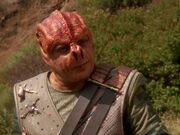
This exchange made me think in all sorts of directions. First and foremost was that this is yet another example of Christians speaking a language foreign to anyone who is NOT a Christian. This in turn brings to mind an old STAR TREK: THE NEXT GENERATION episode called “Darmok”. In a nutshell: a technologically advanced race called the Tamarians who have their own powerful starships, their own territory – and their own way of looking at the universe meets the crew of the
No one on the
All this to say that many Christians assume that all Americans have a common context frame – that we “all speak the same language”. But we don’t, especially when it comes to matters of faith. Even though I responded to my writer’s group friend, I’m still not sure he’ll understand, and to tell you the truth, that’s not his fault, it’s mine. Mine is the storehouse of metaphors that have passed out of common use, so it’s my responsibility to make sure the ideas of my belief system are communicated in ways the culture I live in understands.
Another example: when I was in
I don’t know how they resolved the dilemma, but they had to or risk lose the message of the Good News of Jesus Christ. Once again:
“Can we be culturally relevant for the cause of Christ without becoming spiritually irrelevant?” Beth Moore, DANIEL Bible Study (p 125)
“The point is not to adopt the culture and lose the message, the point is to understand the culture so we can build bridges to it for the sake of gaining a hearing for the Gospel of Jesus.” Reggie McNeal, THE PRESENT FUTURE (p 51)
I’ve waxed long enough. To summarize: Even today, even here, we have to make sure that the message of Jesus’ life-changing power is clear to the culture we’re addressing. We may all speak English (more or less!), but we have to use the right metaphors as well.
Lastly: crises in the Stewart family kept me from writing last Thursday. Sorry. Some days seem like weeks. Some weeks seem like days (summer weeks are especially susceptible to time dilation effects.)
Guy Stewart is a husband; father, father-in-law, grandfather, and retired teacher/school counselor who maintains POSSIBLY IRRITATING ESSAYS offering his writing up for comment. His new novel, MARTIAN HOLIDAY will be released on December 23, 2025 and takes place in a world 500 years in the future of his first novel, EMERALD OF EARTH (YA/MS, 2024! He also writes on other worlds that have touched his life: GUYS GOTTA TALK ABOUT DIABETES, ALZHEIMERS; BREAST CANCER. He has 70+ publications in Analog, Cast of Wonders, Shoreline of Infinity, Cricket, Stupefying Stories, Nanoism, an essay in The Writer, and has created experiments for episodes of the PBS science shows Newton’s Apple, and The New Explorers—for which he became the Science Museum of Minnesota’s Teacher of the Year in 1997. Really.
Subscribe to:
Posts (Atom)