Kinda cool, huh?
November 13, 2010
Connected to AUSTRALIA!
I googled POSSIBLY IRRITATING ESSAYS this morning and have a look at where I popped up:

 Guy Stewart is a husband; father, father-in-law, grandfather, and retired teacher/school counselor who maintains POSSIBLY IRRITATING ESSAYS offering his writing up for comment. His new novel, MARTIAN HOLIDAY will be released on December 23, 2025 and takes place in a world 500 years in the future of his first novel, EMERALD OF EARTH (YA/MS, 2024! He also writes on other worlds that have touched his life: GUYS GOTTA TALK ABOUT DIABETES, ALZHEIMERS; BREAST CANCER. He has 70+ publications in Analog, Cast of Wonders, Shoreline of Infinity, Cricket, Stupefying Stories, Nanoism, an essay in The Writer, and has created experiments for episodes of the PBS science shows Newton’s Apple, and The New Explorers—for which he became the Science Museum of Minnesota’s Teacher of the Year in 1997. Really.
November 11, 2010
THE RECONSTRUCTION OF MAI LI HASTINGS 18
 I read the play version of Daniel Keyes’ FLOWERS FOR ALGERNON when I was in eighth grade. It has stayed with me for decades, a haunting symbol for both the overwhelming possibilities of the human intellect and the overwhelming impossibilities faced by a profoundly challenged human mind. I’ve started and stopped this novel a half a dozen times in eleven years. I want to bring the original idea into the present millennium. To read RECONSTRUCTION from beginning to here, click on the label to the right and scroll to the bottom.
Christopher Jon Hastings studied his mom as she drove. She was biting her lower lip, a sure sign she’d done something about which she was having second thoughts. He said, “What’s wrong, Mom?”
“You sister was pretty clear about neither of us going after her, right?”
“Yeah.” She didn’t say anything for a long time. CJ said again, “What’s wrong, Mom?”
“She’s the ‘super-hyper-major-genius-babe’, right? I’m just her adoptive mother. I can’t compete with her, but…”
“What’d you do, Mom?”
“I called a private investigator.”
CJ stared through the windshield as they drove home. He felt Mom look at him. When he finally spoke, he said, “Mr. Bates asked if I was gonna be on Math Team this weekend. It’s the final rounds of the district tournament.”
“And you said you’d be there?”
“Yeah. I didn’t think I was grounded any more.” He paused. “I’m trying not to do too good in school too suddenly now that I can read.’
Mom glanced at him, “It’s made that much difference?”
He nodded. “I get stuff now that I didn’t get last week. Some of it’s OK to learn. Like some of the stuff we’re doing in Civics seems OK, like government and stuff.” He glanced at Mom and caught her smiling. “Not like I’m gonna like school all of a sudden or nothing.”
She snorted softly then said, “So you think it’s OK I sent a private investigator after your sister?”
CJ shrugged. “I don’t know if anyone can find her if she doesn’t want to be found.”
“You found her when she ran the first time.”
He shrugged. “It was her first time. Now she knows what she’s doing and it won’t be so easy to catch her.” He paused. “Though I could probably find her.”
Mom pulled up the driveway once they reached home and got out. They didn’t speak until they were inside again. Then Mom said, “She may be a genius, but she’s still not that experienced. I’m going to leave the PI to find her – if he can.” She glanced at CJ a smiled grimly. “I’m still worried about her and now it sounds like she’s going to be breaking some real laws.”
“Yeah, but that douchebag Dr. Chazhukaran…”
“Christopher Jon!” Mom exclaimed.
“It’s what he is, Mom!” She pursed her lips and grunted. CJ continued, “Dr. Chaz-what’s-his-name isn’t the genius here. Mai Li is. He doesn’t stand a chance.”
Mom leaned back against the kitchen counter, staring off into space. Finally she said, “You’re probably right,” she glanced at him with a faint, mock scowl, “On all counts. But I’m going to leave the PI.”
“And you’re gonna let me got to the Math Team meet, too, right?”
She sniffed then said, “Yes.” CJ leaped and punched the air and was about to shout in victory when she added, “The attitude starts to change now.” His attitude stayed to same, when she added, “If nothing else, Mai Li taught you that you can change. She taught you to read in a few hours. You can change your attitude without her help.” CJ opened his mouth to protest when she cast a dark look at him. He closed his mouth. “You’re as smart as your sister is now in some ways. I expect you to start to show it.” Her eyes narrowed, “If you want to take the Math Team to the state championship.”
CJ’s eyes got bigger. They locked gazes for some time before he finally nodded and said softly, “Deal.”
*
When the PI showed up at the Math Team tournament, CJ was positive he’d never find Mai Li. He looked like a Secret Service agent standing at the back of the gym where the competition was taking place…
image: http://www.sunglassesguy.com/wp-content/uploads/2007/12/will-smith-sunglasses.jpg
Guy Stewart is a husband; father, father-in-law, grandfather, and retired teacher/school counselor who maintains POSSIBLY IRRITATING ESSAYS offering his writing up for comment. His new novel, MARTIAN HOLIDAY will be released on December 23, 2025 and takes place in a world 500 years in the future of his first novel, EMERALD OF EARTH (YA/MS, 2024! He also writes on other worlds that have touched his life: GUYS GOTTA TALK ABOUT DIABETES, ALZHEIMERS; BREAST CANCER. He has 70+ publications in Analog, Cast of Wonders, Shoreline of Infinity, Cricket, Stupefying Stories, Nanoism, an essay in The Writer, and has created experiments for episodes of the PBS science shows Newton’s Apple, and The New Explorers—for which he became the Science Museum of Minnesota’s Teacher of the Year in 1997. Really.
November 7, 2010
Slice of PIE: “Operation Annihilate”

One of my all-time favorite STAR TREK: THE ORIGINAL SERIES episodes has the same title as this blog entry. I’ve never been sure why I liked the episode, except that it was clearly filmed on location at some very futuristic looking college campus somewhere (actually, the Redondo Beach , CA
Yet recently, the episode came to mind as a parable of my journey with the Holy Spirit. The “neural parasites” that attack the colony on Devena infiltrate the Human nervous system and force them to work for them by building ships so the hive can spread. When one of them attacks Spock and fills him with its nervous system, he must constantly fight to resist its directions to do the bidding of the hive mind.
This is a perfect metaphor for my struggles with the Holy Spirit.
I have surrendered to Jesus and experienced the infilling of the Holy Spirit. But God is NOT a slave driver. The Father and the Son are NOT a hive mind. They will NOT overwhelm me to destroy my free will. Instead, they remind me of their presence in every choice I make and they seek to influence me to do God’s will.
As Spock fights the alien hive’s influence, I know I struggle against the Holy Spirit’s influence. Oh, I stop at times, during worship, especially or when I’m down, want something from God, when I’m in over my head, I back off and let the Holy Spirit control me. I used to characterize it as my “struggle against Satan”.
I’ve recently come to realize that my struggles are not so noble. I struggle instead against the influence of the Holy Spirit. Paul’s words: “For I joyfully concur with the law of God in the inner man, but I see a different law in the members of my body, waging war against the law of my mind and making me a prisoner of the law of sin which is in my members. Wretched man that I am! Who will set me free from the body of this death? Thanks be to God through Jesus Christ our Lord!” (Romans 17: 22-25)
I’d always interpreted these words to be about my noble, righteous, God-loving, worthy struggle against sin and the power of evil. But I’ve learned that the Hebrews didn’t necessarily see the world as spirit on this side and flesh on that. Theirs was a world of unity. So even though Paul speaks as if the two are separate, his words might just as well refer to my vulgar, self-righteous, God-ambivalent, sin-crusted, struggle against God’s will and the Holy Spirit in my life.
My everyday danger is that I discover, like Spock, a way to destroy the influence of the alien; the Holy Spirit living in me.
Like Paul says in verse 13, “May it never be!”
Image: http://www.wired.com/images/slideshow/2007/11/gallery_star_trek_monsters/tmneuralparasite.jpg Guy Stewart is a husband; father, father-in-law, grandfather, and retired teacher/school counselor who maintains POSSIBLY IRRITATING ESSAYS offering his writing up for comment. His new novel, MARTIAN HOLIDAY will be released on December 23, 2025 and takes place in a world 500 years in the future of his first novel, EMERALD OF EARTH (YA/MS, 2024! He also writes on other worlds that have touched his life: GUYS GOTTA TALK ABOUT DIABETES, ALZHEIMERS; BREAST CANCER. He has 70+ publications in Analog, Cast of Wonders, Shoreline of Infinity, Cricket, Stupefying Stories, Nanoism, an essay in The Writer, and has created experiments for episodes of the PBS science shows Newton’s Apple, and The New Explorers—for which he became the Science Museum of Minnesota’s Teacher of the Year in 1997. Really.
October 31, 2010
POSSIBLY IRRITATING ESSAYS: Grist for the Mill (Is that what we are?)

I’m reading a lot of stuff these days.
From UNCHRISTIAN: WHAT A NEW GENERATION THINKS ABOUT CHRISTIANITY AND WHY IT MATTERS by David Kinnaman & Gabe Lyons; to a semi-current issue of ASIMOV’S SCIENCE FICTION (August 2010); to a very strange website called Purpose Drivel: Rantings on the drivel being proclaimed in the name of Christ (she has trouble with everyone’s message but her own, which I guess is the correct one); to friend blogs like The Friday Challenge and The Used Diaper Salesman; to blogs from various and sundry authors and editors and agents – in a effort to walk closer to Christ and be a part of proclaiming His Word.
My way of proclaiming is by writing and the grist (define: Grist is grain that has been separated from its chaff in preparation for grinding. It can also mean grain that has been ground at a grist mill. Its etymology derives from the verb grind. en.wikipedia.org/wiki/Grist) for every story is what I read, hear and experience. Writing stories about alien worlds and not only making my characters realistic, but also letting them believe in Jesus Christ as risen Lord and King has become my mission. I know – it’s crazy, but I think that there will be Christians in space, on Mars, in the clouds of Venus, Jupiter, Saturn, Uranus and
HOWEVER, these Christians will be the type portrayed in…hmmm…I can’t think of any books off the top of my head. Catholic priests have played important roles in science fiction – from the single priest in the haunting borderline literary/SF novel by Mary Doria Russell, THE SPARROW and James Blish’s A CASE OF CONSCIENCE and a Mormon missionary was the viewpoint character in “That Leviathan Whom Thou Hast Made” in the September 2010 issue of ANALOG. But I can’t think of (or GOOGLE) a single reference showing an evangelical Christian in space whose story is portrayed in a specifically secular magazine or website.
The connection for all of this hit me last night as I lay in bed, not daring to move because I didn’t want my back to explode in excruciating pain: Father Mulcahy from M*A*S*H. A Catholic priest, Father Mulcahy’s witness to Christ was unswerving and deeply committed. He did preach, he did lecture – but he also acted in a consistent, loving way in his everyday life. Though the focus of the series was on booze, cross-dressers, adulterers, liars, cheats, thieves and fornication, Father Mulcahy’s witness was always there. The only thing that never happened in the series’ eleven-year history was someone coming into a faith relationship with Christ. (Given the power of the Holy Spirit, I doubt that that would have occurred in real life, but that might be another story.)
While WE may not be sacrificially active in
Corroboration: from THE RISE OF CHRISTIANITY: A SOCIOLOGIST RECONSIDERS HISTORY by Rodney Stark (http://search.barnesandnoble.com/The-Rise-of-Christianity/Rodney-Stark/e/9780691027494) “a series of devastating plagues played an instrumental role in the seemingly miraculous growth of the early church. In AD 165, and again in AD 251, terrifying epidemics descended upon the
“Christians, however, soon gained a reputation for their boldness in the face of death…bishop Dionysius…described how Christians ‘showed unbounded love and loyalty, never sparing themselves and thinking only of one another. Heedless of danger, they took charge of the sick, attending to their every need and ministering to them in Christ, and with them departed this life serenely happy; for they were infected by others with the disease, drawing on themselves the sickness of their neighbors and cheerfully accepting their pains.’ For these Christians, the epidemic became ‘a time of unimaginable joy,’ a chance for believers to witness to their faith by offering themselves as martyrs.
“It was Christian doctrine…that motivated believers’ courageous response to the terrors of the plague. While their non-Christian neighbors abandoned their beliefs and retreated in fear, Christians found their faith a source of comfort as well as a ‘prescription for action.’ They knew they were their ‘brothers’ keepers,’ that it was ‘more blessed to give than to receive,’ and that they ought to ‘do unto others as you would have them do unto you.’ To further understand the radical claims of the Christian faith…Matthew 25:35-40: ‘I was hungry and you gave me food, I was thirsty and you gave me drink, I was a stranger and you welcomed me…’ By loving one another sacrificially, Christians sought to reflect God’s own sacrificial love. Because they believed that God loved all humanity, they also believed that their own love must extend beyond family and tribe. These were revolutionary concepts at the time, and by taking these teachings to heart, early Christians earned a reputation even among their opponents for their radical loving-kindness.”
So – I need to continue to write Christian characters, but they need to be sacrificial Christians and have more in common with those Christians in Rome, the men in THROUGH GATES OF SPLENDOR and any other men and women who have willingly risked their lives for the sake of Christ in the past month.
Hmmm…more grist, indeed.
image: data:image/jpg;base64,/
Guy Stewart is a husband; father, father-in-law, grandfather, and retired teacher/school counselor who maintains POSSIBLY IRRITATING ESSAYS offering his writing up for comment. His new novel, MARTIAN HOLIDAY will be released on December 23, 2025 and takes place in a world 500 years in the future of his first novel, EMERALD OF EARTH (YA/MS, 2024! He also writes on other worlds that have touched his life: GUYS GOTTA TALK ABOUT DIABETES, ALZHEIMERS; BREAST CANCER. He has 70+ publications in Analog, Cast of Wonders, Shoreline of Infinity, Cricket, Stupefying Stories, Nanoism, an essay in The Writer, and has created experiments for episodes of the PBS science shows Newton’s Apple, and The New Explorers—for which he became the Science Museum of Minnesota’s Teacher of the Year in 1997. Really.
October 29, 2010
EXPERIMENTAL WRITING: Can Reading A Story Be Enhanced By Listening To A Song?
I tried this once a year or so ago – and I sort of liked the effect. I thought I’d try it again and this time, tie the story closer to the lyrics. My hope is that the story will be enhanced by the music and the music will enhance the story. Your thoughts on the matter would be greatly appreciated!
1) In a second tab, go to this Youtube: http://www.youtube.com/watch?v=LartL77Nuqs&feature=related and queue it up.
2) Hit play on the Youtube, go to the story below and while listening to the music on low, read it.
The Story –
WHERE HEALING BEGINS
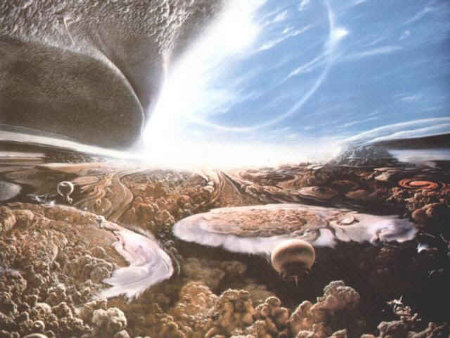
A bolt of actinic lighting slashed the sky, flooding an immense silver web of wires suspended from hot air balloons. Thunder growled faintly in the thin air of the gas giant, River.
Turin Beejis Ramone growled inside his spacesuit, “Give me what I want!” The spider WAS what he only dreamed of being: useful. Salt-ice lattice shell, a Faraday cage protected secret messages delivered by hand and small flyers. It gave the spider its purpose, so that gulping messages to protect them from the lightning, it took them out later, slotted them into a program that broadcast to moons above. Then messages flew to five million grenan, imp, mod, envadan, art, cold and virtual Humans. One chip held
As he raged against that thought, the lattice of the envadan melted in his hot, gloved hands. Its death agony vibrated the carbon fibers of his suit like guitar strings. Jamming his hand into its stomach, he grabbed the treasured metal chips.
He dropped the body and it spun away in the thin arctic wind tugging at his glider. He looked wildly around but no one had seen. Floating through the frigid upper levels of Mekong Band, the antenna was one of a thousand joining data of hot and cold, hydrogen and helium, water and ammonia hurricane gas giant River stripes.
Lightning struck the web, sparking on silver antennae threads. Startled,
Far below, Irog, an environmentally adapted Human manta ray with a five-kilometer wingspan heard the call and pitched himself into a steep dive, opening his maw to scream a stuka siren. Inside an oxygen-nitrogen bubble, rode gear and paramedics. The younger shouted, “I told you to warn us!”
Snickering, Irog the hūmbūlance leveled off. “It’s ten klicks straight up.”
“See anything?” asked an older paramedic.
“There’s a thunderhead between us and the accident.”
Gordon sighed and said, “You know what to do, bud?” He slapped the wall of flesh.
“Ouch!” Irog exclaimed, the floor rippled, “And yes, I do know what to do. ETA in five.” Spinning and twisting up through roiling storm clouds, he circled the antenna. “I have a read on his suit biosigns: stable but critical. Gordon, take the glider down. Rane prep the ER.” Rane hurried through a hall tube; Gordon up through a throat and mouth. With blue kit and a glider, outside, he leapt into a gale and dropped down beside
“Patch me into his comm.”
“Done.”
“
Gordon scowled, “Purity League again?”
“Two in one month,” said Rane. “Ready here.”
Gordon read the bioscan completely and said, “You’re not even Human, why scream at us?”
With a metal cutter, Gordon clipped the antenna, squatted, put his arms under
Guy Stewart is a husband; father, father-in-law, grandfather, and retired teacher/school counselor who maintains POSSIBLY IRRITATING ESSAYS offering his writing up for comment. His new novel, MARTIAN HOLIDAY will be released on December 23, 2025 and takes place in a world 500 years in the future of his first novel, EMERALD OF EARTH (YA/MS, 2024! He also writes on other worlds that have touched his life: GUYS GOTTA TALK ABOUT DIABETES, ALZHEIMERS; BREAST CANCER. He has 70+ publications in Analog, Cast of Wonders, Shoreline of Infinity, Cricket, Stupefying Stories, Nanoism, an essay in The Writer, and has created experiments for episodes of the PBS science shows Newton’s Apple, and The New Explorers—for which he became the Science Museum of Minnesota’s Teacher of the Year in 1997. Really.
October 24, 2010
WRITING ADVICE: Nathan Bransford 9 – Ten Commandments for a Happy Writer

Nathan Bransford is a West Coast agent with the New York literary agency, Curtis Brown, Ltd. For the past nine years, he has been writing a popular blog reflecting on and illuminating the publishing world. Humorous, serious and ultimately enlightening, I’ll be looking at how THE ESSENTIALS (PLEASE READ BEFORE YOU QUERY) continue to influence my writing. I am using them with his permission and if you’d like to read his blog (which I highly recommend) go to http://blog.nathanbransford.com/.
Before I launch into this, I should point out that one of the reasons I’ve stopped reading THE WRITER and WRITER’S DIGEST is that they’ve devolved into magazines that publish lists.
The current Table of Contents of those magazines included the following (incomplete) titles: “6 Key Steps to Writing...”, “The 007 Way to Write…”, “10 Tips for Querying…”, “…4 Simple Exercises”, “5 Tips to Polish…”, “25 Tips to Sharpen…”
Long ago, one of the magazines had articles that seriously explored different aspects of writing. I understand that times change, but today, the two magazines are virtually indistinguishable and I think that’s a great loss. In my opinion, they have started to cater to the “Just Tell Me What I’m Supposed To Do To Get Famous!” mob that looks to start writing careers in the wake of recession by skipping all of that study, sacrifice, practice and trial-and-error garbage that writers had to go through in the olden days. All they want is the REAL stuff -- you know, that stuff Steven King did AFTER the study, sacrifice, practice and trial-and-error and just before signing the $1.3 million contract.
*rant over*
Nathan Bransford offers a different kind of list. His is called 10 Commandments For A Happy Writer
- Enjoy the present.
- Maintain your integrity.
- Recognize the forces that are outside your control.
- Don’t neglect your friends and family.
- Don’t quit your day job.
- Keep up with publishing industry news.
- Reach out to fellow writers.
- Park your jealousy at the door.
- Be thankful for what you have.
- Keep writing.
I’m going to focus on the one I found most surprising. It wasn’t because the concept was surprising I was stunned because he was honest about it.
In the 9th Commandment, Bransford exhorts us to “Be thankful for what you have” and then points out an obvious but little acknowledged circumstance: “There are millions of starving people around the world and they’re not writing because they’re starving. If you’re writing, you’re doing just fine. Appreciate it.”
At first, I was inclined to think he was using hyperbole to make a point, and perhaps he is. It certainly worked with me. But as I paused to think about it, I began to doubt that he did it just to make a point. He said something I rarely, if ever consider: my wealth gives me the opportunity to engage my brain in the pursuit of writing. This dovetailed unexpectedly with a random thought I had the other night.
I’m busy reading shorts right now to update myself in speculative fiction. I glanced at the cover of the August 2010 issue of ASIMOV’S and heard a voice inside my head whisper, “What is the purpose of short fiction?”
Last night, I read a section of Robert A. Heinlein’s semi-autobiography, GRUMBLES FROM THE GRAVE. In it, he said, “…if a writer does not entertain his readers, all he is producing is paper dirty on one side…STRANGER IN A STRANGE LAND…’s entertainment values were sufficient to carry the parable, even if it was read strictly for entertainment.” (page 244-245)
Heinlein wrote at times for the same reason Jesus came to Earth – to tell parables, a parable being “a short fiction that illustrates an explicit moral lesson” (http://www.wwnorton.com/litweb/glossary/).
I’m feeling suddenly inspired to write short stories (if Heinlein implied that STRANGER was a “short fiction”, I wonder what a “long fiction” would have looked like?)
It’s sometimes strange how disparate thoughts come together into a coherent lesson.
For me this happened because of Nathan Bransford’s 9th Commandment for a Happy Writer and I am definitely happier now – but more importantly, I’m wiser.
(I’ve poked around at parables before:
http://faithandsciencefiction.blogspot.com/2008/11/writing-advice-parable-storythat.html
http://faithandsciencefiction.blogspot.com/2008/07/writing-advice-absolutely-basic-flash.html)
image: http://photo.goodreads.com/books/1229984020l/403305.jpg
Guy Stewart is a husband; father, father-in-law, grandfather, and retired teacher/school counselor who maintains POSSIBLY IRRITATING ESSAYS offering his writing up for comment. His new novel, MARTIAN HOLIDAY will be released on December 23, 2025 and takes place in a world 500 years in the future of his first novel, EMERALD OF EARTH (YA/MS, 2024! He also writes on other worlds that have touched his life: GUYS GOTTA TALK ABOUT DIABETES, ALZHEIMERS; BREAST CANCER. He has 70+ publications in Analog, Cast of Wonders, Shoreline of Infinity, Cricket, Stupefying Stories, Nanoism, an essay in The Writer, and has created experiments for episodes of the PBS science shows Newton’s Apple, and The New Explorers—for which he became the Science Museum of Minnesota’s Teacher of the Year in 1997. Really.
October 21, 2010
THE RECONSTRUCTION OF MAI LI HASTINGS 17

Daniel Keyes’ FLOWERS FOR ALGERNON: the story has stayed with me for decades, a symbol for both the overwhelming possibilities of the human intellect and the overwhelming impossibilities faced by a profoundly challenged human mind. I’ve started and stopped this novel a half a dozen times in eleven years. I want to bring the original idea into the present millennium. To read RECONSTRUCTION from beginning to here, click on the label to the right and scroll to the bottom.
Mr. Bates was standing at the far end of the hallway when CJ Hastings turned the corner, running at full speed.
“You can slow down and walk right now, buster, or I’ll send you back to your room and you can walk it all over again!” he bellowed down the hall.
CJ stopped, took, deep breath and walked even though his pulse seemed to thunder in his ears. He twitched as he wrestled with his feet. They got in each other’s way and he tripped, almost falling. When he reached the end of the hall, Mr. Bates said, “So, we’re going to another meet Saturday. I take it you’re no longer grounded?”
Disoriented, CJ nodded and said, “Uh…I can be there.”
“Good! I have a new method we can use to help you read the questions, so I’m excited…”
Mom came out of the office and said, “Thanks, Mr. Bates. I’ll take him from here.” She grabbed CJ’s arm and with long strides, rushed them out of the school.
“Mom? What happened?” CJ asked, trying to shake off Mom’s grip.
She didn’t let go as she said, “Not yet. We’re still on the security cameras and I’m sure someone can hear us.”
CJ gave her a funny look as they headed to the car parked in the VISITOR row. Mom unlocked it with the electronic key, starting it as well. When they were in, CJ said, “What happened?”
Mom put the car in reverse and floored it out of the parking lot as she said, “Mai Li is gone again – but this time she left a message.”
CJ sat back in the car seat and stared through the windshield. What was she doing? Where was she going? Who was she with? He asked, “Where’s the message?”
“On the computer at home.” She handed him her PDA and added, “I downloaded it to MicApple. Watch it.”
He nodded and brought up the video function and hit play. The tiny speaker played a thin version of Mai Li’s voice as her face appeared. He squinted. She looked mad. Her voice matched. She said, “I’ve hit a brick wall here. I’ve been on line with that so-called doctor Chaz-what’s-his-name and he refuses to turn my own records to me! Like he could possibly know more about me than I can know! He’s the retard, little brother – not you! I’m obviously the best person to do research on myself.” She paused, took a deep breath, closed her eyes and continued, he voice more calm. “So, my plan – in general, Mom, so don’t send someone after me, I’m the super-hyper-major-genius-babe, here, thank you very much! – is to get out of here and get the information I need by whatever means.” Her lips thinned and her eyes squinted.
CJ recognized the look. When she’d had brain damage, it was the look she put on her face when she was picking up a piece of cereal to put in her mouth; a look of intense concentration. She said, “I intend to bring this to everyone. Not just the rich.” She snorted. “Maybe I can start a plague of intelligence!” Pause. “See you guys later. Don’t come after me.” The image winked out.
CJ looked at Mom and said, “What are we going to do?”
She shook her head. “She’s a super genius…”
“Like The Brain,” CJ said. “She’s gonna take over the world. With brains – to give everyone else brains.” He paused. “She gave me brains. I think we should leave her alone.”
Mom didn’t say anything as she drove, but CJ saw that she sucked in her lower lip and bit it. It meant she was having second thoughts about something she’d done.
image: http://www.pocket-lint.com/images/waX0/iphone-4-face-time-data-0.jpg?20100803-151003
Guy Stewart is a husband; father, father-in-law, grandfather, and retired teacher/school counselor who maintains POSSIBLY IRRITATING ESSAYS offering his writing up for comment. His new novel, MARTIAN HOLIDAY will be released on December 23, 2025 and takes place in a world 500 years in the future of his first novel, EMERALD OF EARTH (YA/MS, 2024! He also writes on other worlds that have touched his life: GUYS GOTTA TALK ABOUT DIABETES, ALZHEIMERS; BREAST CANCER. He has 70+ publications in Analog, Cast of Wonders, Shoreline of Infinity, Cricket, Stupefying Stories, Nanoism, an essay in The Writer, and has created experiments for episodes of the PBS science shows Newton’s Apple, and The New Explorers—for which he became the Science Museum of Minnesota’s Teacher of the Year in 1997. Really.
October 18, 2010
HOW TO WRITE A BEST-SELLING SCIENCE FICTION NOVEL FOR THE 21ST CENTURY
Just thought I'd let you know I wrote a silly piece over at THE FRIDAY CHALLENGE:
Guy Stewart is a husband; father, father-in-law, grandfather, and retired teacher/school counselor who maintains POSSIBLY IRRITATING ESSAYS offering his writing up for comment. His new novel, MARTIAN HOLIDAY will be released on December 23, 2025 and takes place in a world 500 years in the future of his first novel, EMERALD OF EARTH (YA/MS, 2024! He also writes on other worlds that have touched his life: GUYS GOTTA TALK ABOUT DIABETES, ALZHEIMERS; BREAST CANCER. He has 70+ publications in Analog, Cast of Wonders, Shoreline of Infinity, Cricket, Stupefying Stories, Nanoism, an essay in The Writer, and has created experiments for episodes of the PBS science shows Newton’s Apple, and The New Explorers—for which he became the Science Museum of Minnesota’s Teacher of the Year in 1997. Really.
October 17, 2010
Slice of PIE: Science Fiction and Fantasy – Evangelistic Literature of Hope and Triumph!

No matter if you fall into the dystopian, the utopian or the realist writer’s camp, few people will deny that at one time, science fiction was the evangelistic literature of science and fantasy was the evangelistic literature of the triumph of good over evil.
At one time, science fiction characters solved problems by the dramatic application of science. In fantasy, heroes overcame incredible odds to ultimately triumph over evil. Horror, of course, plumbed the darkest side of human nature and the supernatural, seamlessly illustrating what happened when the two collided.
Not so any more.
Horror leaks into fantasy; fantasy darts into science fiction and the genre itself has broadened to a point where the originals and their clear permutations are now sheltered under the umbrella of Speculative Fiction. (Isn’t ALL fiction speculative? Is that where we’re going?)
And yet…
And yet…
As harbingers of things to come and heralds of good and evil, science fiction and fantasy served clear purposes. The one provided visions of the future that we could mull over, reject or accept and consider implementing. The other gave us clear hope that given great sacrifice, good would triumph over evil. Even the Bible, if taken as simple literature, bears this out over and over.
Science fiction and fantasy, fondly known more briefly as SFF, bore their message both to a very specific slice of
My thesis here – which will go undefended at this point and serve only to irritate or get people thinking – is that by scooting under the skirts of “speculative fiction”, both SF and F have lost their purpose. It is a rare instance now to read SFF and come away with a positive vision of the future or a belief that good will triumph over evil.
That’s not what “specfic” is for. Dystopian SF has flooded the YA/Teen market. Fantasy worlds hold neither good nor evil, just people of various fantastic natures muddling about, trying to do…well, usually not right, but stuff so that they don’t get killed themselves.
Instead of being messengers of future hope and the triumph of good over evil today “specfic” merely seeks to speculate in order to entertain (or grind a particular writer’s axe...but then THAT part hasn’t changed.)
How if we hie back to request those former days – NOT the “Golden Days” of SFF which, besides being schmaltzy, were sexist, racist and almost any other “ist” you can think of) – rather the days when SFF was the evangelistic literature of future hope and the triumph of good over evil?
Guy Stewart is a husband; father, father-in-law, grandfather, and retired teacher/school counselor who maintains POSSIBLY IRRITATING ESSAYS offering his writing up for comment. His new novel, MARTIAN HOLIDAY will be released on December 23, 2025 and takes place in a world 500 years in the future of his first novel, EMERALD OF EARTH (YA/MS, 2024! He also writes on other worlds that have touched his life: GUYS GOTTA TALK ABOUT DIABETES, ALZHEIMERS; BREAST CANCER. He has 70+ publications in Analog, Cast of Wonders, Shoreline of Infinity, Cricket, Stupefying Stories, Nanoism, an essay in The Writer, and has created experiments for episodes of the PBS science shows Newton’s Apple, and The New Explorers—for which he became the Science Museum of Minnesota’s Teacher of the Year in 1997. Really.
October 14, 2010
A SHORT, LONG JOURNEY NORTH 17: July 9, 1946 – July 10, 1946

This series is a little bit biographical and a little bit imaginary about my dad and a road trip he took in the summer of 1946, when he turned fifteen. He and a friend hitchhiked from
The boy – Freddie Merrill found out his name was Charlie – stopped every mile to pick up full milk cans.
After loading on two, three (and one time sixteen!), Freddie and Tommy Hastings would doze off as the truck rumbled along, Charlie grinding the gears like he’d never driven a milk truck before. Tommy’d fall asleep the fastest, so it got to be a game that as Charlie drove along, he’d watch in the rear view mirror for Tommy’s chin to sink to his chest then slam on the breaks just enough to make the younger boy bang his head into a full milk can.
After Freddie busted out laughing the fourth time it happened, Tommy stopped talking to either boy and sat with his arms crossed, sulking after every load they took on.
“Aw, c’mon,” Freddie said after they took on fifteen cans from five farms on either side of a tiny town called
“Would not” came the surly reply from behind crossed arms. Tommy had his knees up, his head down and his face covered.
“Would too,” Freddie said, laughing again. “You’re always making fun of me.”
“I am not,” Tommy said, still not looking up.
“How about the first time I smoked a fag?”
“That’s ‘cause you took too big a drag. Like you were just back from Midway or something.”
Freddie scowled. “That wasn’t why I did that.”
Tommy looked up, “How come, then?”
Freddie shrugged, looked away and said, “ ‘cause Dad said he’d kill me if he caught me smoking and I figured I might as well do it like the big guys do it if I was gonna die the next day.”
Tommy stared at him for a long time before he said, “You’re…” The truck ground to a halt at a stop sign. Charlie leaned out the window and shouted back to them, “Six more stops then we’re in Glen!”
Freddie shouted back, “What then?”
In answer, Charlie floored the accelerator and ground the gears. One of the milk can slid to the edge of the flatbed. Tommy jumped to grab it, shouting, “Hang on, Charlie!”
Charlie slammed on the brakes as Tommy got his hand on milk can’s handle. Everything slid forward. Freddie watched in horror, scrambling against the tilting bed of the truck and trying to dodge teetering milk cans. Tommy, stuck in the handle at an unnatural angle dragged him, cursing and struggling until it collided with another can. The tops of both shot off.
Freddie leaped and grabbed both and as he came down, he screamed, “Are you all right? Are you all right?”
Charlie ran around from the front of the truck shouting, “Are you all right?”
Freddie cussed him out then went to Tommy’s side. “Did it break your hand? Are you OK?”
Tommy looked at him, sank to his knees and lifting his hand, fell forward on to his face.
Guy Stewart is a husband; father, father-in-law, grandfather, and retired teacher/school counselor who maintains POSSIBLY IRRITATING ESSAYS offering his writing up for comment. His new novel, MARTIAN HOLIDAY will be released on December 23, 2025 and takes place in a world 500 years in the future of his first novel, EMERALD OF EARTH (YA/MS, 2024! He also writes on other worlds that have touched his life: GUYS GOTTA TALK ABOUT DIABETES, ALZHEIMERS; BREAST CANCER. He has 70+ publications in Analog, Cast of Wonders, Shoreline of Infinity, Cricket, Stupefying Stories, Nanoism, an essay in The Writer, and has created experiments for episodes of the PBS science shows Newton’s Apple, and The New Explorers—for which he became the Science Museum of Minnesota’s Teacher of the Year in 1997. Really.
Subscribe to:
Posts (Atom)