April 21, 2013

POSSIBLY IRRITATING ESSAY: Les Misérables as Fantasy…

Like many people, I’ve watched Les Misérables more than once on DVD.

Like many others, the pastor of the church I attend has expounded on the connection between Les Misérables and the American Church today (comparing “us” to Jean Valjean and the institutional (i.e., Mainline) Church to Javert).

My interest today however, was sparked when I saw that Les Misérables had been nominated for (among a zillion others!) a Saturn Award. The Saturn is given by The Academy of Science Fiction, Fantasy and Horror Films and I found that strange. On closer examination of course, you can find that among others, it is up for an award for the best Action/Adventure film (http://www.saturnawards.org/nominations.html). But I didn’t seen that until much later. It made me wonder what aspects of Les Misérables were fantasy.

Lo, and Behold! In the very final scene, shortly after the death of Jean Valjean, Fantine, the June Rebellion youngsters, they and several other dead people sing:

Do you hear the people sing
Lost in the valley of the night?
It is the music of the people
who are climbing to the light.

For the wretched of the earth
there is a flame that never dies.
Even the darkest night will end
and the sun will rise.

We will live again in freedom
in the garden of the Lord.
We will walk behind the ploughshare;
We will put away the sword.
The chain will be broken
and all men will have their reward.

Will you join in our crusade?
Who will be strong and stand with me?
Somewhere beyond the barricade
is there a world you long to see?
Do you hear the people sing?
Say, do you hear the distant drums?
It is the future that we bring
when tomorrow comes...
Tomorrow comes!


They stand on a Barricade that has been both a visible and invisible symbol through the entire movie; below them, a throng of thousands join to sing this final number, soprano voices soaring to the ceiling as the camera pans back then lifts to the sky.

On the Other Side of the barricade (or is Jean Valjean et al on the Other Side? Paranormal phenomenon like this always give me a headache), where those still alive eke out their pathetic lives, there are only cannons and litter – and confetti from the barricaded Dead drifts a bit over from the Other Side to reality.

It’s strange that the movie would end this way. The rest of it while fictionalized, is an historic account of the years following the French Revolution.

I have, unsurprisingly, an opinion about that.

While it is clear that “Les Misérables (1862)...[is]…focused on the struggles of ex-convict Jean Valjean and his experience of redemption...Examining the nature of law and grace...” , Twentieth Century French playwrights and the Twenty-first Century media monster can’t handle overtly Christian thoughts of law or of grace, faith and forgiveness. So they changed the meditation of Victor Hugo into a fantasy instead, adding the scene where Fantine escorts him to “heaven” (aka “the barricade”). The novel has no fantasy sequence and Jean Valjean dies at home, forgiven his life-long deception by his daughter and new son-in-law. This is real forgiveness, and moderns like Claude-Michel Schönberg, Alain Boublil, Trevor Nunn and John Caird (adaptation); Alain Boublil and Jean-Marc Natel (French lyrics), Herbert Kretzmer (English adaptation) as well as those who took the French musical and created another, grander altered musical in English, “...with lyrics by Herbert Kretzmer and additional material by James Fenton...a literal translation by Siobhan Bracke of the original Paris version...[to which they added] A third of the English lyrics were a "rough" translation...third were adapted from the French lyrics...the final third consisted of new material...”, were both unable to accept the fact of Christ’s sacrifice – and unable to tamper any more with the message of Les Misérables.

The critics of Victor Hugo’s time tried to pan the Gospel message of Christ’s forgiveness in 1862 by trashing the novel: “...the subject matter immoral...excessive sentimentality...apparent sympathy with the revolutionaries...unconquerable disgust...artificial and disappointing…neither truth nor greatness in it...characters were crude stereotypes...an infantile effort...tasteless and inept...”, but they were unable to stem the tide of popular acclaim and the novel lived on and on, translated into twenty-one languages that has been read for 150 years.

Despite the efforts of critics then and playwrights today, the novel became “...one of the greatest novels of the nineteenth century...”, and the musical, in its various incarnations has been performed in at least ten languages, won the Tony and fourteen other awards on stage, and garnered another thirty in its current film version, including Oscars and Golden Globes for various cast members.

The book and its message of Christ’s forgiveness appeal to Humanity in a way no amount of fantasy-creation, criticism and play re-writing can shed – even after attempts spanning 150 years.

The writer of the Book of Hebrews in chapter thirteen, verse eight iterates that as well and extends it by saying, “Jesus Christ is the same yesterday and today and forever.”

So – how many of you have I irritated?

Image: http://www.hollywoodreporter.com/sites/default/files/imagecache/feature_promo_tout_421x237/2013/01/les_miserable_hugh_jackman_anne_hathaway_a_l.jpg


April 19, 2013

MARTIAN HOLIDAY 41: Paolo To Cydonia


On a well-settled Mars, the five major city Council regimes struggle to meld into a stable, working government. Embracing an official United Faith in Humanity, the Councils are teetering on the verge of pogrom directed against Christians, Molesters , Jews, Rapists, Buddhists, Murderers, Muslims, Thieves, Hindu, Embezzlers and Artificial Humans – anyone who threatens the official Faith and the consolidating power of the Councils. It makes good sense, right – get rid of religion and Human divisiveness on a societal level will disappear? An instrument of such a pogrom might just be a Roman holiday...To see the rest of the chapters, go to SCIENCE FICTION: Martian Holiday on the right and scroll to the bottom for the first story.

Paolo Marcillon lowered his helmet over his head. He visually checked what seals he could, then blinked through a series of suit checks projected onto the inside of his helmet. He turned to the younger man suiting up beside him.

Jack Purvis had just finished battening his latches and did a similar suit survey. A moment later, he spoke over their radio link, “Request external suit check.”

“Ten four,” replied Paolo automatically. They quickly confirmed that both of them were ready for the airlock to partially evacuate and trade breathable air for the cold, carbon-dioxide of the surface of the Red Planet.

Paolo felt the suit stiffen as the air pressure dropped. For an instant, he couldn’t hear Jack’ breathing. Instead, Svetlana said, “We may believe differently, Mr. Marcillon, but I’d like you to know that if you ever need a real hand, we will be here for you.” She was off the circuit before he could draw a breath to thank her. The light over the airlock door glowed green. Jack spun the wheel and they were back out on the surface.

Paolo said, “How did you get here?”

“I sailed.”

“How are you going to get back into the air?”

“I crashed,” Jack replied. Paolo smile at the embarrassed tone that leaked through the radio.

“So you need a ride home?”

“Uh...” there was another embarrassed pause. “If you’re offering?”

“I think I’m going your way.” The other man stopped and turned his entire suit.

“Where’s your ‘bug?”

“In the center of the Grand Island Dust Sink.”

“How can we find it in this murk?”

Even though the dust storm had calmed, it was still difficult to see. The dust had settled some, hanging just above their heads, rolling as if it was mercury, sometimes dipping below his head. In those instants, he could see for kilometers. He pointed, “About three kilometers. You can just see the flag on the antenna.”

“And sometimes the top of the ‘bug,” Jack paused. “You came here in that?”

Paolo sniffed and headed for the ‘bug. “Not many choices when you’re an itinerant missionary.”

Jack followed, the pulled alongside him. “How did you end up with those crackpots?”

“They aren’t crackpots.”

“How else would you define them? They think aliens have been watching Humans on Mars.”

The walked in silence for a kilometer or so, then Paolo said, “Do you believe that Jesus was the Son of God and that He took on our Human form in order to pay up for the sin Humans had committed in all time?”

“Of course I do! I believe in God the Father Almighty, Maker of...”

“I know the Creed of Nicaea – powerful confession. But if you adhere to the Creed, then most of the people on Mars and Earth would agree that you are a crackpot, too.”

They walked another kilometer. Jack said, “I guess.” The last kilometer they walked in silence, slowly approaching the marsbug. “Did you lock the door?”

“Of course.” They walked up to the marsbug and Paolo keyed in the security code. It opened. They clambered inside, pressurizing the ‘bug as he powered up. He said, “You can have a seat. I’ll tell you when you can change out.”

“I think I’ll stay in my suit.”

Paolo turned his body to look at the younger man. “Why?”

Long pause. “I’m scared.”

“Of what?”

Longer pause, then Jack finally said, “This is a lot bigger than just you and me.”

The pressure reached normal level and Paolo started to take the suit off.

“Don’t do that.”

“Why?”

“Those two MA’s? How do you know they didn’t sabotage the ‘bug?”

“They’re fellow believers – seekers at least.”

“How do you know...”

“Jack?”

“Yeah?”

“How do I know that you’re not here to kill me?”

Long, long, long pause. Paolo kept breaking the seals on his suit, slipping off the gloves first; then taking off his boots. He broke the seal on the chest plate then laid it on the floor. Finally Jack said, “You don’t.”

“All I have is my faith in God, Jack. Faith that God is in charge; and faith that even if you’re here to kill me, God is still in charge.” Jack stood up suddenly. Paolo waited, facing the younger man who was still in his environment suit. They faced each other. Jack raised his left hand, crossed it over his chest.

Tapped the release key; reached up. Waited. Grabbed the helmet and twisted. Lifting it off, he looked at Paolo and finally said, “I’m not here to kill you.  It’s been a long time since I talked to real seekers.”

“Where do you live?”

“Jesus Is Lord.”

Paolo’s lips thinned, nodded. “I’m glad you came to find me.”

“We want you to live with us.”

Paolo shrugged, then sat down at the controls. Finally he said, “So you didn’t come to kill me. You came to kidnap me.”

global

April 16, 2013

IDEAS ON TUESDAYS 108

Each Tuesday, rather than a POSSIBLY IRRITATING ESSAY, I'd like to both challenge you and lend a helping hand. I generate more speculative and teen story ideas than I can ever use. My family rolls its collective eyes when I say, "Hang on a second! I just have to write down this idea..." Here, I'll include the initial inspiration (quote, website, podcast, etc) and then a thought or two that came to mind. These will simply be seeds -- plant, nurture, fertilize, chemically treat, irradiate, test or stress them as you see fit. I only ask if you let me know if anything comes of them.

F Trope: xenofiction (point of view of an animal)

Mia had one mission in life.

She was a IED-expert. When she was called up and shipped to Afghanistan, it was the single most exciting moment in her short life. She was certain she’d been made for it. Certain that no one else could do it as well as she could. She knew beyond a shadow of a doubt that her mission was to save lives by getting rid of IEDs that littered this sad country after its abortive war. She was set to do whatever was necessary – almost.

When she found IEDs, she refused to touch them and certainly refused to disarm them no matter how simple the device was. In fact, she couldn’t disarm an IED even if her partner’s life depended on it. She couldn’t handle them – because she didn’t have hands.

But smelling an IED was an entirely different story. She could tell the exact makeup of the IED from thirty meters away.

It had taken her a lot of time to train her partner to be as good as she was. The language barrier itself was nearly impossible to overcome. Ethan Pai-Teles was virtually deaf, couldn’t tell the difference between a rubber band bomb and a mercury-tilt switch bomb. Mia could smell mercury from a long way away – the sharp, poisonous tang would keep her away even when Ethan tried to bribe her with treats.

She’d usually answer him, “Totally unsafe, Ethan! Totally unsafe!”

He rarely understood her. At least now he slowed down some. When they first started working together, he’d tried to get her to understand English. She got that – some of the first words she’d understood were “toy” and “walk”. But the language was so limited. Ninety percent of the scent keys aligned with real language were missing in English. It was nearly impossible for Ethan to hear anything but the most rudimentary phrases in the Bark Tongue.

Yun, a Chinese Shih Tzu soldier Mia had met at the Summer Olympics had it easier. Her partner at least understood the importance of pitch in real speech. Ethan – she loved him, but MAN! – was practically tone deaf, even as far as Humans were concerned.

She had to rely on body language, just as he’d devised a series of hand signals that allowed them to work together as their sight at close range was very nearly the same.

They were patrolling a stretch of road they hadn’t been in a bit. They’d been working together – she knew it was many, many sunrises past the last sandstorm, Ethan said “Two years, six months, five days, thirteen hours and,” he’d glance at his arm, “fourteen minutes” – and she caught the whiff of an IED.

She growled. It smelled strange. Very strange. There was the sharp, Human smell of plastic explosive but it was overlain with something different. She’d never caught the scent of anything like it…except maybe when they’d trained together when she was a pup. It had been in a very dry place, a long way away from her favorite water and the fabulous birds Ethan killed for her but didn’t allow her to eat.

This place had a two white marks laid on the floor of one of the buildings, smelling strongly of oil paint. Ethan had made a violent sound and exclaimed something softly and low so she could actually hear it, “Area Fifty-One?”

This smell was the same as that...

Names: ♀ UK-Scotland ; ♂ UK, Portuguese

April 14, 2013

POSSIBLY IRRITATING ESSAY: The Efficacy of Prayer…The Efficacy of Intent


I interrupt my regularly scheduled Bruce Bethke Writing Advice to bring you this at-first seemingly disconnected set of ideas. Hang with me and either you’ll discover something unexpected as I did – or find something irritating...

The January 1959 issue of The Atlantic carried an essay by C.S. Lewis called “The Efficacy of Prayer” where he asked, “What sort of evidence would prove the efficacy of prayer?” He meanders through prosaic observations of his own life and then comes to the crux of the matter when he points out that “…He who served [God] best of all said, near His tortured death, ‘Why hast thou forsaken me?’…that Man, of all others, is least comforted by God at His greatest need...little people like you and me, if our prayers are sometimes granted…had better not draw hasty conclusions to our own advantage.”

Lewis also wrote in MERE CHRISTIANITY, “No man who bothers about originality will ever be original: whereas if you simply try to tell the truth (without caring a twopence how often it has been told before), you will, nine times out of ten, become original without ever having noticed it.” (Chapter 11, Book 4)

He wanted to know if there was any way to prove, without a doubt, that prayer did as advertised (“The prayer of a righteous person is powerful and effective.” James 5:16) and he wanted to point out that when being creative, honesty will produce originality.

I have been wrestling with prayer in my own creative life the past months – maybe years – and still have no clear answer as to whether or not I should be praying to become a better writer, to sell a novel, to be able to make a substantial portion of my income by doing something I dearly love. As I may have seen progress in the first, the latter two are still in the works, perhaps. Or “never gonna happen”.

However, I had some evidence recently that supports Lewis second assertion.

My daughter is a marvelous artist, and while I can’t say I UNDERSTAND all of her work, I strive to appreciate it. A year ago, a piece of work she created on a whim won Best of Show at the Augsburg Juried Art Show. Titled “Brainstorm”, it was a watercolor of an umbrella with the sun shining on it. Underneath a thunderstorm is brewing. I loved it.

This year, she didn’t win Best of Show; nor any of the “second-best” or “runners-up”. She won one of two first annual Clair and Gladys Strommen Center for Meaningful Work (“promotes the exploration of vocation, purposeful living and meaningful work by connecting liberal and professional knowledge and skills with talent, faith and core values”) art award. Presented by Robert Strommen of Strommen & Associates (St. Paul) and his sons, the award also stipulates that the piece be displayed for the next year at the Center. He shared that the piece represented the intent of the Center and the direction they were aiming for.

In other words, the piece was original and resonated with him, his sons and the mission of the company.

I confess that the stories of mine that have been published had usually been pieces in which I wasn’t trying to do anything but express a deeply held idea in a way that entertained me. It was “accidental” that others liked the stories – not accidental in that I sent them out in the hope that they would be published, but that they appealed to others.

My daughter’s work was an expression of ideas she held and expressed and while she entered the art in a show, “winning” was incidental. (This was illustrated both times by gasps of delight from my wife and I – as well as her “god-parents” (last year) and her roommate and another college friend (this year). Not from Mary, either time.)

The link back to CS Lewis and “The Efficacy of Prayer” is that as Christians, we are called to serve God. We are called to pray to Him and lift others up in prayer – “Be anxious for nothing, but in everything by prayer and supplication with thanksgiving let your requests be made known to God.” (Philippians 4:6). HOWEVER, there is NO PROMISE ANYWHERE that we will “get what we want”, whether it’s healing from illness or a contract for a novel. What is important is to serve God. What is important is to serve our ideas.

Accolades are incidental – always appreciated, giving warm fuzzies, and drawing us on to greater things – but never the goal. Never the intent. The intent is to obey God and pray. The intent is to create art that expresses who we are and what we think.

What is important is to SERVE.

April 12, 2013

SHORT LONG JOURNEY NORTH #48: July 19, 1946 - July 20,1946

This series is a little bit biographical and a little bit imaginary about my dad and a road trip he took in the summer of 1946, when he turned fifteen. He and a friend hitchhiked from Loring Park to Duluth, into Canada and back again. He was gone from home for a month. I was astonished and fascinated by the tale. So, I added some speculation about things I've always wondered about and this series is the result. To read earlier SHORT LONG JOURNEY NORTH, click on the label to the right. The FIRST entry is on the bottom.

Freddie Merrill cried out, “Whaddya mean ‘kill you and your friend’?”

Edwina Olds, Lieutenant, WACS (ret.) sighed, ground another gear and said, “Just what I mean, son. One of the three of us has a connection with our socialists friends following us. It ain’t me...”

“It sure as hell ain’t me!” Freddie said. “We didn’t do nothin’ to nobody!” His words fell unremarked into the cooling night air. “One of you two say something!”

Edwina looked across Freddie at Tommy Hastings. The boy appeared to have leaned into the door in an effort to hide from her and his best friend. She said, “Seems to be the only one could have any connect to these crazy Socialists is you, son.”

“But I never did nothin’ to them,” Tommy said faintly – though he might have shouted it over the roar of the logging truck’s engine.

“I signed on to take a pair of youngsters up north on a trip into Canada. I didn’t sign on to fight a political battle. Much as I enjoyed givin’ the Japs a black eye after Pearl Harbor, I never much cared for politics. That’s one science ain’t never gonna bring no good thing to no woman, man, girl, or boy. Avoiding grief or causing grief is the only thing politics does and it’s my considered opinion that politicians are the only people what enjoys doing it. As to fighting Socialists – that’s best left to people in their own country.”

“Like the Socialists who are following me?” Tommy asked bleakly.

The truck roared on into the night. Tommy leaned forward to see if the Socialists were still following them in the side mirror of the rig. He’d breathe easier for a moment, then catch his breath when the yellow glow of the headlights appeared around a curve or from behind a tree.

“Would you quit doing that!” Freddie finally shouted, slugging Tommy in the shoulder.

Ed piped up, “For once I agree with your friend. Every time you do that, it makes my heart pound.”

“Well, what are we gonna do?” Tommy exclaimed. “Every time I see the headlights, they’re closer!”

“It’s your imagination, kid.”

“It is not!”

“Is so,” Freddie said, leaning on Tommy. They went back and forth for three minutes until Ed barked with a military snap and told the both of them to shut up. It was the strongest language she’d used with them and both boys fell back against the seat, panting. They drove on until a faint light to the right. Ed downshifted.

“What are we doing?” Tommy asked, twisting around in his seat to look at Ed and look into the side mirror. She shifted down three more times, Tommy’s question getting higher and higher pitched each time. When Ed tapped the brakes and the light on the right grew brighter, Ed laid on the rig’s horn in a weird, syncopated pattern. “Where are we going?” Tommy screamed.

A sign loomed into the headlights that read, “Naniboujou”

Tommy shouted, “What’s that?”

“Quiet down, boy! Sit and keep your mouth shut or I’ll shut if for you with my fist!” She paused, then added, “Naniboujou is a wild spirit and a werewolf.”

Tommy shut up, sat still and leaned against Freddie, who felt his best friend shaking against his shoulder. He didn’t think it was from the cold, because the cab was hot from the truck heater. “Is she gonna give me to the Socialists?” he said and though he couldn’t see him, Freddie knew Tommy was on the verge of tears. Ed rolled down her window and as she did, he rolled to a near halt. Through the window came a rig horn’s mournful response to her pattern. The truck stopped just as another set of headlights came bouncing along behind them.
Tommy took one last look in the side mirror and said, “Sorry, everybody.”

“Nothing to be sorry about, son. Just wait here and I’ll see them Socialists get taken care of.” Ahead of them, it seemed like the light of a millions suns exploded all at once from the forest.

April 9, 2013

IDEAS ON TUESDAYS 107

Each Tuesday, rather than a POSSIBLY IRRITATING ESSAY, I'd like to both challenge you and lend a helping hand. I generate more speculative and teen story ideas than I can ever use. My family rolls its collective eyes when I say, "Hang on a second! I just have to write down this idea..." Here, I'll include the initial inspiration (quote, website, podcast, etc) and then a thought or two that came to mind. These will simply be seeds -- plant, nurture, fertilize, chemically treat, irradiate, test or stress them as you see fit. I only ask if you let me know if anything comes of them.

SF Trope: inside a computer system

Amelia Qasoori curled her lower lip, tucking it under her teeth then tapped them as she stared at the Apple 27 inch Cinema Display screen. She tapped another key on her computer.

Artem Torres tossed his backpack on the lab table, peeked over her shoulder then went to his own computer and booted it up. His screen was much smaller however and there were multiple images. All of the images were of rats.

Amelia glanced over at him and wrinkled her nose and said, “I don’t know how you can stare at those ugly things all day long.”

He smirked at her and said, “I can open the cages and play with them if you’d like.”

“You’re both obscene and disgusting at the very same instant,” she said, leaning closer to her screen and tapping a section of an image. The screen was covered with tiny squares.

“What’s even more disgusting and obscene is that we’re trying to do the same thing with organic and inorganic matter.”

Amelia nodded slowly as she tapped another square then made an entry on an old-fashioned yellow notepad with an even older-fashioned pencil. She made a few more notes, then typed for several minutes. The images on the screen whirled wildly and when they were done, Artem leaned back on his lab stool, looked at the image and said, “I don’t see any difference.”

Amelia made a raspberry. “That’s because you’re a wetwareologist. You people couldn’t feel your way off a kindergartner’s graphing calculator.”

“That’s not true! I use computer modeling all the time!” He waved at his smaller computer screen. “Just because everything I do is reality instead of virtuality doesn’t mean it’s not important.”

“I’m not talking about ‘importance’ here, Art! I’m talking about relevance. What I do is relevant. What you do is...cute in a sort of old-fashioned way.”

From behind them, a stentorian voice spoke, “My two favorite high school geniuses continue to banter mindlessly, ignoring my strict instructions to MELD the techniques and technology to form something new.”

Artem and Amelia jumped to their feet, spinning around. In unison they said, “Hello, Dr. Willard.”

He nodded to them and passed between them. He was tall. Unusually tall, well over two meters tall. He patted both of them on their heads. “So, my tremendous twins, what do you have for me today?”

“Look, Dr. Willard, I can make a fine rat robot for you! There’s no need for...”

“Dr. Willard, if you get me some really great tech who won’t talk back every time I ask for something, I could have a ‘borg rat ready for you in two shakes of a…a...”

“A rat’s tail, Mr. Torres? There’s no need for me to have a biological brain, Ms. Qasoori?” He stood back and studied her screen. Then he stepped sideways and leaned forward to study Artem’s screen. Straightening, he said, “What I need, dear pupils, is a seamlessly integrated part organic-part inorganic creature to do a very, very interesting job.” He favored each one with a cold glare, then left the lab, adding without turning around, “A word from me can get you into the most select graduate study programs in the world.” He stopped in the doorway, and still without turning around, said, “A word form me can get you barred from the most pathetic study programs in the world.”

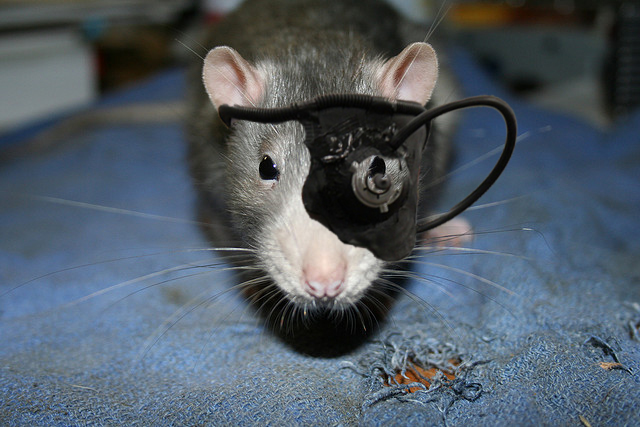
Stranger Than Fiction: http://blogs.smithsonianmag.com/smartnews/2013/02/neuroscientists-wire-two-rats-brains-together-and-watch-them-trade-thoughts/
Names: ♀ Australian (NSW), Pakistan; ♂ Russian, Spanish

April 7, 2013

Slice of PIE: Driving To Work and Writing...


Every morning for the past 23 years, I’ve driven pretty much the same route to work.

Every morning for the past 23 years, there’s someone on the road who APPEARS to have the following attitude:

1)      “I would have been on time, except I got behind this really STUPID, OLD, POS pickup truck that wouldn’t get out of my way!” The problem with this attitude is that my stupid, old pickup truck has nothing to do with you running behind. You didn’t get into the car until you were behind schedule. You’re behind schedule because you didn’t get up soon enough. You didn’t get up soon enough because you just didn’t want to get up. Ergo – it’s the stupid, old pickup truck’s fault that you didn’t feel like getting up on time.

2)     “I have to break the speed limit and go faster than everyone else to make sure people know that I’m in charge of my own life and I’m the BOSS!” The problem with this attitude is that the road is shared by all kinds of people. Some of them prefer to follow the laws. They typically don’t have the revelation that you’re the boss. They have the revelation that you’re an idiot.

3)     “I own the road and my car is the only one that counts!” Obviously you don’t and it’s not. ACTING like this is true makes people shake their heads at you and think you’re an idiot.

4)     “NO ONE can tell me what to do!” When you get pulled over for breaking the law, the officer will tell you what you should have been doing. They will also hand you a piece of paper that says what you WILL be doing. These kinds of people often then tell their family and colleagues that, “These cops are just out to fill their quotas!” ignoring the fact that they broke the law and that’s what cops are there for – to enforce the law.

5)     “This whole driving thing is all about ME!” Aside from the obvious presence of thousands of other cars on the road (roughly 250,000,000 in the US alone. China is catching up!), these kinds of people believe firmly that laws were written for other people and that they are some kind of affront to the personal freedom every American insists is theirs and theirs alone. For them, a YIELD sign means, “Get out of my way, here I come!” They also believe that merging lanes mean, “Get out my way, here I come!” Yellow lights serve the same purpose in everyday driving.

How does this relate to writing?

There are a surprising number of parallels that I see and read on the websites I visit.

1)      “I’d be published now except that editors only publish people they like!” No. Editors publish people their READERS will like. That’s their job. They send stories back...Oh, that’s right, editors don’t send ANYTHING back any more. They send emails. And if it’s not instantaneous gratification, then “the market’s wrong!” It has nothing to do with the fact that your writing STINKS and that you haven’t bothered to get up early enough to START WORKING ON YOUR WRITING.

2)     “I need to get published NOW so I can tell people that getting published is EASY and they should be published like me! I’m the boss!” Getting published STILL isn’t easy, yet with the advent of electronic submissions and the elimination of paper as a viable medium for publication, everything happens fast. So writers expect that NO MATTER WHAT, they should be published FAST, the editorial response should be well-nigh unto instant, and seeing your piece in “print” should be an expectation rather than an anomaly. They want to be their own bosses and publish themselves – because no one understands them.

3)     “My story is better than all these other ones getting published today! No one understands my genius! I think my story is brilliant, unprecedented and absolutely original!” Because many writers today “started writing speculative fiction last month” and then expect that the apprenticeship period will be brief, [because, after all THEIR ideas are NEW! They have their finger of the CAROTID ARTERY of speculative fiction today and what they have written HAS NOTHING AT ALL TO DO WITH ALL THAT ‘OLD STUFF’ written like, in the 90s. That’s passé, what’s past is past, this is today; MY STUFF IS NEW!], their anticipation of the instant recognition of their innovative genius appears to be very high. Even with epubbing, the writing has to be good. Without PRACTICE and READING in the field, it won’t be. I read the first paragraph of the majority of self-pubbed novels and think, “Here’s another idiot writer.”

4)     “All traditional publishers are evil and their sole intent is to make money – which has nothing to do with bringing up good writers who write powerful fiction. Oh, and paper is dead, Amazon is god – they give me exactly what I want! Instant gratification! NO ONE can tell me what they want to publish!” While mediocre writers rush past apprenticeships to publish their FABULOUS WRITING through venues like Smashwords, Createspace, XLibris and zillions of others – because no one understands their genius, traditional publishers are evil moneylords, and “I’m just as good as anyone else who got their book published – my Mom SAYS SO!” These people often read and reread the success stories and ignore the facts. (In case one of you is reading this, try this cold assessment on for size: http://www.wisegeek.org/what-is-e-publishing.htm)

5)     “My writing is all about ME!” That’s true. It is. My writing is all about me, too. But should it be? Was Heinlein’s writing all about himself? JK Rowling’s? Cory Doctrow? John Scalzi? Charles de Lint? No. Their writing was NOT all about them. They had something to say. You cannot convince me that the endless number of “space war” novels I have skimmed through on Amazon are Joe Haldeman-ish attempts to recreate THE FOREVER WAR. They are mostly “innovative” repeats of David Weber’s HONOR HARRINGTON books, John Ringo or any of the other masters or space war fiction – but they aren’t innovating. They are copying substance whilst changing details.

Bad drivers and bad writers seem to have a lot in common.

*sigh*

April 5, 2013

Eblogger Messed Me Up

For some reason known only to the eblogger idiots, they chose to tell me that my blog didn't satisfy them in its design and urged me to "upgrade" to a better design -- because for whatever reason, they thought that I don't know what I want and that they DO.

So my blog has currently been messed up by some idiotic "technogeek teenager".

I'll get it back to what I wanted as soon as I can...

April 4, 2013

STEAMPUNK MONKEY #11

The idea for this starts with a story I tried to write about a thieving monkey who took keys and used them to unlock its cage. That was it. The story was called BRIGHT FLASH THE MONKEY’S PAWS. It was my third or fourth attempt at writing a picture book – and it was really bad. With the advent of the genre of steampunk, I started rethinking the story. Here it is – OK, just realized that I wrote something entirely different for #5 than I thought I did. So…this is going to be where the story SHOULD have gone. If you don’t mind, ignore #6 above!

Clementine knew she would sneeze.

She sneezed at dogs and cats. She wheezed at birds and fish. Frogs were no good. Turtles were bad.

She said, “Ah...”

The bird’s eyes got big, the cat held its breath, the fish stopped its moving around.

The frog froze in place, the turtle lay in the sun. The steam monkey’s nose shot steam into the warm, sunny air .

April 2, 2013

IDEAS ON TUESDAYS 106

Each Tuesday, rather than a POSSIBLY IRRITATING ESSAY, I'd like to both challenge you and lend a helping hand. I generate more speculative and teen story ideas than I can ever use. My family rolls its collective eyes when I say, "Hang on a second! I just have to write down this idea..." Here, I'll include the initial inspiration (quote, website, podcast, etc) and then a thought or two that came to mind. These will simply be seeds -- plant, nurture, fertilize, chemically treat, irradiate, test or stress them as you see fit. I only ask if you let me know if anything comes of them.

H Trope: Above Good and Evil (objectives are more valuable than meaningless considerations of good and evil)
Current Event: “Swat Sociopaths? I came up with the idea because I thought it would be useful for sociopaths to be able to speak to one another. I thought that I would like to meet other like-minded people, but there is absolutely no way to do that in general life. Thus, an anonymous forum of sorts seemed the best way to go about it.” (http://daily.swarthmore.edu/2013/03/20/qa-with-founder-of-new-anonymous-group-swat-sociopaths/)

Niya Ouellet stared at the email. The minute she’d seen the advertisement on the UofM Confessions wall, she’d been captured, bound, and gagged. Her pulse pounded in her ears as her finger hovered over the SEND icon. A club for sociopath’s sounded weird to her.

It also sounded perfect. All she needed was to get together with others who thought like her and together they could get rid of the people who were so jealous of her – and others like her who were so gifted and talented.

She sent it.


Mehdi Claes stared at his computer screen. The Dean of the Computer Science Department sat across from him, staring at a mirror screen. She said, “How many of these have you gotten so far?”

“Twelve,” said Mehdi.

“You’re kidding.”

“Nope.” Mehdi took a deep breath, held it, then let it out slowly. “It was a joke.”

“How many of these people do YOU think are joking?”

Mehdi pursed his lips. “I’m only a college freshman.”

“But you have a brain. You also had the sense to text me and have me come and look at these.” Professor Lenae touched her computer. If even one of these people is seriously a sociopath...”

“A what?”

“Sociopath.”

“What’s that?”

“They aren’t ‘its’, they’re ‘whos’. They have brains that compel them to certain behaviors.”

“Like what?”

“Sociopaths are charming, charismatic, spontaneous, intense, and are happy to betray people, threaten or harm others without giving it a second thought. They are also  outrageous liars. They hate to lose anything; use their brainpower to deceive others; are entirely self-serving master wordsmiths; they never apologize; are delusional and literally believe that what they say becomes truth.”

“And there’s one of these here?”

Professor Lenae stared at him for some time before she said, “According to what you have here, there are twelve.” She paused, shook her head and added, “And they think you’re going to be their leader.”

Names: ♀Israel (Jewish), French Canadian ; ♂ Tunisia, Belgian