Showing posts with label Christianity -- Anthropocentric or Universal?. Show all posts

July 31, 2022

Slice of PIE: Creating Alien Aliens Part 17 -- How Do the Heptapods in “Arrival” and CS Lewis’ God Perceive Time?

NOT using the Programme Guide of the 2021 World Science Fiction Convention, DisCON III, which I WOULD have been attending in person if I felt safe enough to do so in person AND it hadn’t been changed to the week before the Christmas Holidays…I WILL NOT use the Programme Guide to jump off, jump on, rail against, or shamelessly agree with the BRIEF DESCRIPTION given in the pdf copy of the Program Guide. This explanation is reserved for when I dash “off topic”, sometimes reviewing movies, sometimes reviewing books, and other times taking up the spirit of a blog an old friend of mine used to keep called THE RANTING ROOM…


I was having trouble writing this and couldn’t figure out why. After a six hour interval during which I went to a Celebration of Life for a work friend of mine, I sat down again to try and finish this.

The problem was that I hadn’t defined my goal; my question. I got hold of the question as soon as I sat down again: Why is an altered perception of time OK in an alien and ridiculed in God? Both the original story and the movie won glowing reviews:

“The Story of Your Life”: “won the 2000 Nebula Award for Best Novella, the 1999 Theodore Sturgeon Award; nominated for the 1999 Hugo Award for Best Novella; translated into Italian, Japanese, French and German”; James Gleick wrote: ‘[This] poses the questions: would knowing your future be a gift or a curse, and is free will simply an illusion?’, answering himself, ‘For us ordinary mortals, the day-to-day experience of a preordained future is almost unimaginable’, but Chiang does just that in this story, he ‘imagine[s] it’. It was reprinted ten more times before the movie came out. Besides the awards above it was nominated for a HOMer, a Tiptree / Otherwise Gender-bending SF, a Locus, and won a 2002 Seiun (Japan) for the Best Translated Short Story.

The movie “Arrival”: was “nominated for eight Academy Awards, including Best Picture and Best Adapted Screenplay; won the 2017 Ray Bradbury Award for Outstanding Dramatic Presentation, Hugo Award for Best Dramatic Presentation”. In addition, “It grossed $203 million worldwide and received critical acclaim, with particular praise…for the exploration of communication with extraterrestrial intelligence. Considered one of the best films of 2016, [it] appeared on numerous critics' year-end lists and was selected by the American Film Institute as one of ten ‘Movies of the Year’… ‘Adams received nominations for a BAFTA, SAG, Critics' Choice, and at the 74th Golden Globe Awards, nominated for the Golden Globe Award for Best Actress…The score…was nominated for Best Score Soundtrack for Visual Media at the 60th Grammy Awards.”

The thing is, I agree with all of the above hype. My question however, is WHY did the story and movie generate so much attention; so much praise; such awe? During a summer school class I teach called ALIEN WORLDS, I have my students watch clips from it. IMDb describes it this way, “A linguist works with the military to communicate with alien lifeforms after twelve mysterious spacecraft appear around the world.”

Really??? What it DOESN’T say is absolutely crucial: The aliens don’t experience time as Humans do. The aliens, whom people call Heptapods (from the Greek: seven + feet (as in podiatry, not units of 12 inches)) may possibly have a similar perception of time that CS speculates God does.

In his Section 3 of his book, MERE CHRISTIANITY, in “Time and Beyond Time”: “…in [this] final section of the book…C.S. Lewis addresses the question of how in the world God can hear all of the prayers in the world at once. In 1945, CS Lewis also addressed the same problem that Ted Chiang did. In his essay, he writes, “Everyone who believes in God at all believes that He know what you and I are going to do tomorrow. But if he know I am going to so so-and-so, how can I be free to do otherwise?...the difficulty comes from thinking God is progressing along the timeline like us…But suppose God is outside and above the timeline. In that case, what we call tomorrow, is visible to him just the same way as what we call today. All the days are ‘now’ for Him. He does not foresee you doing things tomorrow; he simply sees you doing them.’”

The Heptapods in “Arrival” make a similar statement. When Louise is behind the transparent shield and (apparently) breathing the same air as the Heptapods, and after she understands their language, she has a conversation.

Louise: Where is Abbott.
Costello: Abbott is death process.
Louise: I don’t understand.
Costello: Louise has weapon. Use weapon. We help Humanity.
Louise: I don’t understand.
Costello: In 3000 years, we need Humanity help.
Louise: [She experiences another out-of-linear-time event where her seven or eight year old daughter shows her different representations in different media of her mother (Louise) and her father (Ian)]
Costello: There is no linear time.

Chiang and Lewis explore a fascinating concept and somehow, they arrive (no pun intended!) with the same answer as they explore how aliens and God might experience time and how nearly-incomprehensible that seems.

My students were both captivated and confused with the Heptapods (of course, I can’t mention CS Lewis and God…though I suppose I could bring up Lewis’ Space Trilogy and the aliens in THAT).

Hmmm…

The upshot of this post is to bring to light that the question both Chiang and Lewis sought to explore were the same.

The answer they explored was also the same.

May 19, 2019

Slice of PIE POSSIBLY IRRITATING ESSAYS: ALIEN Sin…Hmmm


NOT using the panel discussions of the most recent World Science Fiction Convention in San Jose, CA in August 2018 (to which I be unable to go (until I retire from education)), I would jump off, jump on, rail against, and shamelessly agree with the BRIEF DESCRIPTION given in the pdf copy of the Program Guide. But not today. This explanation is reserved for when I dash “off topic”, sometimes reviewing movies, sometimes reviewing books, and other times taking up the spirit of a blog an old friend of mine used to keep called THE RANTING ROOM…

“From the Inside Out”
(Hillsong UNITED)

“Your light will shine when all else fades
…never ending,
Your glory goes beyond all fame.
In my heart and my soul
Consume me from the inside out…”


The same night we sang that song, Pastor M spoke about how not ONLY do we need to confess our sins, but that we need to seek the root of that sin.

Jesus clearly knew and understood our pain and the author of the Book of Hebrews is clear when they write: “Therefore, since we have a great high priest who passed through the heavens, Jesus the Son of God, let us hold fast our confession. For we do not have a high priest who cannot sympathize with us, rather, one who was tempted in all things as we are, yet without sin. Therefore, let us draw near with confidence to the throne of grace so that we may receive mercy, and find grace to help in time of need.” (Hebrews 4:14-16)

How did all of this get tangled in my head?

Funny you should ask.

I love science fiction and dozens of years ago, ALIEN hit the big screen. It wasn’t part of a “franchise”, it wouldn’t intersect with the PREDATOR “franchise” for another quarter century or so. The original movie had some basis in reality as the titular aliens reproduce by laying eggs in warm-blooded hosts. The idea took its lead from the life cycle of the Ichneumonoids (https://en.wikipedia.org/wiki/Ichneumonoidea), insects who lay their eggs in or on other insects. The eggs hatch and eat their way out of the host insect, continuing their life cycle when the host is dead.

In my thought process, Satan is a member of the Ichneumonoid family and lays an egg in each Human, it is a sin (or a suite of sins) that are set to plague us for the rest of our lives.

Even the pillar of the New Testament, the Apostle, Paul, experienced this, writing, “For I know that nothing good dwells in me, that is, in my flesh; for the willing is present in me, but the doing of the good is not. For the good that I want, I do not do, but I practice the very evil that I do not want. But if I am doing the very thing I do not want, I am no longer the one doing it, but sin which dwells in me.” (Romans 7: 18-20)

While it is an admittedly bizarre connection, it illustrates for me the nature of sin in my own life.

Imagine that my sin is gluttony. Initially, my life is simple, I eat to live. But, as my life grows more and more complex, the simple act of eating to live grows into the parasite in which I live to eat. Something normal has become something abnormal, an alien so-to-speak. The Apostle Paul was non-specific regarding his “thorn-in-the-flesh” in 2 Corinthians 12:7-10, “Because of the surpassing greatness of the revelations, for this reason, to keep me from exalting myself, there was given me a thorn in the flesh, a messenger of Satan to torment me—to keep me from exalting myself! Concerning this I implored the Lord three times that it might leave me. And He has said to me, ‘My grace is sufficient for you, for power is perfected in weakness.’ Most gladly, therefore, I will rather boast [c]about my weaknesses, so that the power of Christ may dwell in me. Therefore I am well content with weaknesses, with [d]insults, with distresses, with persecutions, with difficulties, for Christ’s sake; for when I am weak, then I am strong.”; but I have my suspicions that it was something normal that grew to overtake him to a point where he begged God to remove it. Clearly, God did not, and Paul grew to understand that in his weakness, God was creating a stronger him.

In ALIEN, the alien deposits an egg in Executive Officer Kane after melting through his helmet and covering his face with a weirdly pulsing, skin-covered, spider-ish creature that drops off dead with its done depositing egg in his chest cavity. It grows and eventually kills its host when it hatches in a scene that is impossible to excise from the memory of anyone who has ever seen it. (Remember that while it has become iconic, it was shocking then and like nothing anyone had ever seen in 1979. It left an indelible impression on me and also led to endless jokes with the friend who saw it with me…)

So, the synthesis is clear in my brain: we are born into sin (Psalm 51:5, “Behold, I was brought forth in iniquity and in sin my mother conceived me.”)

That sin grows within me, breaking out into all of its myriad perversity (definition: “the quality of being contrary to accepted standards or practice.”, bursting out into my life.

Then the Hillsong verse, “Lord I give You control/Consume me from the inside out…” The egg is inside, we were born with it and Satan encourages us to feed it. The ONLY way to destroy that sin is to allow the Lord access to the depths of who we are where He fills us with the Holy Spirit and instead of the sin consuming us, breaking out, and not only killing us, but threatening those around us; the sin itself is consumed.

Of course, the movie is quite clear that even though Kane died, the Alien was a threat to everyone who remained on the Nostromo. The ending is clear – the Alien is swept out of Warrant Officer Ripley’s escape pod and blasted into gas by the ship’s exhaust. But I remember mutterings among my friends…had the alien laid an egg in Ripley?

Even when I am cleansed by the Holy Spirit, the possibility exists that sin can once again grow in my, therefore the Scriptural injunction in James 5:16, “…confess your sins to one another, and pray for one another so that you may be healed.”; and 1 John 1:9 “If we confess our sins, He is faithful and righteous to forgive us our sins and to cleanse us from all unrighteousness.” will keep us confessing our daily sins to one another – and to receive the forgiveness of Christ.

I know…convoluted…but that was where these thoughts led me!


April 28, 2019

Slice of PIE: Racist Ideas, Christianity, and Fantasy & Science Fiction

NOT using the panel discussions of the most recent World Science Fiction Convention in San Jose, CA in August 2018 (to which I be unable to go (until I retire from education)), I would jump off, jump on, rail against, and shamelessly agree with the BRIEF DESCRIPTION given in the pdf copy of the Program Guide. But not today. This explanation is reserved for when I dash “off topic”, sometimes reviewing movies, sometimes reviewing books, and other times taking up the spirit of a blog an old friend of mine used to keep called THE RANTING ROOM…

I wrote this a month ago and I am currently at a men's retreat where we studied the book of Jonah. I discovered that THIS is a book for me. Jonah was a normal guy (pun intended); not a king, a rich man, or anything else special. I understand that people argue about whether he was "real" or whether Jonah is a work of "pious fiction". (Funny that, I know lots of people who are neither pious nor fiction writers who use fictions to make a point. You're reading one of them...). I am posting this again because after re-reading it, I think it makes some important points and I found myself agreeing even MORE with my own writing. So if you thought you read this before, you did...

I’ve sort of been doing a lot of non-fiction reading lately.

I’m almost done with STAMPED FROM THE BEGINNING:  A Definitive History of Racist Ideas In America (Ibram X. Kendi); the men’s group at my church have been reading MERE CHRISTIANITY (CS Lewis); and for our upcoming men’s retreat, our pastor recommended THE PRODIGAL PROPHET: Jonah and the Mystery of God’s Mercy (Timothy Keller)…

I’m going to go off on a few tangents here, but I’ll tie it up into a coherent thesis statement shortly (I hope).

I don’t read much fantasy, but with my daughter’s guidance, I’ve been exposed to a fairly broad, strong base that supports the quote I use in my IDEAS ON TUESDAY posts when I suggest fantasy ideas: “I see the fantasy genre as an ever-shifting metaphor for life in this world, an innocuous medium that allows the author to examine difficult, even controversial, subjects with impunity. Honor, religion, politics, nobility, integrity, greed—we’ve an endless list of ideals to be dissected and explored. And maybe learned from.” – Melissa McPhail

I’ve read DR. STRANGE AND MR. NORRELL; (of course) LORD OF THE RINGS; THE CHRONICLES OF NARNIA; THE CHRONICLES OF THOMAS COVENANT, UNBELIEVER; CHILDREN OF BONE AND BLOOD is on my “to read” list; the DERYNI books; THE SHADOW SPEAKER; and very few others…

Octavia Butler, without a doubt, was one of the most profound speculative fiction writers of the 20th Century and she started very young: “At 12, she watched the televised version of the film Devil Girl from Mars (1954) and concluded that she could write a better story. She drafted what would later become the basis for her Patternist novels. Happily ignorant of the obstacles that a black female writer could encounter, she became unsure of herself for the first time at the age of 13, when her well-intentioned aunt Hazel said: ‘Honey ... Negroes can't be writers.’ But Butler persevered in her desire to publish a story, even asking her junior high school science teacher, Mr. Pfaff, to type the first manuscript she submitted to a science fiction magazine.” While obviously a science fiction writer, her work can also be read as fantasy as she wrapped myth and parables in future trappings. Nnedi Okorafor, a relatively new speculative fiction writer wrote, “Wild Seed showed me that the publication of the type of stories I was writing was possible. It showed me that I wasn’t alone and that what I was writing was ok. Octavia gave me strength.” (https://bookriot.com/2017/06/22/writers-inspired-by-octavia-butler/)

OK – now to pull the reigns in all of this together.

Keller mentions in his book, an encounter with Gimli the Dwarf with Galadriel, Queen of the Elves in Lothlorien. Gimli is a foreigner in the land, in fact, a victim of racist ideas – the Elves have long seen the Dwarves as inferior simply because of who they are, that is, ALL Dwarves are ugly, greedy, evil…

Kendi, in his book defines a racist idea as “…any concept that regards one racial group as inferior or superior to another racial group in any way…‘intersectionality’, prejudice stemming from the intersections of racist ideas and other forms of bigotry, such as sexism, classism, ethnocentrism, and homophobia.” (SFTB, Prologue, p5)

In LOTR:FOTR, Galadriel says, “‘Dark is the water of Kheled-zaram, and cold are the springs of Kibil-nala, and fair were the many-pillared halls of Khazad-dum in Elder Days before the fall of mighty kings beneath the stone.’ She looked upon Gimli, who sat glowering and sad, and she smiled. And the Dwarf, hearing the named given in his own ancient tongue, looked up and met her eyes; and it seemed to him that he looked suddenly into the heart of an enemy and saw there love and understanding…” (Chapter 7, “The Mirror of Galadriel”)

CS Lewis writes in MERE CHRISTIANITY, “…whenever we do good to another self, just because it is a self, made (like us) by God, and desiring its own happiness as we desire ours, we shall have learned to love it a little more or, at least, to dislike it less.” (Book 3, Chapter 9)…

*drawing a deep breath*

For me, the speculative fiction community has ALWAYS intersected with my faith, just as it has for Gene Wolfe, Mike Duran, Madeleine L’Engle, Kathy Tyers, Gray Rhinehart, Orson Scott Card…I’m sure there are others I don’t remember. (io9 published this almost ten years ago: https://io9.gizmodo.com/christian-readers-demand-more-science-fiction-books-wh-5574733 and got quite a bit of discussion. I was corresponding with Mike Duran a bit before he was quoted there.)

By reading all of my current books (MERE CHRISTIANITY for roughly the sixth or seventh time) it sparked in me an entirely new idea. I opened myself up to the Holy Spirit, and along with hearing sermons like the  one I heard today in context of what I’ve been studying, (based on Mark 2:1-12, and from which I took the single message: after Jesus told the paralytic first, “Your sins are forgiven.”; then asked the pharisees “Which would be easier?”; then told him, “Get up, pick up your pallet and go home.” Then came the part that I found startling this morning: “…they were all amazed and were glorifying God, saying, ‘We have never seen anything like this.’”), I may have become both a better man and (I hope) a better writer to add this point of view to my stories.

I noted that “…THEY WERE ALL AMAZED AND WERE ALL GLORIFYING GOD…”. Not just the paralytic, not just his friends, not just those listening to Jesus – but the pharisees as well. All of them had witnessed and seen the change and (possibly) believed on Jesus’ name, that he was God (who could forgive sins).

I have never  published a piece of Christian science fiction (not for lack of trying!), but as I reflect on it now, that may be a good thing. It allows me to integrate a number of ideas into my stories. This intellectual journey has given me the foundational paradigm for a set of stories I’m writing and (finally) defined by the question: “What if entry into an interstellar union required a ‘charity’ factor in the entire population of an intelligence?”

March 17, 2019

WRITING ADVICE: “On Christ the Solid Rock…” I Need To Learn To Build My Stories

In September of 2007, I started this blog with a bit of writing advice. A little over a year later, I discovered how little I knew about writing after hearing children’s writer, Lin Oliver speak at a convention hosted by the Minnesota Society of Children’s Book Writers and Illustrators. Since then, I have shared (with their permission) and applied the writing wisdom of Lin Oliver, Jack McDevitt, Nathan Bransford, Mike Duran, Kristine Kathryn Rusch, SL Veihl, Bruce Bethke, and Julie Czerneda. Together they write in genres broad and deep, and have acted as agents, editors, publishers, columnists, and teachers. Since then, I figured I’ve got enough publications now that I can share some of the things I did “right”.

While I don’t write full-time, nor do I make enough money with my writing to live off of it...neither do all of the professional writers above...someone pays for and publishes ten percent of what I write. When I started this blog, that was NOT true, so I may have reached a point where my own advice is reasonably good. We shall see! Hemingway’s quote above will now remain unchanged as I work to increase my writing output and sales! As always, your comments are welcome!

[I am reposting this today because it's still important and it made me think...again. It's less advice to those who read this; more advice to myself as I continue to figure out what I write about and why.]

A number of years ago, a church my wife and I were going to encouraged the entire congregation to read and apply the principles elucidated in a fairly thin, profoundly important book.

Unlike the What Would Jesus Do? movement, which was inspired by the novel IN HIS STEPS (as well as the concept of Christian Socialism) and the Prayer of Jabez “fad” which was entirely based on a single verse from I Chronicles, chapter 4, verse 10 (both of which the church we were in did…), this was less direction than observation. Doubtless the author, Reggie McNeal made money from the concept, but his program hasn’t seen near the sweeping faddishness of the other two. Mostly because it takes critical aim at the Christian Church as a whole.

Published in 2003 as part of the John Wiley & Sons Jossey-Bass Leadership Network Series; and after reading it in 2005 and 2009, I picked up THE PRESENT FUTURE again recently. Sadly, I haven’t noticed any kind of profound changes in the Christian Church or witness since that time, but I did stumble across something that might help my writing.

As I’ve said before, I’m striving to create both greater consistency and more relevance in my stories. I’ve talked about how to create an ensemble cast, making my stories skinnier, and maybe even agree with myself about what the theme to my writing will be. Seems every writer I like has some sort of theme:

Lois McMaster Bujold: “…bias against the disabled, economic exploitation, and the role of women in society…old-school ideas such as faith in humanity and the desire to probe and do good in the universe…sheer humanity of her characters…” (Project MUSE)

Julie Czerneda: “…first contact, xenobiology…” (The Encyclopedia of Science Fiction)

David Brin: “…the impact on human society of technology humankind…repairing the world, i.e. people have a duty to make the world a better place…working to improve the human condition, to increase knowledge, and to prevent long-term evils…humans as caretakers…importance of laws and legality…do what common sense dictates as good for all…” (Wikipedia)

Jack McDevitt: “…archaeology or xenoarchaeology…making first contact…a universe that was once teeming with intelligent life, but contains only their abandoned artifacts…novels frequently raise questions which he does not attempt to answer…to puzzle and intrigue his readers…” (Wikipedia)

Anne McCaffery: “strong women protagonists…the problems of living and gaining career success…” (Wikipedia); “gender, power and politics, duty and responsibility, tradition and innovation, self and society…family” (Anne McCaffery Discussion forum)

Michael F. Flynn: education, plans that go awry, how we interact with dying cultures and react to the new, extraordinary first contact…(deduced by reading), sometimes Libertarian (Prometheus Award, nominated and won)

Gene Wolfe: “to make [us]…feel cosmic, epic, large…why human progress may (or seems to be) failing.” (Ultan’s Library)

So what are the things that are important to me? What are my themes?

Guy Stewart: Education. First contact. Faith in God. How we interact with very alien thinking and meeting, domestication (see Jared Diamond’s GUNS, GERMS, AND STEEL), technological solution to problems today (wholly unsuccessful right now); self-sacrifice as a missing component of today’s society;

So how does this all tie back to reading McNeal’s book?

A few days ago, I read this: “The central act of the Old Testament is the Exodus, a divine intervention into human history to liberate his people from oppression and slavery. The decisive act of the New Testament is the divine intervention of God into human history to liberate his people from oppression and slavery…In both Old and New Testaments all other mini-dramas and subplots relate back to this central theme.” (Chapter 1, THE PRESENT FUTURE)

As a Christian (that’s what it says in my banner above!), how do my themes tie back to the central theme of God?

I don’t know if they do. My published work is more-or-less silent on God, though in some, I hint that He’s important (“A Pig Tale”, “Teaching Women to Fly”, “Looking Down on Athena”, “Christmas Tree”, SIMPLE SCIENCE SERMONS FOR BIG AND LITTLE KIDS, “Test”…) Though Michael F. Flynn’s work (though I wasn’t reading critically) doesn’t seem to be overtly Christian. Gene Wolfe’s work is founded on his faith, though, again, it’s not overt. Others who are agnostic, atheist, humanist (Isaac Asimov springs to mind), Libertarian (Brin is, by his own definition, “a libertarian’s libertarian”, oddly enough, he’s only been nominated for the Prometheus award once…), Buddhist, Muslim, or any other varieties of faith or spiritual belief allow their beliefs to come out in their writing; so I suppose mine do as well.

What I need to do then, is lay down a clear foundation of Christianity on which to build my stories of Human/Alien interaction, education, and self-sacrifice then work to spin the foundation and theme into saleable works.

“That’s all?” ^raised eyebrow^


October 15, 2017

Slice of PIE: Alternative Venerations – or Christian vs Not-Christian

Using the Programme Guide of the World Science Fiction Convention in Helsinki Finland in August 2017 (to which I will be unable to go (until I retire from education)), I will jump off, jump on, rail against, and shamelessly agree with the BRIEF DESCRIPTION given in the pdf copy of the Programme Guide. The link is provided below…

Religious Diversity in Fiction
Religious quests are often used in science fiction and fantasy and - very often - they draw on Christianity. But how about other religions? How are they used in fiction?

Naomi Libicki: a science fiction and fantasy short fiction writer who lives in Jerusalem
Mrs. Philippa Chapman: Authority on eldercare and religious diversity, Church of England
T. Thorn Coyle: writer of science fiction, fantasy, and alternative history; understands pagan practice
Brad Lyau: science/fiction historian (http://www.rawbw.com/~mikeb/BL_SFList.html)

This is a strange statement. What kind of proof does the person who generated the subject of this panel offer for the statement that “religious quests…in science fiction and fantasy…very often…draw on Christianity.”?

Certainly Lewis’ CHRONICLES OF NARNIA, Tolkien’s LORD OF THE RINGS, and Donaldson’s THOMAS COVENANT books do (though only tangentially), Steele’s COYOTE books certainly (but, IMO, only to create sympathetic dramatic attention between oppressive conservatives and heroic…non-conservatives) as do David Weber’s SAFEHOLD series which draw on Christian hymns (but my objection is the same for Steele’s COYOTE books); but Pullman’s HIS DARK MATERIALS, Herbert’s DUNE books, Rowling’s HARRY POTTER books (though there may be pseudo-Christian architecture and ritual), and Alastair Reynold’s REVELATION SPACE novels, have markedly not-Christian worldviews. Quite a few feature no gods at all – the STAR TREK universe is the best-known a-theist society, after that, Cherryh’s ATEVI books, McDevitt’s several universes, Czerneda doesn’t touch on religion as far as I can remember.

While none of the above (except the Lewis and Tolkien books) are specifically “quest” series, certainly all of them contain characters who set off on quests of one form or another.

So what was this discussion like? Was it Christian-bashing?

I DO have a friend who was there and he had this to say: “I did make it to that one, but I'm afraid I don't remember much. Looking at the names of the panelists, I remember one was a pagan, one was a lay minister in the Anglican Church, and the moderator was an Orthodox Jew. There was one other, but I don't remember what, if any, his affiliation was. It was a decent conversation, but nothing new or earth-shattering. – Paul Foth, 10/15/17”

WHEW! It was good to hear they didn’t waste time in venerational hair-splitting (as in, “Paganism is WAY better than Christianity” or “If there was no Christianity there would be no war on Earth” or “Christians stole all of their pathetic religion from the druids, indigenous peoples, and Babylonian pantheons”…)

So then, after poking around at the books listed above, I thought I’d add the following from my collections: While Robert A. Heinlein himself was not a Christian, strictures of publishing for young people in the 1950s dictated at least a non-aggressive attitude (his adult novels are different stories); the Pern books of Anne McCaffrey have no religion at all; the UPLIFT books of David Brin have multiple religions and are THE driving forces in the series; the DERYNI series by Katherine Kurtz are deeply intertwined with Christianity; Kristine Kathryn Rusch’s THE DISAPPEARED science fiction mystery novels occasionally use alien religions but not (that I can recall) Christianity; Tobias Buckell’s XENOWEALTH books seem rooted in Mesoamerican religion; Zelazney’s CHRONICLES OF AMBER have some Christian threads, but more “Celtic...Norse mythology, and Arthurian legend…Philosophical texts...Plato's Republic…and the classical problems of metaphysics, virtuality, solipsism, logic, possible worlds, probability, doubles and essences are also repeatedly reflected on.” (From the Wikipedia article) As well, the science fiction of some writers has been heavily influenced by the decidedly a-Christian worldview of the Singularity (the works of Charles Stross, Iain M. Banks, Vernor Vinge); Peter F. Hamilton’s next series will feature aliens in search of their god, though the VOIDSHIP series didn’t seem to have much to do with Christianity.

So – while it’s true that several novels and series draw from Christianity, I’d say that in my experience it’s far more evenly split and may in fact, lean more toward what I would call alternative venerations…

Image: https://dhilipkumarek.files.wordpress.com/2010/05/christianity-vs-non-christians1.jpg

May 19, 2013

Slice of PIE -- Christianity: UNIVERSAL OR ANTHROPOCENTRIC VII: Did God Specifically Make the Life Forms We See Today (The Birds and the Bees and the Flowers and the Trees)?

Five years ago, I started pondering this question and people have clicked on this essay over a thousand times since then, making it the single most-viewed thing I’ve ever posted. I’d like to continue thinking out loud on the issue now that I’m older and the world has changed a bit...

A very well-known aphorism in the speculative fiction writer’s community is this:

‘“Call a Rabbit a Smeerp: A cheap technique for false exoticism, in which common elements of the real world are re-named for a fantastic milieu without any real alteration in their basic nature or behavior. ‘Smeerps’ are especially common in fantasy worlds, where people often ride exotic steeds that look and act just like horses. (Attributed to James Blish.)” (Edited by Lewis Shiner; Second Edition by Bruce Sterling; http://www.sfwa.org/2009/06/turkey-city-lexicon-a-primer-for-sf-workshops/)

For my argument, I’m going to suggest that when God created the heavens and the Earth, he created life forms that fit Earth’s biomes and fit specific niches in the ecologies of those biomes.

I’ll talk about “life as we don’t know it” in a later post, but I’ll be sticking with “life as we know it” for the time being – based on some version of DNA, able to live within a certain range of temperatures, for the most part aerobic (though anaerobes are important, there are no COMPLEX anaerobes on Earth).

Given those conditions, I might also limit the types of biomes available for life as we know it. Penguins, polar bears, and icefish (Notothenieioidei) live in the most inhospitable environment on Earth at the lowest end of the temperature scale. At the highest end of the temperature scale, there’s an entirely different set of life:

“Over 600 endemic species have been found so far in these communities. Some are living fossils, whose ancestors disappeared for 350 million years from the surface waters
Clams filter the bacteria, and crabs eat the bacterial mucus deposed over the rocks. Fish and echinoderms prey on all the smaller species. In these deep sea communities, some researchers found densities 100 times higher than on surface communities. The life communities are disposed in circles around the vents, on 100 to 1,000 square meters. Of course, all these animals had to adapt to the extremely toxic acid and sulphuric water and to the high temperatures. Some minute worms can make their tubes on the furnaces, where water can be up to 300 C (572 F).” (http://news.softpedia.com/news/Black-Smokers-Extraterrestrial-Life-on-Earth-78839.shtml)

So life as we know it will need to exist on planets like Earth. At last count, NASA’s Kepler mission had reasonable evidence for some 132 planets in the “Goldilocks zone” or the habitable zones around target starts. While NASA considered looking for stars that had ANY type of planet in the zone, they’ve tried to stick with Earth-like planets in order to keep the search manageable.

There are two planets that are more-or-less confirmed to be Earth-like. While they are distant, they offer the best chance so far that Humans may discover life on other worlds.

So – given that there may be two Earth-like planets some 1200 light years from Earth, is there anything in the Bible that specifically states that “the only place I created life was on Earth”?

To the best of my ability to search Scripture, there is no such passage. When the alien IS mentioned, (Hebrew e achdba or bgr or uegr, Greek xenoi koi paroikoi), God’s people are commanded to care for it. Other Bible readers concur: “The Bible is silent about extraterrestrial life, as it is popularly conceived, in other parts of the universe. At the same time, most of the world is markedly ignorant of the ‘extraterrestrial’ life to which the pages of the Bible so abundantly testify.” (http://www.ucg.org/doctrinal-beliefs/extraterrestrial-life-what-does-bible-say/)

If there is no ban on extraterrestrial life and when God DOES speak of sojourners and strangers, it is to direct God’s people to care for them; then I think that the idea of complex life on other worlds is acceptable to Him – and while it’s not proof that there IS (of course, no one on Earth has proof that there is extraterrestrial life (only well-reasoned arguments and hopes)) complex life elsewhere, it’s at least a strong suggestion that IF there is, THEN God approves of it AND it will probably be recognizable as such and perhaps even be classifiable along lines we might find comprehensible.

February 24, 2013

Christianity – UNIVERSAL OR ANTHROPOCENTRIC VI: Did God Make COMPLEX Life Forms?

Five years ago, I started pondering this question and people have clicked on this essay nearly a thousand times, making it the single most-viewed thing I’ve ever posted. I’d like to continue thinking out loud on the issue now that I’m older and the world has changed a bit...

Whether you are a far right Creationist or a far left Evolutionist, one thing is perfectly clear: complex life forms came before Humans and after planetary formation.

To be more specific, in Creation and Evolution, plant life came first:

“Then God said, “Let the earth sprout vegetation, plants yielding seed, and fruit trees on the earth bearing fruit after their kind with seed in them”; and it was so. The earth brought forth vegetation, plants yielding seed after their kind, and trees bearing fruit with seed in them, after their kind; and God saw that it was good. There was evening and there was morning, a third day.” Genesis 1:11-13

3.4 billion years of stromatolites demonstrating photosynthesis.” Timeline of Evolutionary History (Wikipedia)

Once photosynthesizing plant life was present, the atmosphere of Earth burgeoned and according to both Creation and Evolution, complex life forms developed in the oceans:

“Then God said, ‘Let the waters teem with swarms of living creatures...’” Genesis 1: 20a (the Hebrews inserted the creation of the Moon in there just before plants and included birds along with aquatic life –but Genesis is a summary, and a poetic one at that. We grant great authors poetic license, what about God and Moses? The basic idea was right.)

It was...during the Proterozoic that the first symbiotic relationships between mitochondria (for nearly all eukaryotes) and chloroplasts (for plants and some protists only) and their hosts evolved. The blossoming of eukaryotes such as acritarchs did not preclude the expansion of cyanobacteria; in fact, stromatolites reached their greatest abundance and diversity during the Proterozoic, peaking roughly 1200 million years ago. Classically, the boundary between the Proterozoic and the Phanerozoic eons...the first fossils of animals including trilobites and archeocyathids appeared. In the second half of the 20th century, a number of fossil forms have been found in Proterozoic rocks, but the upper boundary of the Proterozoic has remained fixed at the base of the Cambrian, which is currently placed at 542 Ma.” (Wikipedia, Proterozoic)

The same comparison of the Torah and evolutionary history can be performed for animal life.

I might also point out that the Hebrews had a strong foundation for the concept of DNA that was, while based on purely observational evidence, an idea they then applied to all life whether they’d seen it or not: “...plants yielding seed after their kind, and trees bearing fruit with seed in them, after their kind...” (Genesis 1:9); “...every living creature that moves, with which the waters swarmed after their kind, and every winged bird after its kind...” (Genesis 1:21); and “Then God said, “Let the earth bring forth living creatures after their kind: cattle and creeping things and beasts of the earth after their kind”; and it was so. God made the beasts of the earth after their kind, and the cattle after their kind, and everything that creeps on the ground after its kind; and God saw that it was good.” (Genesis 1: 24-25) (If I may be permitted a bit of editorial license, I will add that God seemed to LIKE creating – once He was done, he pronounced each development good. Given that He had eternity to work with, I have little trouble imagining that He did this planetary seeding more than once. What are the arguments AGAINST such a belief?)

So – if I grant a bit of poetic license to Moses – and the evolutionary timeline is pretty well established in the mind of the scientific community, then I have to grant that given similar conditions (accidental for evolution, purposeful for God), there is good reason to BELIEVE that complex life exists elsewhere in the wide Universe.

February 3, 2013

Slice of PIE Christianity – UNIVERSAL OR ANTHROPOCENTRIC V: Did God Make SIMPLE Life Forms?

Five years ago, I started pondering this question and people have clicked on this essay nearly a thousand times, making it the single most-viewed thing I’ve ever posted. I’d like to continue thinking out loud on the issue now that I’m older and the world has changed a bit...

I was studying astronomy with my son – he’s gone back to college to finish his AA degree and then wants to move on to a physics degree – and we were discussing…oh…everything under the sun (literally!).

Paging through the book, I came to the last chapter. Since the end of the 20th Century, you’ll find that most astronomy textbooks for undergraduates end the class with a discussion of Extraterrestrial Life.

I find this amusing because in a book filled with theories, observations and a careful delineation of the history of the science, they end on a note of Science Fiction.

After filling pages of the text with high-sounding quotes from any and every authority who can be quoted, they conclude that THERE MUST BE LIFE OFF OF EARTH.

Mind you, they offer not a single shred of evidence except for the extremely tired old saw about “Martian Meteorite Fossils”, found during the analysis of a meteorite fragment discovered in Antarctica in 1984. Most add the script quote from the movie CONTACT which is obliquely attributed to Carl Sagan: "I'll tell you one thing about the universe, though. The universe is a pretty big place. It's bigger than anything anyone has ever dreamed of before. So if it's just us... seems like an awful waste of space. Right?
A recent addition to the canon of “if there’s life here, there OBVIOUSLY must be life elsewhere!” is this: http://www.buckingham.ac.uk/wp-content/uploads/2011/09/Polonnaruwa-meteorite.pdf (this is the original paper that all the tabloid headlines screamed from -- of course, it's from a "fringe" website and the paper isn't peer-reviewed).

Undeniably, these are shaped like the diatoms we find on Earth. The authors compare the cometary diatoms to Earth diatoms and conclude: “...that the identification of fossilised diatoms in the Polonnaruwa meteorite is firmly established and unimpeachable. Since this meteorite is considered to be an extinct cometary fragment, the idea of microbial life carried within comets and the theory of cometary panspermia is thus vindicated (Hoyle and Wickramasinghe, 1981,.1982, 2000; Journal of Cosmology, Vol,21, No,37 published, 10 January 2013 Wickramasinghe, Wickramasinghe and Napier, 2010). The universe, not humans, must have the final say to declare what the world is really like.”

A quick read of the Wikipedia entry on the Polonnaruwa meteorite under the heading, Criticism will give you a succinct review the scientific community has taken of this startling discovery. I’ve provided the link below because my purpose here is not to discuss panspermia or cometary diatom fossils.

I want to talk about WHY I believe that God has allowed for simple life on other worlds.

First, I think that Scripture supports the view that it’s neither beyond God’s power nor outside of God’s desire to create simple life forms off of Earth: “The heavens are telling of the glory of God; and their expanse is declaring the work of His hands.” Psalm 19:1

The Hebrew word used for “heavens” here would be pronounced “eshmim” in Hebrew.

According to my survey, it is a form of the Hebrew word whose Anglicized form is “shamayim”. This noun can mean several things – as all languages do when we give multiple and shaded meanings to different words – among them: “the physical heavens (includes all that is above the earth, and any given passage may include all or merely a constitute universe), and “the heavens as the abode of God (as in ‘the heavens are infinitely high above the Earth, so are God's thoughts and ways infinitely above man's ability to comprehend’).”

To my mind, God has used the things we see on Earth to reveal Himself: “For since the creation of the world His invisible attributes, His eternal power and divine nature, have been clearly seen, being understood through what has been made, so that they are without excuse.” Romans 1:20 New American Standard Bible (NASB)

Why would He do anything different in the rest of the Universe. It’s effectively infinite, so He would fill it with life. Why not simple life?

Despite the crazies, I believe there’s good evidence that it was an act of God to fill the Universe with simple life forms.

Can you Christians, Muslims, Buddhists, Hindus, Sikhs, Jews, Bahais, Confucians, Jains or Shintos point to a Scripture that would contraindicate God creating simple life elsewhere?

May 20, 2012

Christianity – Anthropocentric or Universal IV: If God Made Everything, Does That Include Life Off of Earth? (Slice of PIE)

Short answer: yes.

This is where I will get in trouble with Christians and materialists. The vast majority of Christians believe that Humans are it. This is the definition of “anthropocentric: regarding humans as the final aim of the universe” that a reader five years ago suggested I take in order to narrow down my argument to a practical, useable tenet. Most Christians, at least in the published Christian world (I don’t know what all Christians think, but in my experience, the majority when asked will state the Humans are all the intelligent life there is in the Universe.

A materialist most likely will agree with the Carl Sagan character who says in CONTACT (movie), “[the child ‘Dr. Eleanor Arroway’ (played by Jodie Foster), ‘…asks her father if life exists out in the Universe, to which he responds: “Well, if there wasn’t, it’d be an awful waste of space.”’ (Hollywood released a movie (on July 11, 1997) based on Sagan’s novel, Contact (1985). The film’s central character, is surely the embodiment of the formative experiences, philosophical perspectives, and spiritual beliefs of Sagan himself.” While the exact wording isn’t in Sagan’s book, CONTACT, I have never seen anyone deny that this phrase didn’t embody his intent.
However, there’s no evidence that there is life off of Earth at this point. That fact strengthens the Christian stance and weakens the materialists stance.

Recently, I have seen more Christians willing to accept the possibility of non-intelligent life in the Universe and the Vatican has granted that it is possible and that it does not contradict the doctrine of the Catholic Church, it’s still a minority point of view.

Also, materialists are generally of the opinion that the discovery of intelligent life in the Universe will cause the collapse of Christianity, and while some have a more charitable opinion (http://www.wired.com/wiredscience/2008/06/will-aliens-des/), it seems that many do not (http://www.space.com/13152-aliens-religion-impacts-extraterrestrial-christianity.html).

So in general, God made the Universe and created other life as well. A quote from the Bible supports this: “And God said, ‘Let there be lights in the vault of the sky to separate the day from the night, and let them serve as signs to mark seasons and days and years, and let them be lights in the vault of the sky to give light on the earth.’ And it was so.” (Genesis 1:14-15).

“And God said, ‘Let the water teem with living creatures, and let birds fly above the earth across the vault of the sky.’  So God created the great creatures of the sea and every living and moving thing with which the water teems, according to their kinds, and every winged bird according to its kind. And God saw that it was good.  God blessed them and said, ‘Be fruitful and increase in number and fill the water in the seas, and let the birds increase on the earth.’ And there was evening, and there was morning —the fifth day. And God said, ‘Let the land produce living creatures according to their kinds: livestock, creatures that move along the ground, and wild animals, each according to its kind.’ And it was so. God made the wild animals according to their kinds, the livestock according to their kinds, and all the creatures that move along the ground according to their kinds. And God saw that it was good.” (Genesis 1: 20-25) I would argue – though I’m sure some will protest – that nowhere in these verses does it read that God created life on Earth only. The Hebrew word for earth here is not a planetary name, it’s the word for “matter” or “dirt” and might be interpreted to mean anywhere that has dirt or matter.

Astronomers are very clear now that there is dirt elsewhere in the Universe.

To exobiologists it’s a natural extension to believe that life exists elsewhere. For Christians, it should be a natural extension to believe that life exists elsewhere as well.

I do. You?


April 29, 2012

Christianity – Anthropocentric or Universal III: Did God Make Everything? (Slice of Pie)

Five years ago, I started pondering this question and people have clicked on this essay nearly a thousand times, making it the single most-viewed thing I’ve ever posted. I’d like to continue thinking out loud on the issue now that I’m older and the world has changed a bit...

Let’s start at the very beginning because I’ve decided to make this an EIGHT part series. (No, I DON’T have anything better to do with my time, thank you very much!)

Did God Make Everything?

Yes.

Simple answer, complex evidence from multiple cultures: http://www.magictails.com/creationlinks.html. While these provide evidence that God (by whatever name granted by the culture) made the universe, a serious problem comes up. Most atheists and other questioners will ask, “If God made the Universe, then who made God?”

I am NOT a MENSA candidate. I’m an ordinary guy with an ordinary job. I like to think and in this case, my thoughts have led me to believe that that Universe was created by an always present being.

“How can that be? If the being was always present, then something had to create the being in the first place!”

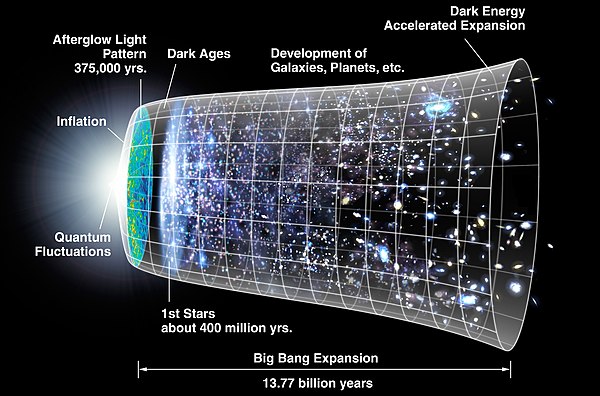
My response would be that the Universe came into being so long ago that there is no solid evidence remaining that it “just happened”. Your average materialist cosmologist (I’m not talking the MENSA candidates here, I’m not sure I would understand anything they had to say.) might have a some trouble if I asked them, "What 'went Bang!' in the Big Bang?"

The standard explanation is: it started with “the Universe [at] an infinite density and temperature at a finite time in the past.” (Hawking, S.W.; Ellis, G.F.R. (1973). The Large-Scale Structure of Space-Time. Cambridge University Press. ISBN 0-521-20016-4.)

This doesn’t answer the question of where the Universe at that density and temperature came from; but cultures can’t explain where God came from, either. Science demands that something be observable and that any experiment be repeatable. We take God on faith. Since none of us was there, we can’t go there and we have no observational records from there, both sides on this one must call it a draw, quit arguing and agree that if you want to believe in God, then God made everything. If you want to assign causality to Nature, then Nature made everything.

End of part one.

Comments?

October 17, 2007

CHRISTIANITY -- ANTHROPOCENTRIC OR UNIVERSAL II: God Appears To Have Disappeared From Science Fiction (B)

Five years ago, I started pondering this question and people have clicked on this essay nearly a thousand times, making it the single most-viewed thing I’ve ever posted. I’d like to continue thinking out loud on the issue now that I’m older and the world has changed a bit...

First a couple of definitions: (taken from a google search, specific sites available on request)

anthropocentric: with a human bias, considering humans the center of the universe; regards the human as being the central fact or final aim of the universe; the idea that humans are the most important beings in the universe; human-centered; for humans, humans must be the central concern and humanity must judge all things accordingly

universal: applicable or common to all members of a group or set; adapted to various purposes, sizes, forms or operations; a universal “type”, a property or a relation; pertaining to all, especially all times, all places and all things

First the accusation: Christianity is anthropocentric. I would argue that rather than being anthropocentric, the BIBLE is anthropospecific. It was a message from God directed to humans using metaphors and symbolism with which we are familiar. There is nowhere in the Bible that speaks to Jesus being the exclusive property of humanity. In fact, John 10:16 can be used to argue quite the opposite (it’s been used to argue Joeseph Smith’s message from the angel Moroni as well as ultimate salvation of all people in all religions). “And other sheep I have, which are not of this fold: them also I must bring and they shall hear my voice and there shall be one fold and one shepherd.” (KJV). Another part of the argument is that Jesus was a human, so he can’t represent any other alien KPCOFGS (Kingdom, Phylum…). But out of SF, the response must be obvious: is Odo human? Is Paul Muad’Dib human? Is R. Daneel Olivaw human? No – merely human on the outside. Their essence is decidedly NOT human. While Jesus was obviously human on the outside, was he essentially human? The answer to this is “yes” He is human. It is also “yes” He is God. Frank Herbert allowed that in DUNE, Paul Muad’Dib was both human and god-emperor – and I agree. So Jesus could represent all sentient life in the universe – there’s nothing in the Bible that says He is only “for” humanity.

Genesis 2:1 gives some evidence that Jesus is for all intelligent life: “Thus the heavens and the earth were completed in all their vast array…” Not “the earth in its vast array” – but the heavens as well. God created it all, declared it all good (Genesis 1:8), cares for it all (Romans 8:38-39) and sent His Son to save it all (John 3:16 – NOTE: the English word here “world” is actually translated from the Greek word “kosmon”, the same root word as the English “cosmos”…which we use interchangeably with “universe”. No mistake here, but a different emphasis makes a real difference.)


September 22, 2007

CHRISTIANITY -- ANTHROPOCENTRIC OR UNIVERSAL? II: God Appears To Have Disappeared From Science Fiction (B)

Five years ago, I started pondering this question and people have clicked on this essay nearly a thousand times, making it the single most-viewed thing I’ve ever posted. I’d like to continue thinking out loud on the issue now that I’m older and the world has changed a bit...

In discussing this entry with various people, I've come to the conclusion that I'm not making myself clear.

When I talk about Christianity disappearing in space, I'm talking about the observations that I've made in the reading I've done. I'm a member of Science Fiction and Fantasy Writers of America and am currently on the Norton Award Committee. As part of that group, we read and recommend new SF and F written specifically for middle school/high school/early college aged young people. So far, out of over a hundred novels I've read or previewed, only one character has been a professing Christian. The others curse, talk to gods, goddesses and other minor deities and engage in any number of normal, mundane things -- but they don't appear to be Christians.

Don't get me wrong, it's not amazing to me that author's biases, beliefs, and orientations -- their personalities -- come out in their writing. Someone once made a comment that eventually became an aphorism, "Want to be a writer? Just open up a vein and bleed." An author's philosophy of life becomes clear when we read their writing.

C.S. Lewis, my favorite writer, observed, "We can make people (often) attend to the Christian point of view for half an hour or so; but the moment they have gone away from our lecture or laid down our article, they are plunged back into a world where the opposite position is taken for granted. As long as that situation exists, widespread success is simply impossible. We must attack the enemy's line of communication. What we want is not more little books about Christianity, but more little books by Christians on other subjects with their Christianity latent." (GOD IN THE DOCK)

What I am talking about is that evangelical Christians (or for that matter, evangelical Buddhists, Hindus or Confucianists) have either a) made little or no effort to write stories and novels with latent faith -- or b) Christianity is being supressed by evangelical atheists in the SF/F world. (c) is a hard one for me to consider, but here it is: that Christians, Muslims and Taoists all write bad SF/F. It's possible but on the face of it, unlikely. After all, despite Philip Pullman's rants, people still read Tolkein and Lewis more often than they read him and both of them are Christians.)

Christianity will NOT disappear from space. Christians will "boldly go where no one has gone before" -- as will Muslims, Hindus, Buddhists and atheists. Christian writers need to write GOOD science fiction with Christianity latent in every story. Atheist/agnostic editors and publishers need to quit panicking in fear that publishing stories with Christians in them will somehow undermine their atheist or agnostic beliefs and quit pretending that Christianity (and other faiths) will somehow disappear when the real exploration of the Universe begins. They need to be bold in their willingness to look at futures that might include faiths other than insipid atheism or militant agnosticism...

Image:  http://coto2.files.wordpress.com/2011/04/2001-oddity.jpg