Showing posts sorted by relevance for query Humor. Sort by date Show all posts

September 30, 2023

POSSIBLY IRRITATING ESSAYS (PIE, Get it?): Trying To Write Funny Is Serious Business!

On October 7, 2007, I started this blog. Sixteen years later, I am revising and doing some different things with my blog. My wife and I are now retired senior citizens, our kids are both married, we have a bonus daughter and her wife and we have three grandchildren, the oldest of which just became a teenager. I have forty-five professional publications, plus countless other publications as a slushpile reader, and sometime essay contributor to Stupefying Stories https://stupefyingstories.blogspot.com/.

These days, I write whenever I want to – or when I’m not busy exploring the world with my wife or kids or grandkids. I write, read constantly. Then I discovered that I was writing longer and longer pieces. My new focus is to write shorter; and to write HUMOR. On purpose. Maybe I can still irritate people while being funny. It works pretty well for John Scalzi! We’ll see what happens.


So, all I can do here is talk about the humorous SF I have read and attempted to write. I wrote this on February 18, 2018 – nearly six years ago. I was (if you check to the right of the column here) still nine stories from my total thus far. Of the ones published, only one could be considered an attempt at humor – that was “Doctor To the Undead” was somewhat humorous, but also had a serious point. Read it if you haven’t and let me know if I balanced the funny with the un-(funny, that is). https://stupefyingstories.blogspot.com/2021/08/doctor-to-undead-by-guy-stewart.html

This was supposed to be funny, too! It was called “Bogfather”: (https://stupefyingstories.blogspot.com/2017/12/today-on-showcase.html) Intended to be a play on words using a drifting bog island in northern Minnesota as a setting…it was supposed to reflect the lives of typical lake cabin owners here. As there have been no rave reviews (or even any comments, for that matter, though people HAVE stopped at it 410 times. Those can’t ALL be accidents!). I have to assume that the humor was lost on anyone but me (and maybe Bruce Bethke…).

But what IS humor – putting speculative fiction aside for a moment – and is it definable and something that can be intentionally created? One definition: “the tendency of particular cognitive experiences to provoke laughter and provide amusement”. To me, this means that how you evaluate an experience forces you to either make a barking sound or feel something (probably pleasant).

Ah! Here’s a REALLY helpful theory of what humor is, it’s even “endorsed by Peter McGraw [an associate professor of Marketing and Psychology at the University of Colorado Boulder], attempts to explain humour's existence. The theory says ‘humour only occurs when something seems wrong, unsettling, or threatening, but simultaneously seems okay, acceptable or safe’.” (Wikipedia)

I’ve written on humor in speculative fiction before. In the article (http://faithandsciencefiction.blogspot.com/search?q=Humor), I noted, “I have a COMEDY WRITING SECRETS book; I read THE HUMOR CODE)…I’m a funny guy. I’ve read collections of science fiction humor, too like ANALOG Science Fiction and Fact’s THE FUNNY SIDE (an old collection) and the Kelvin Throop III stories. Of course, I’ve read all of Spider Robinson’s CALLAHAN’S CROSS TIME SALOON books.” Also, here: http://faithandsciencefiction.blogspot.com/2017/05/possibly-irritating-essay-laughing.html; and here http://faithandsciencefiction.blogspot.com/2014/03/slice-of-pie-james-thurber-o-henry-mash.html; and here http://faithandsciencefiction.blogspot.com/search?q=Humor

I love to laugh, and my humor of choice is slapstick. I LOVE a good pratfall! My wife and I thoroughly enjoyed watching Despicable Me 3 – which is just one sight gag after another. I spent most of the movie laughing out loud. I should just say that she doesn’t REALLY get it. Her sense of humor is much more subtle than mine is. She enjoys the cerebral humor of M*A*S*H (which I do as well) and the movies made from the Jane Austen books. She likes the gentle humor of Barbara Streisand rather than the slapstick of Ellen DeGeneres.

I made my first sale to ANALOG with a humorous piece called “Absolute Limits” in which I hyper-exaggerated the search for a FTL drive and the tendency of Americans to take speed limits set by law enforcement to be suggestions. “Bogfather”, linked above is funny, as is one I’m shopping around called, “Titan Mission Drops Bomb” (which never hooked anyone, sadly; though I confess that that one is a bit of scatological humor that even I’m uncomfortable with!)

It also happens to be the only story I’ve ever submitted to Daily Science Fiction (recently defunct) that made it into the “Hold for further consideration” category, so maybe I’m finally getting close. So far, though, (updated), I don’t seem to be. I have a humorous piece at NATURE FUTURE that was both intentionally written to be humorous AND had an interesting science fiction idea in it as well.

I’m continuing to study humor as well as flash fiction. I think the two make a decent pair: HUMOR – Techniques To Tickle the Funny Bone (Donna Cavanaugh); THE DEER ON A BICYCLE (Patrick McManus); THE ART OF BREVITY (Grant Faulkner, “Why yes, is IS related to THAT Faulkner!”). I’ve waiting in the wings a collection of humorous SF stories collected in THIS IS MY FUNNIEST, (Isaac Asimov, Connie Willis, Josepha Sherman, and David Brin, and many others). And lastly; HAPPY TO BE HERE (Garrison Keillor, local superstar and comedian).

So, as I quest, I’ll keep y’all updated. And if you’d like, read the stories and articles I linked above! Maybe my stuff will be funny – maybe you’ll learn something about writing humor!

Inspiration: Humorous SF Fiction Lists: https://theportalist.com/13-science-fiction-books-that-will-tickle-your-funny-bone, https://www.tor.com/2016/07/14/in-praise-of-humor-in-fantasy-and-science-fiction/, https://best-sci-fi-books.com/19-funniest-science-fiction-books/, http://dailysciencefiction.com/hither-and-yon/humor, http://greatsfandf.com/humorous-books.php

And this is a REAL list!: https://io9.gizmodo.com/5950437/the-best-science-fiction-and-fantasy-novels-to-cheer-you-up-when-youre-feeling-blue, https://alexshvartsman.com/ufo-unidentified-funny-objects/, https://www.goodreads.com/list/show/4967.Best_Humorous_Fantasy_and_Science_Fiction_
Image: 

September 2, 2023

POSSIBLY IRRITATING ESSAYS: Alien Humor? "Foipiargnaaadi"

On October 7, 2007, I started this blog – and NO, I’M NOT DONE BLOGGING!!! – I’d just hit the half-century mark, and I had nine professional publications. My son was 20, my daughter 16; and my wife and I had celebrated our 21st wedding anniversary two months earlier.

Today, August 31, 2023, sixteen years later, I am revising and doing some different things with my blog. My wife and I are now retired senior citizens, our kids are both married, we have a bonus daughter and her wife and we have three grandchildren, the oldest of which just became a teenager. I have forty-five professional publications, plus countless other publications as a slushpile reader, and sometime essay contributor to Stupefying Stories (https://stupefyingstories.blogspot.com/). These days, I write whenever I want to and I’m not busy exploring the world with my wife or kids or grandkids. I’m working on my writing, reading constantly, and because I discovered that was writing longer and longer pieces, I thought I might focus on saying what I need to say in fewer words. I also discovered that I CAN’T write humor, even though I can TALK humor (several people will attest to that; the biggest proof is that I can make most of a room of 30 middle-schoolers laugh at something I’ve intentionally set up.


My GOAL is to learn to write short humor. To that end, I’ve been both reading about humor and trying my hand at writing short humor pieces. So, I’ll be posting both musings on humor and experiments in writing science fiction humor here from time to time. Today is one of those times.

I think our sense of humor makes us Human…and that ALL OF US play with language in order to make ourselves laugh. Take for example the silly words we create.

HOBBIT: The vast majority of those of you reading this know that this word is a pronoun denoting a very specific imaginary being as depicted in JRR Tolkien’s LORD OF THE RINGS novels. He invented the word.

NARNIA: A large number of you know that this is a proper noun attached to an imaginary land found in the works of English author, C. S. Lewis. He invented the word.

PERN: Many of you know that this is an acronym from an interplanetary survey done by a future Humanity imagined by Anne McCaffrey. It stands for Parallel Earth Resources Negligible. For some of us, that abbreviation explodes into memories of a world colonized by Humans seeking a simpler, agrarian existence on an alien world inhabited by nothing that seemed capable of harming us. Fate of course constantly surprises – and Pern was a cyclical victim of an alien plague that jumped from an eccentrically orbiting moon. Humans had to bioengineer a creature to combat these “threads”. From tiny, harmless flying lizards who could also teleport themselves when face with grave danger; Humans gengineered telepathic dragons…

FOIPIARGNAAADI: None of you will recognize this as a word meaning something like “the humorous power of made up words”. That’s because myself, my wife and four young adults (two of them related to us, two of them not) invented it one night playing an impromptu game of SCRABBLE®. We even invented a grammar: the triple “a” pluralizes the word and the suffix “di” feminizes the noun. Why did we do this then conclude the game with gales of laughter?

I think it’s because on Earth, language (and the humor it creates) is innate and perhaps even unique to Humans. Don’t get me wrong. Every living thing communicates. There are levels of communication as well. Few people would question that flax plants and flatworms communicate differently than orcas and octopi.

There is good evidence that certain animals have a sense of humor: Dogs, meerkats and rats laugh…chimpanzees, bonobos, gorillas and orangutans do, too. Chimpanzees and bonobos, our closest relatives, have the most human-like laughter. The Dogs of Spokane laugh, as do ravens and dolphins – at least provisionally. However, I think I’m safe in saying that two adult chimpanzees with four young adult chimpanzees in a safe environment at a Primate Research Center somewhere; would be unlikely to make up a word, create a simple grammar then find the whole thing amusing.

I contend that it is the “spark of the divine” (aka God) in us that gives Humans the ability to use language of extreme complexity. In the Bible, Numbers 22 tells the tale of a man who was beating his donkey who had refused to walk past an angel because it recognized that the angel was about to kill the man. The man’s name was Balaam. In the end, the angel granted the donkey the ability to speak to the man. Even the rankest “animals-are-the-same-as-humans” activist and those who believe that animals deserve all the protection granted humans under law, would find it hard to credit this story as fact. At best, I could muster up enough BELIEF to grant that it might be possible. Even so, when talking about having a sense of humor, there are more complex ways to communicate and simpler ways to communicate.

Humor is communication at its most complex and least understood. “What makes us special is the range and amount of laughter we seek and produce, which in large part stems from our unique evolution, as well as our culture. Indeed, as Martin writes: ‘…being able to enjoy humor and express it through laughter seems to be an essential part of what it means to be human.’” (SURVIVAL OF THE FUNNIEST)

It is the complexity of humor that separates us from the animals. While it’s been said that “a monkey hitting keys at random on a typewriter keyboard for an infinite amount of time will almost surely type a given text, such as the complete works of William Shakespeare.” (The Infinite Monkey Theorem: http://en.wikipedia.org/wiki/Infinite_monkey_theorem ), the same article goes on to explain that the obvious meaning isn’t the significant meaning of this statement. Monkeys aren’t going to write “Much Ado About Nothing” because monkeys aren’t Human. I suppose, though that it might be that monkeys would write a MONKEY equivalent of “Much Ado About Nothing” – but would a Human find it funny?

If or when we meet sapient aliens, will we be able to share a sense of Humor? I suppose that the family of STAR TREK aliens might be able to. Supposedly Humans, Cardassians, and Klingons – and at the end of the episode, Romulans, implying that Vulcans, Ferengi, Bajorans, Tellarites, Andorians, and all other Humanoids in and near the Federation are descended from a single race of sapient aliens who “seeded our” part of the galaxy with their DNA. It makes sense that Klingons and Humans can laugh together; certainly that Cardassians and Humans can forge relationships based on humor, and while Vulcans and Humans don’t “laugh together” per se, they can certainly share a sense of humor.

All this to say that we play with language in order to make ourselves laugh. It MAY be possible, but unlikely that Humans and aliens can EVER share a laugh, though I suppose they MAY share some sort of alcoholic (or its metabolic equivalent) beverage that would ease relationship tensions.

I am working at being able to WRITE funny for my fellow Humans – whose to say that an alien wouldn’t find my writing funny!

Sources: https://english.elpais.com/science-tech/2023-07-29/do-animals-have-a-sense-of-humor-this-scientist-has-been-tickling-rats-for-years-to-prove-it.html, https://exploringyourmind.com/do-animals-have-a-sense-of-humor-science-says-yes/, https://www.smallanimalplanet.com/the-science-behind-animal-laughter-do-animals-have-a-sense-of-humor/, Survival of the Funniest: A review of Rod Martin, Psychology of Humor: An Integrative Approach https://journals.sagepub.com/doi/pdf/10.1177/147470490800600111 Image: https://cdn.mos.cms.futurecdn.net/qWigLxdUzjXa6hmKdQGGuY.jpg

July 17, 2016

POSSIBLY IRRITATING ESSAYS: Writing Fantastic Humor…

Using the panel discussions of the most recent World Science Fiction Convention in Spokane, August 2015, I will jump off, jump on, rail against, and shamelessly agree with the BRIEF DESCRIPTION given in the pdf copy of the Program Guide. This is event #4198. The link is provided below…

Humor in Teen and Middle Grade Fiction Humor within young adult and middle grade fiction is abundant. What is it about the bending of these genres with humor that works so well? Why are we drawn to tales that make us laugh? Our panelists take a walk on the lighter side of speculative fiction for children and teens as they dish about their favorite authors, books, and stories. Frog Jones (m), Gail Carriger, Kaja Foglio, Nichole Giles

First of all, what do the participants know about humor in YA/MG speculative fiction?

Frog & Esther Jones – authors of the Grace series. Check
Gail Carriger – author of the Parasol Protectorate series. Check.
Kaja Foglio – author of the Agatha Heterodyne and the… series. Check. (She also does the art for Magic: The Gathering cards!)
Nicole Giles – YA writer, but as far as I can see, nothing funny…she’ll get a check, too.

So these folks know what they’re talking about.

I still can’t pull off written humor. I CAN make people laugh, though I’m not what you’d call a funny guy (get it?). I get laughs by doing word play, funny voices, physical humor, and timing comments – none of these seems to translate well into writing. If you think about it, The Three Stooges, or Jim Carey in LIAR, LIAR would have been hard to put into words. Though I suppose they were written somewhere – or were they “extemporaneous”?

As a guidance counselor at a near-inner-city (ie: 10% of our students are bussed in from a major metropolitan inner city district; poverty rate as measured by recipients of free or reduced lunches is about 45%) I KNOW my kids love to laugh. Race doesn’t matter when it comes to teens laughing. If you can get them to smile, even in a bad situation, they tend to feel better. I’m good at that.

But I suck at writing humor. I CAN do one or two funny situations, but on balance, my writing is pretty serious.

OTOH, I know humor writer Gordon Korman. His books are ALL funny! But he’s never won a major award – let me amend that: he’s never won a major award from ADULTS. Kids pick him all the time. What does that say? (He does write speculative fiction, too – the Nosepickers From Outer Space are right up there!) I could guess, but I’ll leave that action to you.

I have a COMEDY WRITING SECRETS (https://www.amazon.com/Comedy-Writing-Secrets-Best-Selling-Think/dp/1582973571/ref=sr_1_3?s=books&ie=UTF8&qid=1468770151&sr=1-3&keywords=How+To+Write+Comedy) book; I read THE HUMOR CODE (https://www.amazon.com/Humor-Code-Global-Search-Things/dp/1451665423/ref=sr_1_3?s=books&ie=UTF8&qid=1468770086&sr=1-3&keywords=international+humor+study); and like I said, I’m a funny guy. I’ve read collections of science fiction humor, too like ANALOG Science Fiction and Fact’s THE FUNNY SIDE (an old collection) and the Kelvin Throop III stories. Spider Robinson’s CALLAHAN’S CROSS TIME SALOON books.

But I can’t seem to make it work. Why? Am I not funny enough?

Did these people reveal the formula for writing speculative humor novels for teens and middle grade readers.

Probably – it’s just that I wasn’t there.

What does the internet say? Lots of things, so I’ll leave you with this – and I’ll start working with it as well and update you in the future. Accordingly: “J. K. Rowling, Stephenie Meyer, and Suzanne Collins all use a mix of:

 1) One-liners
2) Awkward situations
3) Fainting scenes

“…to lighten the mood.”

So there you go. What do you think?


February 18, 2018

POSSIBLY IRRITATING ESSAY: Funny Aliens & Humorous Spacemen


Using the Programme Guide of the World Science Fiction Convention in Helsinki Finland in August 2017 (to which I will be unable to go (until I retire from education)), I will jump off, jump on, rail against, and shamelessly agree with the BRIEF DESCRIPTION given in the pdf copy of the Programme Guide. The link is provided below…

Humour in SF: Science fiction and fantasy are serious genres, but of course there are very humorous works as well. Douglas Adams, Terry Pratchett - and many more! Who are the others? Come hear our panelist discuss the lesser well-known humorous SF fiction!

Laura Pearlman: stories have appeared in Shimmer, Flash Fiction Online, Daily Science Fiction, and a handful of other places; her LOLcat captions have appeared in McSweeney's
Phazedout: Irish and Finnish Geek, dwarven singer, wandering podcast writer and bibliophile
Craig Macbride: old science fiction fan
Ian Stewart: popular science writer on mathematical themes, published more than 120 books on a number of different fields of science; The Science of Discworld series with Sir Terry Pratchett and Jack Cohen; two science fiction novels, Wheelers and Heaven, Jack of All Trades, The Living Labyrinth (with Tim Poston)

Must have been a strange session, because as far as I can tell, nobody here has WRITTEN humorous science fiction, fantasy, or horror (of COURSE there’s such a thing. Just watch “The Attack of the Killer Tomatoes”…)

So, all I can do here is talk about the humorous SF I have read and attempted to write.

For example, this was supposed to be funny: http://stupefyingstories.com/ (Scroll to December 6, 2017…) It was called “The Bogfather”. It was intended to be a play on words using a drifting bog island in northern Minnesota as a setting…

As there have been no rave reviews (or even any comments, for that matter), I have to assume that the humor was lost on anyone but me (and maybe Bruce Bethke…).

But what IS humor – putting speculative fiction aside for a moment – and is it either definably or is it something that can be intentionally created?

One definition: “the tendency of particular cognitive experiences to provoke laughter and provide amusement”. To me, this means that how you evaluate an experience forces you to either make a barking sound or feel something (probably pleasant).

Ah! Here’s a REALLY helpful theory of what humor is, it’s even “endorsed by Peter McGraw [an associate professor of Marketing and Psychology at the University of Colorado Boulder], attempts to explain humour's existence. The theory says ‘humour only occurs when something seems wrong, unsettling, or threatening, but simultaneously seems okay, acceptable or safe’.” (Wikipedia)

I’ve written on humor in speculative fiction before. In the article (http://faithandsciencefiction.blogspot.com/search?q=Humor), I noted, “I have a COMEDY WRITING SECRETS book; I read THE HUMOR CODE)…I’m a funny guy. I’ve read collections of science fiction humor, too like ANALOG Science Fiction and Fact’s THE FUNNY SIDE (an old collection) and the Kelvin Throop III stories. Spider Robinson’s CALLAHAN’S CROSS TIME SALOON books.” Also, here: http://faithandsciencefiction.blogspot.com/2017/05/possibly-irritating-essay-laughing.html; and here http://faithandsciencefiction.blogspot.com/2014/03/slice-of-pie-james-thurber-o-henry-mash.html; and here http://faithandsciencefiction.blogspot.com/search?q=Humor

I love to laugh, and my humor of choice is slapstick. I LOVE a good pratfall! My wife and I just finished watching Despicable Me 3 – which is just one sight gag after another. I spent most of the movie laughing out loud.

I should just say that she doesn’t get it. Her sense of humor is much more subtle than mine is. She enjoys the cerebral humor of M*A*S*H (which I do as well) and the movies made from the Jane Austen books. She likes the gentle humor of Barbara Streisand rather than the slapstick of Ellen DeGeneres.

I made my first sale to ANALOG with a humorous piece called “Absolute Limits” in which I hyper-exaggerated the search for a FTL drive and the tendency of Americans to take speed limits set by law enforcement to be suggestions. “Bogfather”, linked above is funny, as is one I’m shopping around called, “Titan Mission Drops Bomb”; though I confess that that one is a bit of scatological humor that even I’m uncomfortable with!

It also happens to be the only story I’ve ever submitted to Daily Science Fiction that made it into the “Hold for further consideration” category, so maybe I’m finally getting close.

At any rate, as no one in this group actually wrote humorous speculative fiction (at least as far as I can tell), I guess I didn’t miss anything…


August 20, 2022

POSSIBLY IRRITATING ESSAY: Is It REALLY POSSIBLE To Write Humorous Science Fiction? (And HOW Can I Do It????)

NOT using the Programme Guide of the 2021 World Science Fiction Convention, DisCON III, which I WOULD have been attending in person if I felt safe enough to do so in person AND it hadn’t been changed to the week before the Christmas Holidays…I WILL NOT use the Programme Guide to jump off, jump on, rail against, or shamelessly agree with the BRIEF DESCRIPTION given in the pdf copy of the Program Guide. This explanation is reserved for when I dash “off topic”, sometimes reviewing movies, sometimes reviewing books, and other times taking up the spirit of a blog an old friend of mine used to keep called THE RANTING ROOM…


While biking out to the Tessman Farm this morning, I stumbled onto a truth that I had never realized before: my favorite stories are a weird combination of science fiction (hard SF often, softer SF sometimes, and more-often-than-not having aliens) plus a bit of a mystery plus humor. What I just discovered, is that since I wrote and posted my first Possibly Irritating Essay in June of 2007 (fifteen years ago!), I’ve written about HUMOR often. Why is that? Because I love to laugh and I love to make people laugh!

I’m good with verbal humor. I’m able to make my students laugh…but honestly? I’ve never analyzed my humor; nor have I successfully applied what I know about making people laugh to my WRITING! Or, as my 12-year-old grandson is fond of saying these days, “Or DO you????”

So, let me analyze my writing and see if I MIGHT have figured it out and just don’t realize it – or if I don’t have any idea what I’m doing and turn to writing hack-and-slash horror stories. I think I’ve gotten the hard SF part down – with seven stories published in ANALOG Science Fiction and Fact (plus one more coming out in the November/December 2022 issue), as well as another nineteen in various other professional and/or semi-professional venues. I think I have a reasonable grip on the mystery as well. My most recent completed novel, THE LEOPARD’S SPOTS, is a straight-up future mystery. Not long before that, I completed and shopped around “The Murder of AutoTech #47269”. I’ve got some mysteries in several of them, like “Mystery on Space Station Courage” and “Road Veterinarian”. Am I consistent yet?

Maybe.

I’ve got the deadly serious concept down pretty well: “A Pig Tale”, “Dear Hunter”, “Firestorm!”, “Oath”, “The Penguin Whisperer”, “Invoking Fire”, “Pigeon”, “Kamsahamnida, America”, are just a few of them.

Hmmm…humor? I think the following stories have definite humorous veneers: “Road Veterinarian”, “Dinosaur Veterinarian” (less so than “Road”), “A Woman’s Place”, “Baptism of Johnny Ferocious”, “The Last Mayan Aristocrat”, “Bogfather”, “Doctor to the Undead” might be humorous (try it here and let me know what you think: https://stupefyingstories.blogspot.com/2021/08/doctor-to-undead-by-guy-stewart.html)

What do the pros have to say?

Regarding Spider Robinson, O’Leary writes: “And for those who underestimate his art, I ask: You think it's easy to make someone laugh?

“Perhaps people condescend because most of Robinson's Art is between the lines, in what Albert Brooks would call "Timing...sayitwithmeTiming."…The way his characters suddenly feel like friends…Robinson's chief speculative leap is to imagine a place where community is possible. And the task he has taken upon himself is to embody the spectrum of Happiness. Now, that may seem a rather hifalutin way of saying he's funny and his books make you feel good. But what Robinson is up to is nothing less than a participatory utopia that a reader enrolls in by reading.

“Robinson himself describes Mike Callahan. ‘Fixed broken brains. Made sad people happy and happy people merry and merry people joyous. Tutored in kindness and telepathy. Smoked hideous cigars. Forgave people. Accessory before and after the pun.’”

“Think of the audacity and courage it takes, in these days of cynical Family Values and jaded Pulp Sensationalism, to create an art about the possibility of Joy. I suspect that's either a dream that terrifies, or a dream so many times broken that it hurts to contemplate.” http://www.spiderrobinson.com/oleary.html )

LOIS MCMASTER BUJOLD is another writer who has mastered the art of subtle humor: “I’ve been reading science fiction since I was nine years old…Eleanor Cameron’s ‘The Wonderful Flight to the Mushroom Planet’…What drew me was the adventure and the humor I occasionally found.’ Randall Garrett was always a good bet. Adventure was offered by too many writers to name, but then as now, smart humor was thin on the ground.” https://awthome.wordpress.com/2010/02/08/an-interview-with-author-lois-mcmaster-bujold/

JOHN SCALZI is obviously a sharp humorist as well as an amazing SF writer. When asked, “‘What role does humor play in your writing?’ he responded: ‘It plays a pretty important role, but it's a role that has to be integrated with everything else you're doing. It's like life -- there are funny parts and then there are the parts that aren't so funny, and you move between the two all the time…putting humor into the mix as part of the events that fuel the plot is a good way to make the reader feel the story has a natural flow. Of course, sometimes it's also fun just to write something, but even when I write something that's in a comic mode, I try to get a mix of other emotional moments in there -- if you go for funny every single second, you're going to burn out your readers.’ https://www.writersdigest.com/improve-my-writing/scalzi-1

CONNIE WILLIS Noted, “Learning to Write Comedy or ‘Why It's Impossible and How to Do It.’

From the beginning, she notes, “Writing comedy is a real pain, made more painful by two persistent myths. The first is that writing comedy is a hoot, something people do for fun when they! While reading comedy may be an amusing experience, writing it is the same pain in the neck as any other kind of writing, only more so.

“The way to learn to write comedy is to watch and read comedies and analyze what you’re watching and reading…writing comic science fiction is no different from writing any other kind of comedy. Which is why I use them as examples along with science fiction writers. After you’ve read a bunch of comedy, you’ll see that why it’s funny. If something is funny it’s due largely to the comic bag of tricks the writer uses and has nothing to do with the situation at hand.” (https://www.scribd.com/document/357893022/Willis-Connie-Learning-to-Write-Comedy)

The Stack Exchange (see link below), notes: “Humor in stories and novels, regardless of genre, is a function of the author's sense of humor, and the traits of the characters in their stories.”

Last of all, from SFWA’s blog, KE Flan had this to say: “Instead, channel real people who make you laugh. Funny people tend to view life through a slightly different lens. Perspective is a tool that’s very much available to a fiction writer. By filtering action through a character, you keep humor in-world rather than impose it. For example, Martha Wells’s “Murderbot” offers us an askew perspective that lends itself well to humor. The key is to ensure the perspective is consistent and nuanced, just as it would be in a real person.”

Hmmm…food for thought. Food for thought…What do you think?

References: https://www.tor.com/2013/07/15/eleven-funny-science-fiction-books/, http://www.ufopub.com/stories-archive/, https://dailysciencefiction.com/hither-and-yon/humor, https://writing.stackexchange.com/questions/46446/sense-of-humor-in-your-sci-fi-stories, https://www.sfwa.org/2022/04/12/i-feel-funny-humor-tips-novelists/, https://www.eldersignspress.com/?p=387, https://www.epicreads.com/blog/funny-science-fiction-books/
Image: http://best-sci-fi-books.com/wp-content/uploads/2016/02/funny.jpg

November 30, 2024

POSSIBLY IRRITATING ESSAYS: Will Aliens Have A Sense of Humor We Can Understand?

On October 7, 2007, I started this blog. Seventeen years later, I am revising and doing some different things with my blog. My wife and I are now retired senior citizens, our kids are both married, we have a bonus daughter and her wife and we have three grandchildren, the oldest of which just became a teenager. I have forty-five professional publications, plus countless other publications as a slushpile reader, and sometime essay contributor to Stupefying Stories https://stupefyingstories.blogspot.com/.

These days, I write whenever I want to – or when I’m not busy exploring the world with my wife or kids or grandkids. I write and read constantly. Then I discovered that I was writing longer and longer pieces. My new focus is to write shorter; and to write HUMOR. On purpose. Maybe I can still irritate people while being funny. It works pretty well for John Scalzi! We’ll see what happens.


I think our sense of humor makes us Human…and that ALL OF US play with language in order to make ourselves laugh. Take for example the silly words we create.

HOBBIT: The vast majority of those of you reading this know that this word is a pronoun denoting a very specific imaginary being as depicted in JRR Tolkien’s LORD OF THE RINGS novels. He invented the word.

NARNIA: A large number of you know that this is a proper noun attached to an imaginary land found in the works of English author, C. S. Lewis. He invented the word.

PERN: Many of you know that this is an acronym from an interplanetary survey done by a future Humanity imagined by Anne McCaffrey. It stands for Parallel Earth Resources Negligible. For some of us, that abbreviation explodes into memories of a world colonized by Humans seeking a simpler, agrarian existence on an alien world inhabited by nothing that seemed capable of harming us. Fate of course constantly surprises – and Pern was a cyclical victim of an alien plague that jumped from an eccentrically orbiting moon. Humans had to bioengineer a creature to combat these “threads”. From tiny, harmless flying lizards who could also teleport themselves when face with grave danger; Humans gengineered telepathic dragons…

FOIPIARGNAAADI: None of you will recognize this as a word meaning something like “the humorous power of made up words”. That’s because some years ago, myself, my wife and four young adults (two of them related to us, two of them not) invented it one night playing an impromptu game of SCRABBLE®. We even invented a grammar: the triple “a” pluralizes the word and the suffix “di” feminizes the noun. Why did we do this then conclude the game with gales of laughter?

I think it’s because on Earth, language (and the humor it creates) is innate and perhaps even unique to Humans. Don’t get me wrong. Every living thing communicates. There are levels of communication as well. Few people would question that flax plants and flatworms communicate differently than orcas and octopi.

There is good evidence that certain animals have a sense of humor: Dogs, meerkats and rats laugh…chimpanzees, bonobos, gorillas and orangutans do, too. Chimpanzees and bonobos, our closest relatives, have the most human-like laughter. The Dogs of Spokane laugh, as do ravens and dolphins – at least provisionally. However, I think I’m safe in saying that two adult chimpanzees with four young adult chimpanzees in a safe environment at a Primate Research Center somewhere; would be unlikely to make up a word, create a simple grammar then find the whole thing amusing.

I contend that it is the “spark of the divine” in us that gives Humans the ability to use language of extreme complexity. In the Bible, Numbers 22 tells the tale of a man who was beating his donkey who had refused to walk past an angel because it recognized that the angel was about to kill the man. The man’s name was Balaam. In the end, the angel granted the donkey the ability to speak to the man. Even the rankest “animals-are-the-same-as-humans” activist and those who believe that animals deserve all the protection granted humans under law, would find it hard to credit this story as fact. At best, I could muster up enough BELIEF to grant that it might be possible. Even so, when talking about having a sense of humor, there are more complex ways to communicate and simpler ways to communicate.

Humor is communication at its most complex and least understood. “What makes us special is the range and amount of laughter we seek and produce, which in large part stems from our unique evolution, as well as our culture. Indeed, as Martin writes: ‘…being able to enjoy humor and express it through laughter seems to be an essential part of what it means to be human.’” (SURVIVAL OF THE FUNNIEST)

It is the complexity of humor that separates us from the animals. While it’s been said that “a monkey hitting keys at random on a typewriter keyboard for an infinite amount of time will almost surely type a given text, such as the complete works of William Shakespeare.” (The Infinite Monkey Theorem:

http://en.wikipedia.org/wiki/Infinite_monkey_theorem ), the same article goes on to explain that the obvious meaning isn’t the significant meaning of this statement. Monkeys aren’t going to write “Much Ado About Nothing” because monkeys aren’t Human. I suppose, though that it might be that monkeys would write a MONKEY equivalent of “Much Ado About Nothing” – but would a Human find it funny?

If or when we meet sapient aliens, will we be able to share a sense of Humor? I suppose that the family of STAR TREK aliens might be able to. Supposedly Humans, Cardassians, and Klingons – and at the end of the episode, Romulans, implying that Vulcans, Ferengi, Bajorans, Tellarites, Andorians, and all other Humanoids in and near the Federation are descended from a single race of sapient aliens who “seeded our” part of the galaxy with their DNA. [“…the 20th episode of Star Trek: The Next Generation’s sixth season, “The Chase,” in which Picard and crew discover pieces of a computer program hidden inside the DNA of species from dozens of different planets.”]

It makes sense that Klingons and Humans can laugh together; certainly that Cardassians and Humans can forge relationships based on humor, and while Vulcans and Humans don’t “laugh together” per se, they can certainly share a sense of humor.

All this to say that we play with language in order to make ourselves laugh. It MAY be possible, but unlikely that Humans and aliens can EVER share a laugh, though I suppose they MAY share some sort of alcoholic (or its metabolic equivalent) beverage that would ease relationship tensions.

I am working at being able to WRITE funny for my fellow Humans – whose to say that an alien wouldn’t find my writing funny?

Sources: https://english.elpais.com/science-tech/2023-07-29/do-animals-have-a-sense-of-humor-this-scientist-has-been-tickling-rats-for-years-to-prove-it.html, https://exploringyourmind.com/do-animals-have-a-sense-of-humor-science-says-yes/, https://www.smallanimalplanet.com/the-science-behind-animal-laughter-do-animals-have-a-sense-of-humor/, Survival of the Funniest: A review of Rod Martin, Psychology of Humor: An Integrative Approach https://journals.sagepub.com/doi/pdf/10.1177/147470490800600111
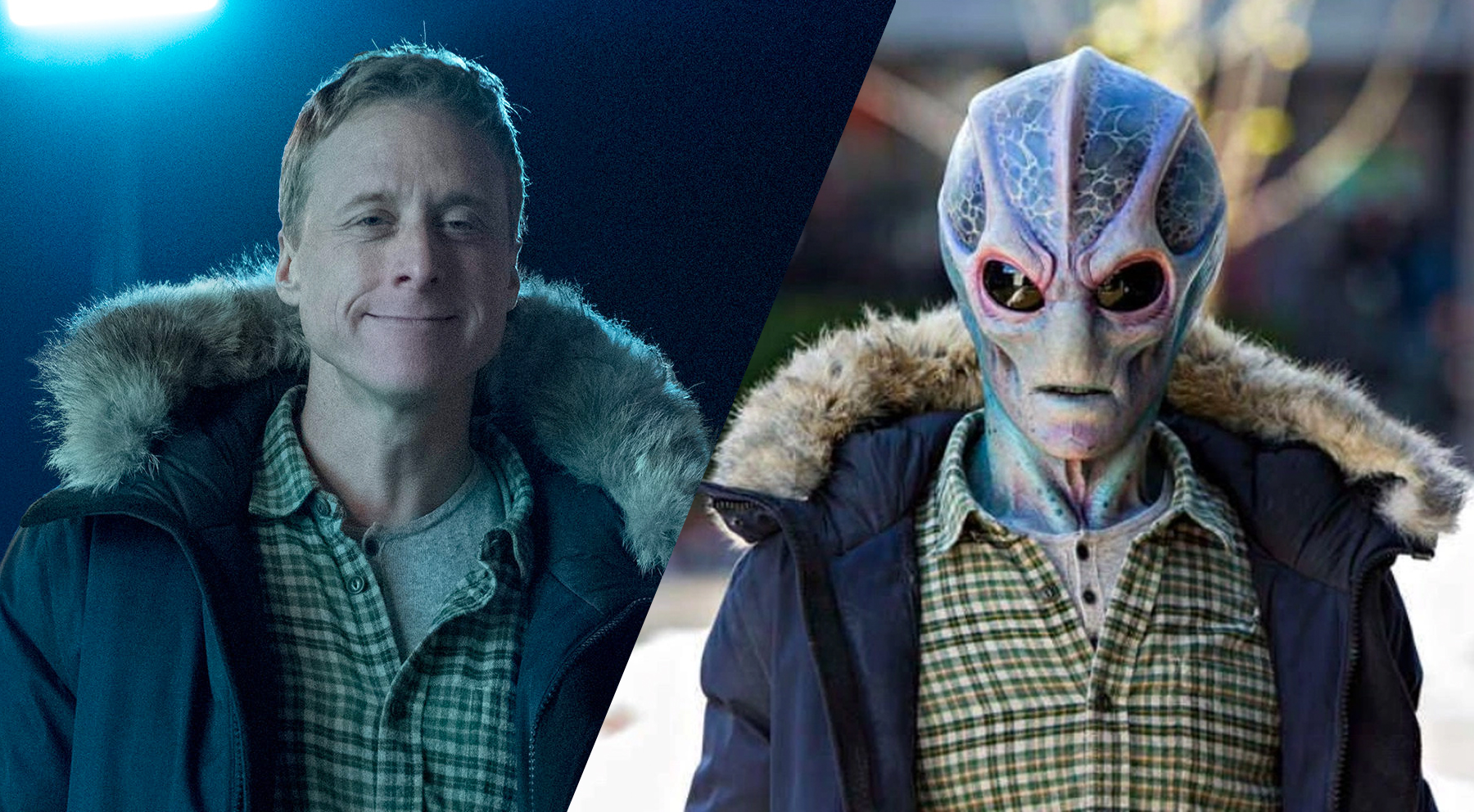
Image: https://static1.cbrimages.com/wordpress/wp-content/uploads/2024/04/resident-alien-harry-and-joseph-laughing.jpg

May 14, 2017

POSSIBLY IRRITATING ESSAY: Laughing Aliens and Dragons

Using the panel discussions of the most recent World Science Fiction Convention in Kansas City in August 2016 (to which I was invited and had a friend pay my membership! [Thanks, Paul!] but was unable to go (until I retire from education)), I will jump off, jump on, rail against, and shamelessly agree with the BRIEF DESCRIPTION given in the pdf copy of the Program Guide. This is event #2600. The link is provided below…

Truly, Madly, Funny: SF That Makes Us Smile: Although the humorous SF or fantasy story is often said to be a rarity, there are numerous authors who write funny tales all of kinds. Living post-Pratchett, where can you go for your humor requirements, and what makes us laugh?

Alex Shvartsman –  A person I “met” in the CODEX Online Writers Group I’m a member of and editor of (oddly!) UFO Magazine – Unidentified Funny Objects
David Gerrold (M) – Author of THE funniest Star Trek ever: “The Trouble with Tribbles”!
Connie Willis – Award-winning SF writer also has a keen and sharp wit – to say nothing of the dog…
Tina Connolly – Also a person I also “met” in the CODEX Online Writers Group I’m a member of and writer of several YA fantasies.
Cynthia Ward – speculative fiction writer and editor/owner of Market Maven…and co-author of an incredibly serious book with Nisi Shaw, WRITING THE OTHER.

By now, I hope you know that I enjoy laughing. I can also make other people laugh. F course, one of the most humorous science fiction writers left us with THE HITCHHIKERS’S GUIDE TO THE GALAXY. Another funny fantasy writer left us with THE DISCWORLD books. These two writers are world-renowned for their sense of humor in their writing.

I’ve read the entire Hitchhiker series at one go (several weeks, but without a break). I’ve only read one of the DISCWORLD books. Of current authors, I loved Scalzi’s REDSHIRTS, and Willis’ TO SAY NOTHING OF THE DOG. Unlisted is Spider Robinson’s CALLAHAN’S series (which I love) and Wrede’s DEALING WITH DRAGONS books; Robert Lynn Aspirin’s PHULE’S Company series; Harry Harrison’s STAINLESS STEEL RAT stories; Lois McMaster Bujold’s VORKOSIGAN saga and Jonathan Stroud’s amazing BARTIMAEUS books.

I know what science fiction and fantasy humor looks like and I like reading it.

But…I haven’t figured out how to WRITE funny.

This would have been a great panel to sit in on. The question I would have asked is if you can “write” funny and not “be” funny…and conversely, can you “be” funny but unable to “write” funny. I’m a funny person. I have been making people laugh for years. I’ve tried writing a few things with a sense of humor – I guess “The Penguin Whisperer” (CRICKET Magazine, January 2013) had a bit of humor in it, but I didn’t try to write it funny – it’s just that penguins can’t help but be funny…and the two kids’ interactions with them, while serious, also had a humorous aspect to them as well. An ANALOG story I wrote that was a takeoff on Clifford D. Simak’s WAYSTATION novel…though almost no one else got it, the editor did!

So then, what are the essential elements of humorous writing?

I own and have read three times Mel Herlitzer’s COMEDY WRITING SECRETS (http://time.com/44168/how-to-be-funny-the-six-essential-ingredients-to-humor/) in which he points out that there are six essentials: target, hostility, realism, exaggeration, emotion, and surprise.

A different article has this to say regarding the elements of humor: (https://www.quora.com/What-are-the-essential-elements-of-comedy) superiority, revelation, incongruous, observational, and imitation  

Another one: (http://dilbertblog.typepad.com/the_dilbert_blog/2007/07/writing-funny.html) simple sentences, about PEOPLE, visual, leave room for imagination, use funny words, animal analogies, exaggerate, near-logic, come back to the first funny thing you wrote.

Four: (http://www.writersdigest.com/qp7-migration-writers-digest-conference/comedy-writing-secrets-excerpt) says imagination & creativity, call attention to yourself, this article quotes the world-famous humorist, Erma Bombeck, “There is a thin line that separates laughter and pain, comedy and tragedy, humor and hurt.”; consistency, and targeted material.

Last: (https://hubpages.com/education/a-few-essential-points-on-the-elements-of-comedy) machine malfunction when a person is working, the person malfunctions while the machine is working; timing, misleading cues, out-and-out trickery (this has to do with timing and letting someone THINK they know the answer then saying something else; make your reader WORK a bit for the humor.

So I’ve quoted five websites directing how to write humor. Are there any commonalities?

machine malfunction when a person is working
the person malfunctions while the machine is working
timing (2x)
misleading cues
out-and-out trickery
imagination (2x)
creativity
call attention to yourself
consistency
targeted (2x)
simple sentences
about PEOPLE
visual
use funny words
animal analogies
exaggerate (2x)
near-logic
come back to the first funny thing you wrote
superiority
revelation
incongruous
observational
imitation
hostility
realism
emotion
surprise

Hmmm…not a good list because there are like 20 things you’re supposed to do. Layer on top of that the fact that you’re using an unfamiliar background (science fiction and fantasy) and you can eliminate some of these:

timing (2x)
out-and-out trickery
creativity
consistency
simple sentences
PEOPLE
visual
exaggerate (2x)
observational
hostility
emotion
surprise

OK…so that’s a bit simpler to work with. I dropped some of the factors from the first lists because when you’re doing science fiction, it’s not about “me” per se. The first two things give me some incredibly interesting ideas…some of the others I eliminated because they were oxymoronic – SF/F is creative and can’t, by definition be “realistic”. Everything in an SF world would be strange, so finding something incongruous would be difficult at best, same goes for misleading cues (in an alien space station, what would be misleading? Everything.) Funny words and animals…confusing because with aliens and their languages…they might be mistaken for animals and their language may ALL sound funny (Example: the farting language, Flatula in TREASURE PLANET. Brilliant, but evidence for my point.)

I’m going to be writing a story to send to Julie Czerneda’s anthology about a place in her immensely popular CLAN CHRONICLES series. There is a murder in it, but the two main characters are going to have a humorous relationship and will do “funny” things. I’m going to take what I’ve learned here and apply it there.

I’ll eventually let you know the outcome!

AFTERNOTE: B&N posted a blog entry about this very subject -- with several NEW authors and novels today! https://www.barnesandnoble.com/blog/sci-fi-fantasy/6-space-operas-explore-comedic-side-cosmos/


May 10, 2026

POSSIBLY IRRITATING ESSAYS: Can I Use SF To Tell Sad Stories With A Sense Of Humor?

On October 7, 2007, I started this blog. Eighteen years later, I am revising and doing some different things. My wife and I are now retired senior citizens, our kids are both married, we have a bonus daughter and her wife and we have three grandchildren, (with a fourth on-the-way!) the oldest of which will soon finish his first year in high school, one smack in the center of Middle School; the third almost done with kindergarten. I have forty-five professional publications, plus countless other publications as a slushpile reader, and sometime essay contributor to Stupefying Stories https://stupefyingstories.blogspot.com/.

These days, I write whenever I want to – or when I’m not busy exploring the world with my wife or kids or grandkids. I write and read constantly. Then I discovered that I was writing longer and longer pieces. My new focus is to write shorter; and to write HUMOR. On purpose. Maybe I can still irritate people while being funny. It works pretty well for John Scalzi! We’ll see what happens.


FOUNDATION FOR THOUGHTS ON WRITING HUMOR: https://www.huffpost.com/entry/why-every-writer-should-t_b_5811562

I just finished reading a second draft of a soon-to-be-published biography called BANANITO: The Lost Boy the Toughest Street Couldn’t Kill…

For those who don’t have a good grip on Spanish (like me!), a bananito is literally, “little banana”, but it became the writer’s name for the rest of the story. He was nine-years-old, tiny, and when his family lost their home and livelihood, they had to live “on the street” in Guatemala City.

What followed was a sad story (duh! Of course it was!) But because I knew one of the people who came later in the story, I kept reading to find out what happened.

Some really horrible – and sometime graphically explained – things happened. Death, murder, abuse, loss, hopelessness…and sometimes hope…happened in quick succession. But it was only quick for me. BANANITO covers some truly horrific events in his relatively short life: the book covers his experiences from 8 to his late teens. As I texted my Famous Friend who encouraged Bananito to write his story, I realized the wisdom and perspective in this book might make a worthwhile foundation for SF stories…

Could I possibly turn such a sad story into something that might not ONLY create a fascinating narrative that takes place on an colony world – but could I make the events and stories similar to those of Bananito’s, and use them as a foundation for stories that take place off Earth AND make people think of the poor, destitute, sick and hurting and inspire them to help change the world through the love and faith in Christ?

OK – that was a very dense sentence! Lemme break it down!

The book was terrifyingly sad.

Also, writers have asked, “If laughter is indeed the best medicine, it may allow us to cope with the trauma of being in the world.” The book was traumatic – certainly for the people who lived through it (my friend as well as Bananito). It was uncomfortable for me. And I have to ask, “What’s funny about trauma?”

That’s the point – there IS nothing funny about child abuse, prostitution, poverty and starvation. But if THEY could laugh: “We laughed because wanting hurt and laughing patched that for a second.” – even in the midst of a horrible life filled with rats, disease, death, and hopelessness, perhaps there might be more ways to laughter. Maybe we can work harder to heal the world’s pain when we can laugh – not AT those who suffer, but WITH those who suffer.

That’s the rub, ain’t it? How can you tell the difference between laughing AT someone and laughing WITH someone? The answer is actually easy: if you feel like crying on the inside and they START it, then you’re laughing with them. If you’re laughing alone and they turn away, then you’re laughing AT them

I saw that as a school counselor. After tears, it wasn’t unbelievable for laughter to follow; sometimes I even initiated it – like by blowing my nose. Or them by farting (you tend to swallow air when you’re crying hard, and your stomach can’t handle it, so…you know…it escapes (also, belches are funny, too!)

If I can mix humor and horror on an alien world, or a nearly-abandoned space station, or – then maybe I can lead people to be interested in helping those on Earth – people we share a world with – if not a continent.

Sounds really difficult. But, but I’m going to start with trying. After that, we’ll see how many people’s feelings I hurt or how many people look at me in horror and ask, “How could you even WRITE that?”

Inspiration: https://faithandsciencefiction.blogspot.com/2019/02/possibly-irritating-essays.html, “Why Every Writer Should Take a Humor Writing Class”
(Whatever or whoever you are, there's one very enjoyable step you can take, right now -- or at least, fairly soon -- to make yourself a better writer: Take a course in humor writing.) (by Siobhan Adcock); https://lithub.com/why-horror-needs-humor/ “Why Horror Needs Humor” (Tyler Malone; 10/31/24)
Science Fiction and Humor (besides HITCHIKER’S GUIDE TO THE GALAXY): https://electricliterature.com/7-new-sci-fi-comedies-you-dont-want-to-miss/ Image: https://t3.ftcdn.net/jpg/14/61/31/10/240_F_1461311036_MViWj3gBpw4LNjp4h0mdikU2gho7a51c.jpg

January 11, 2009

POSSIBLY IRRITATING ESSAYS: Foipiargnaaadi

God gave us humor to make us Human…and we play with language in order to make ourselves laugh. Take for example the silly words we create.

HOBBIT: The vast majority of those of you reading this know that this word is a pronoun denoting a very specific imaginary being as depicted in JRR Tolkien’s LORD OF THE RINGS novels.

NARNIA: A large number of you know that this is a proper noun attached to an imaginary land found in the works of English author, C. S. Lewis.

GROK: Nowhere near as many of you would know that Robert A. Heinlein made up this Martian word to explain a process or state of being somewhat related to “knowing” or “understanding” and the laughter its use engendered in the early 1960s.

FOIPIARGNAAADI: None of you will recognize this as a word meaning something like “the humorous power of made up words”. That’s because myself, my wife and four young adults (two of them related to us, two of them not) invented it one night playing an impromptu game of SCRABBLE®. We even invented grammar! The triple “a” pluralizes the word and the suffix “di” feminizes the noun. Why did we do this then conclude the game with gales of laughter?

I think it’s because on Earth, language (and the humor it creates) is innate and perhaps even unique to Humans. Don’t get me wrong. Every living thing communicates. There are levels of communication as well. Few people would question that flax plants and flatworms communicate differently than orcas and octopi. I think I’m safe in saying that two adult chimpanzees with four young adult chimpanzees in a safe environment at a Primate Research Center somewhere would be unlikely to make up a word, create a simple grammar then find the whole thing amusing.

I contend that it is the “spark of the divine” in us – or bluntly, the hand of God on us – that gives Humans the ability to use language of extreme complexity. In the Bible, Numbers 22 tells the tale of a man who was beating his donkey who had refused to walk past an angel because it recognized that the angel was about to kill the man. The man’s name was Balaam. In the end, the angel granted the donkey the ability to speak to the man. Even the rankest “animals-are-the-same-as-humans” activist and those who believe that animals deserve all the protection granted humans under law, would find it hard to credit this story as fact. So even they must grant that there are more complex ways to communicate and simpler ways to communicate.

Humor is communication at its most complex and least understood. “What makes us special is the range and amount of laughter we seek and produce, which in large part stems from our unique evolution, as well as our culture. Indeed, as Martin writes (p. 3): ‘…being able to enjoy humor and express it through laughter seems to be an essential part of what it means to be human.’” (Evolutionary Psychology www.epjournal.net – 2008.6(1): 90-95 Book Review Survival of the Funniest: A review of Rod Martin, Psychology of Humor: An Integrative Approach. Elsevier Academic Press, Email: Humorology@gmail.com)

It is the complexity of humor, given to us by God that separates us from the animals. While it’s been said that “a monkey hitting keys at random on a typewriter keyboard for an infinite amount of time will almost surely type a given text, such as the complete works of William Shakespeare.” (The Infinite Monkey Theorem: http://en.wikipedia.org/wiki/Infinite_monkey_theorem ), the same article goes on to explain that the obvious meaning isn’t the significant meaning of this statement. Monkeys aren’t going to write “Much Ado About Nothing” because monkeys aren’t Human.

All this to say that God gave us humor to make us Human…and we play with language in order to make ourselves laugh. Which is of course, ancillary evidence for this statement as well: God has a sense of humor… ;-)

November 24, 2019

Slice of PIE: Teen Humor Combatting the Grim Plans of Adults…


Using the Program Guide of the World Science Fiction Convention in Dublin, Ireland in August 2019 (to which I will be unable to go (until I retire from education)), I will jump off, jump on, rail against, and shamelessly agree with the BRIEF DESCRIPTION given in the pdf copy of the Program Guide. The link is provided below where this appeared on page…

You Have To Laugh: Humour in Young Adult Speculative Fiction

What with all the struggles of growing up, finding love, saving the world, and overthrowing dystopias, YA literature has a lot of serious business to take care of. But laughter is an outlet too. Is there room for laughter in YA? What kinds of humour do you find in the genre, how are they used, and is there a generation gap when it comes to what’s funny anyway?

Gail Carriger: YA and A author; well-known.
Ellen Klages: YA, A, historical fiction, SF, F author; well-known.
Sarah Rees Brennan: author; well known.

So – lots of experience here; lots of fun, I’m sure. I’ve never read any of these writers, but I DID order WHITE SANDS, RED MENACE by Ellen Klages from my local library.

However, what I do see is that all of them take speculative fiction aimed at young adult readers seriously.

I do, too. Several published stories target young adults – “Skipping School”, “Biking Mars”, “Prince of Blood and Spit”, “Invoking Fire”, “I Need More Space!”, “Fairy Bones”, “Peanut Butter and Jellyfish”, “Penguin Whisperer”, “Mystery on Space Station COURAGE”, and “Test”. But none of them are specifically humorous.

Not that I can’t make teenagers laugh. I do often as both a teacher and a counselor. But the stories above, while there may be funny moments, don’t actually wield humor as a weapon to break through the armor most young adults build around themselves to protect their growing hearts.

And, yes, I DO believe that.

I’ve got several UNpublished stories that lean more heavily on humor than others – “Alien Swimmer From Otter Space”, “An End To Faerie”, and “Not Quite Blue Boy”.

And while many, many, MANY speculative fiction writers who attempt to writer science fiction lean heavily on slaughtering teens for sport (THE HUNGER GAMES, THE WHITE MOUNTAINS trilogy, the MOON CRASH quartet, and many others), some OLDER science fiction found humor a different lens through which to view the future – not that the SITUATIONS were funny, but the characters have a “snarky”, hopeful outlook rather than resigning themselves to either revolution or destruction.

Heinlein’s HAVE SPACESUIT, WILL TRAVEL is one such. THE EVER EXPANDING UNIVERSE series by Martin Leicht and Isla Neal are newcomers to writers who deal with hard teen problems with humor without resorting to mass slaughter or using teens to solve the world’s problems. READY PLAYER ONE by Eric Cline is another novel that, while it has its dark moments, has a streak of rough humor running through it.

While SF is difficult to write, and given the current “adult view” of adolescents, there’s very little to recommend them to the general reading public, and when teachers and reviewers hold up examples like the dystopian novels I listed above, teens take them in (reading ones do, anyway) and absorb the image adults have of them. (I’ve ranted on this before and most other writers shrugged and said I was making too much of a big deal about it…but everyone who commented was…um…an adult. You can read the rant here: http://www.sfwa.org/2012/07/guest-post-when-did-science-fiction-and-apocalypse-become-interchangeable/).

What young people need is tools to deal with any future they discover. Right now, those futures seems to mostly involve them giving up. What you don’t find is teens rising to meet challenges on other worlds, meeting other intelligences, and forging alliances – nope, that’s for “adult professionals”. It’s also true that middle and high school young people are frequently victims, I have seen countless students rise to meet profound challenges.

I rarely see that resiliency reflected in the SF produced “for them”. In fantast, I see the same thing – HARRY POTTER for instance. The Hogwarts students were the victims of two adults who secretly and overtly manipulated them to reach their own goals. While some adults stood up for the young people, they were mostly swept aside by the more “important” adults. In the prequel movies FANTASTIC BEASTS, the same thing happens to Credence Barebone…

At any rate, my idea for a collection of published and unpublished short stories called MOVING OUT: Tales of Teens Who Left Earth Behind To Explore the Universe! As I noted above? Several of those stories showing those young people making FUN of the universe and the adults who seek to control them. As always, there might be one or two adults who actually CARE about young people, but as always, they remain few and far between and have to watch out for the “important adults” who are watching to see who tries to thwart their desires.


April 17, 2021

Slice of PIE: James Thurber, O. Henry, M*A*S*H & Science Fiction

NOT using the Programme Guide of the 2020 World Science Fiction Convention, ConZEALAND (The First Virtual World Science Fiction Convention; to which I be unable to go (until I retire from education – which I now have!)), I WOULD jump off, jump on, rail against, and shamelessly agree with the BRIEF DESCRIPTION given in the pdf copy of the Program Guide. But not today. This explanation is reserved for when I dash “off topic”, sometimes reviewing movies, sometimes reviewing books, and other times taking up the spirit of a blog an old friend of mine used to keep called THE RANTING ROOM…

James Thurber was a well-known cartoonist and humorous short story writer. Most of his work was published in the New Yorker. Today, he’d be best known for his short story “The Secret Life of Walter Mitty”, which was released as a film starring Ben Stillerl years ago and has become one mf our favorites (though it has little to do with the short story except for the title...). He is still celebrated by “the annual Thurber Prize [which] honors outstanding examples of American humor”.


O. Henry is the pen name of William Sydney Porter. He chose the name – the choosing of which has three different tales but I like this one best! – when he began writing humorous short stories while he was in prison for embezzlement. He kept it and went on to write some 381 other short stories. He is still celebrated by “The O. Henry Award...a prestigious annual prize named after Porter and given to outstanding short stories”. (I wrote an essay about his influence on my writing: https://faithandsciencefiction.blogspot.com/2021/03/writing-advice-short-stories-advice-and.html

What does this have to do with speculative fiction and science fiction in particular?

Unfortunately not much.

From ANALOG, Stan Schmidt collected a few shining examples of humorous SF in ANALOG’S LIGHTER SIDE and BEST OF collections – most notably “The Dread Tomato Addiction”, though it wasn’t strictly a short story and it turned on the idea that you can make statistics say whatever you want them to say. Written by Mark Clifton, it was published in ASTOUNDING in 1958, and when I read it for the first time in left a deep impression on me.

Kelvin Throop was the star of several ANALOG short stories in the 1960s through the 80s and had numerous sayings attributed to him. Invented by R.A.J Phillips, several writers wrote stories about him and he became a sort of fall back for snarky sayings that were space fillers.

The website BestScienceFictionStories.com has more than 80 stories that they consider “Funny” – http://bestsciencefictionstories.com/category/funny/. I just discovered it when I started looking for humorous SF. Other recent forays into speculative short fiction humor come from a writer I first came across in an online writer’s group I’m a member of, CODEX’s Alex Schvartsman. The fifth UNIDENTIFIED FUNNY OBJECTS anthology is due out later this year and while I've tried several times, I guess I'm not able to transfer my moderate sense of humor to the page..

So I KNOW humorous short stuff is being written – but it doesn’t seem that there are many writers who have become closely associated with it any more. Gordon R Dickson and Poul Anderson wrote the Hokas series, Asimov’s sporadic funny stuff, even Haldeman wrote “A !Tangled Web”, Mike Resnick – but no one seems to have emerged as a regularly humorous  writer – and it seems “everyone” has written funny short stories as evidenced by Resnick’s THIS IS MY FUNNIEST: SCIENCE FICTION WRITERS PRESENT THEIR FUNNIEST STORIES EVER in 2006 and 2007.

Yet it doesn’t seem that the awards come to humor. An old friend of mine who is a prolific writer of YA humor (Gordon Korman) has never once been up for a Nebula, a Hugo, a Newbery, a Printz, Morris, Globe-Horn, or ALA Best...because none of the committees believe that serious issues can be dealt with humorously.

I think that this may also be the problem with speculative short fiction as well. When it comes time for the awards to be handed out, people say to themselves, “Wow! That was funny! But serious can’t be funny, so I’d better not nominate/vote for/write something funny because no one will take me seriously.”

Of course, we need only look at the accolades showered on the King of Television Dramedy, M*A*S*H: 12 Emmys, a Golden Globe, a Peabody, a Director’s Guild of America, several Humanitas Prize and Writers Guild of America nominations, an exhibit in the Smithsonian, and one of the highest ratings in the history of the Neilson’s for its final episode. The SF medical drama of James White tries to be funny in his SECTOR GENERAL novels, but the seriousness overwhelms the gentle comedy...where M*A*S*H usually managed to keep the drama and the comedy neatly separated by different story lines...

So where is science fiction’s short fiction version of M*A*S*H, O. Henry, or James Thurber, eh? 

Image: https://i.imgur.com/ZM4fDGk.jpg

March 23, 2014

Slice of PIE: James Thurber, O. Henry, M*A*S*H & Science Fiction


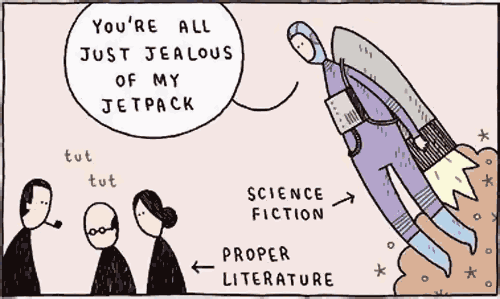
http://www.stevey.com/wp-content/uploads/2008/04/science-fiction-vs-proper-literature.gif
James Thurber was a well-known cartoonist and humorous short story writer. Most of his work was published in the New Yorker. Today, he’d be best known for his short story “The Secret Life of Walter Mitty”, which was recently released as a film starring Ben Stiller. He is still celebrated by “the annual Thurber Prize [which] honors outstanding examples of American humor”.

O. Henry is the pen name of William Sydney Porter. He chose the name – the choosing of which has three different tales – when he began writing humorous short stories while he was in prison for embezzlement. He kept it and went on to write some 381 other short stories. He is still celebrated by “The O. Henry Award...a prestigious annual prize named after Porter and given to outstanding short stories”.

What does this have to do with speculative fiction – science fiction in particular?

Unfortunately not much.

From ANALOG, Stan Schmidt collected a few shining examples of humorous SF in ANALOG’S LIGHTER SIDE and BEST OF collections – most notably “The Dread Tomato Addiction”, though it wasn’t strictly a short story and it turned on the idea that you can make statistics say whatever you want them to say. Written by Mark Clifton, it was published in ASTOUNDING in 1958, and when I read it for the first time in left a deep impression on me.

Kelvin Throop was the star of several ANALOG short stories in the 1960s through the 80s and had numerous sayings attributed to him. Invented by R.A.J Phillips, several writers wrote stories about him and he became a sort of fall back for snarky sayings that were space fillers.

The website BestScienceFictionStories.com has 78 stories that they consider “Funny” – http://bestsciencefictionstories.com/category/funny/. I just discovered it when I started looking for humorous SF. Other recent forays into speculative short fiction humor come from a writer I first came across in an online writer’s group I’m a member of, CODEX’s Alex Schvartsman. The third UNIDENTIFIED FUNNY OBJECTS anthology is due out later this year and I’ve got a story I may submit there.

So I KNOW humorous short stuff is being written – but it doesn’t seem that there are many writers who have become closely associated with it any more. Gordon R Dickson and Poul Anderson wrote the Hokas series, Asimov’s sporadic funny stuff, even Haldeman wrote “A !Tangled Web”, Mike Resnick – but no one seems to have emerged as a regularly humorous  writer – and it seems “everyone” has written funny short stories as evidenced by Resnick’s THIS IS MY FUNNIEST: SCIENCE FICTION WRITERS PRESENT THEIR FUNNIEST STORIES EVER volume one and two.

Yet it doesn’t seem that the awards come to humor. An old friend of mine who is a prolific writer of YA humor has never once been up for a Nebula, a Hugo, a Newbery, a Printz, Morris, Globe-Horn, or ALA Best...because none of the committees believe that serious issues can be dealt with humorously.

I think that this may also be the problem with speculative short fiction as well. When it comes time for the awards to be handed out, people say to themselves, “Wow! That was funny! But serious can’t be funny, so I’d better not nominate/vote for/write something funny because no one will take me seriously.”

Of course, we need only look at the accolades showered on the King of Television Dramedy, M*A*S*H: 12 Emmys, a Golden Globe, a Peabody, a Director’s Guild of America, several Humanitas Prize and Writers Guild of America nominations, an exhibit in the Smithsonian, and one of the highest ratings in the history of the Neilson’s for its final episode.
So where is science fiction’s short fiction version of M*A*S*H, O. Henry, or James Thurber, eh?