February 28, 2010

WRITING ADVICE: Jack McDevitt 11: Forget Pacing – On With The Action!

(The Twelve Blunders are used with permission of Jack McDevitt, from his webpage: http://jackmcdevitt.com/Writers.aspx)


I find it strange that the word “cliffhanger” is both a single word and easily recognizable. As a word-a-holic, I love finding the etymology of words. Here it is: “A cliffhanger or cliffhanger ending is a plot device in fiction which features a main character in a precarious or difficult dilemma, or confronted with a shocking revelation. A cliffhanger is hoped to ensure the audience will return to see how the characters resolve the dilemma. The phrase is believed to come from the end-of-episode situation in adventure silent films of the early 1900s days, with the protagonist literally left hanging from the edge of a cliff, although the oldest usage the Oxford English Dictionary has is from 1937. Some serials end with the caveat ‘To be continued,’ or ‘The End?’ In television series, the following episode usually begins with a recap (a.k.a. ‘previously’).” (http://en.wikipedia.org/wiki/Cliffhanger)


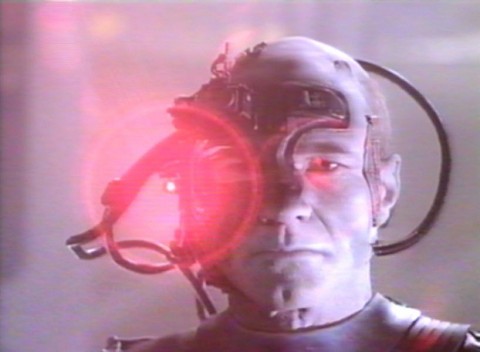
A cliffhanger I remember well was the last moment of STAR TREK: THE NEXT GENERATION, “The Best of Both Worlds”, part I. It aired in Minnesota in early June of 1990 and when Captain Picard abruptly appeared on the screen, his laser implant glaring malevolently from the side of his head, I screamed, slid off the couch and writhed on the floor knowing that I would have to wait until the premier of season 4 in September to find out what happened. Now THAT was a cliffhanger!


As a writing coach for hundreds of young people and dozens of adults, I KNOW the temptation of wanting to keep dragging your reader along behind you with explosion after death after battle after murder after chase scene as they wonder, “What next? What next?” I also know this is the WRONG way to treat your reader. In writing my teen novel, VICTORY OF FISTS (which made the first cut of the Amazon Breakthrough Novel Award ;-)), I decided to break scenes of sometimes intensely violent fights, arguments and life-and-death situations with chapters in which Langston reflected on his life and wrote poetry, pacing the novel and giving readers a chance to breathe.


As in writing, also in life. Most of us know that long periods of terror, trauma or life-drama leave us exhausted, drained. I remember being frozen before the TV on September 11, 2001; unable to tear myself away, horrified and deeply wounded. I was exhausted that night but had trouble sleeping. The unending torrent of images and commentary in the weeks that followed was unrelenting and left me feeling tired and defeated.


As writers, we can’t do that to our readers. We need to give them room to breathe. In his novels, Jack McDevitt does it. His closing line in this blunder is good advice: “…the joy of anticipation is very nearly too much to bear.” The key words here are “very nearly”. Giving breaks makes it possible to bear – and it makes me want to go back.


image from: http://www.ebb.org/bkuhn/img/locutus-of-borg.jpg

February 25, 2010

Amazon Breakthrough Novel Award...


I made the first cut in the Amazon Breakthrough (Young Adult) Novel Award...something over a 1000 people entered the first stage. Amazon folk passed 1000 through to the second. I was one of the people on THAT list...It's a PDF file. You'll find me on page 21 with VICTORY OF FISTS...

http://g-ecx.images-amazon.com/images/G/01/books/ABNA/Young_Adult_2nd_Round_entries.pdf


To read the first two chapters of my novel look to the right and click on the label...

THE RECONSTRUCTION OF MAI LI HASTINGS 11: Outhouse


Daniel Keyes’ FLOWERS FOR ALGERNON: the story has stayed with me for decades, a symbol for both the overwhelming possibilities of the human intellect and the overwhelming impossibilities faced by a profoundly challenged human mind. I’ve started and stopped this novel a half a dozen times in eleven years. I want to bring the original idea into the present millennium. To read RECONSTRUCTION from beginning to here, click on the label to the right and scroll to the bottom.

By the time Mom came home, CJ had been sitting on the floor of the kitchen for three hours and the house was dark.

The kitchen light flicked on, blinding him. Squinting, he looked toward the door and said, “Hey, Mom.”

“Christopher!” she exclaimed as she stepped forward, falling to her knees. She touched him then her eyes swept the room and saw the knife drawer emptied on the floor. “What happened to your face? Were we robbed?”

“She made me tell her where the credit card was and she took it and she’s gone.” He looked up at her. “She’s gone, Mom.”

“Mai Li?”

He nodded slowly, dizzy as his head bobbed. “She said she was leaving this dump. She punched me. Scratched me.”

She touched the scratches hesitantly the. She let herself slide to the floor, staring at the door. “This is all my fault. If I hadn’t…”

“I have to go get her, Mom,” said CJ, struggling to his feet. Clamping his lips together, he waited for a wave of nausea to pass, scrambling instead on hands and knees to the knife drawer.

“You can’t take a knife,” she began.

“I’m not. I’m gonna help pick it up. I can’t go now.” He paused, “But if I don’t leave now, I’ll never be able to catch her.”

“You can’t go after her!” Mom cried from the floor as CJ pulled himself to his feet.

“I know where she’s going.”

“You can’t know that! She’s not the same person she was – she’s someone new. She’s not the Mai Li we know…”

“I know, Mom. But she’s the same deep down,” he insisted, staring at her.

She met his gaze then looked away. “I don’t know, Christopher…”

“She is!” he shouted. He squinted his eyes tightly the side of his face throbbing where she’d slugged him. “She is,” he said more softly. “If I stop believing that, she’ll be gone forever.”

Mom nodded from where she still sat on the floor. Sighing, she asked, “Where is she, then?”

“I think she went back.”

“To Vietnam?”

“No. To her foster family.”

“The Neisen’s?”

He nodded.

“Why would she go there?”

“It’s where she started her life here in the US. Maybe she thinks she remembers them.”

“She was only there for two months before she got here.”

“She lived her first two years in the Vietnamese reeducation camps. The Neisen’s worked there before they brought her back. They know what it was like.”

“Why would she want to know something like that? Those places were horrible.”

“She wants to know her roots.”

“Why?”

“It’s all she has left of her old self.”

“She was born with her handicaps.”

He shrugged. “I think she’s going to the Neisen’s. I have to catch her. Stop her. She doesn’t need to know any of that stuff – and I only know about it because of that school report I did when I was in sixth grade.”

“Do you know where they live?” Mom asked. She twisted slowly and got up on her hands and knees, standing slowly and leaning on the counter. She looked around. “She really called our house a dump?”

CJ nodded. “I love it here, Mom. Don’t worry.”

She sighed and said slowly, “I thought Mai Li did, too. I thought she did, too.”

CJ slid the drawer of knives back into its slot, sighed and said, “I need to go. It’ll be really dark by the time I get there.” Mom’s head fell into her hands and she didn’t say anything as CJ hurried out the door.

February 21, 2010

Slice of PIE: If Scientists Ran the World…

By definition, science is all about experiments. For centuries, scientists have been portrayed in stories, books, in movies and on TV as people who seek the truth by carefully setting up conditions, doing something and then recording what happened.


We expect science to be totally objective.
But what happens when it’s not? Increasingly, as we define our personal world, science reaches farther and farther out in both time and space.
At first, defining our personal world typically involved making observations that were easy to confirm within the lifetime of an individual (for example: blood is pumped by the heart; giving a vaccine prevents certain diseases; the bottom of the Mariana Trench is 11,000 meters below sea level). Other observations, however involved collecting data for more than a single person’s lifetime in order to verify the validity of that observation (the continents are moving; protons, neutrons and electrons are made of smaller particles called quarks; the rings of Saturn are more than a uniform ring, but made of complex strands of orbiting material). Still other observations require far more than a mere two or three hundred years of collected data to confirm.
Of course, that doesn’t mean that scientists can’t use tiny slices of data to prove a point when to draw objective conclusions, it would require a millenium to collect and confirm the conclusion. This lengthy time of observation means that scientists can safely overlook tinier slices of data that don’t suit their needs. It’s this last bit that creates politicians out of scientists.
Most scientists make good scientists but rather poor politicians. Politicians, being who they are, make fine politicians, but equally poor scientists. It is a rare individual who has acumen in both arenas. In fact, Benjamin Franklin is the only person I can think of (after making a cursory Google search) who has successfully navigated both fields.
Today, we have committees of scientists who advise politicians and politicians who support legislation for scientists (the grants presented by the National Science Foundation come to mind). A cozy relationship to say the least. This leads not only to bad politics, but to bad science as well. A brief peek at world history and Germany in the middle of the Twentieth Century is all the farther you need to go to find a possible outcome of this situation. American history has its own science and political history as Googling the Tuskegee syphilis experiment will illustrate.
Science fiction itself contributed to the deeply profound belief that science should be able to influence politics. You need look no farther than Frank Herbert’s DUNE books and you find scientists (as well as religionists) influencing government on all levels. More recent books like Allen Steele’s COYOTE books (he has both scientists and religionists influencing politics) and David Weber’s SAFEHOLD series (again, scientists and religionists struggle for control over the politics of a world). It seems to be a swelling belief that scientists should control the government – at least the decisions of government.
Given the reality of the bedfellowship of science and politics, why don’t we see scientists running for government offices to influence politics directly? Hmmm… Anyone want to try and answer this one?

February 18, 2010

A SHORT LONG JOURNEY NORTH 7: July 4, 1946 -- July 5, 1946

This series is a little biography about my dad and little imagination about a trip my dad took the summer of 1946 – he was almost fifteen. He and friend hitchhiked to Duluth. He says is was “something to do”. I prefer to think there was a more cosmic, mysterious reason. Hence, this story! To read earlier SHORT LONG JOURNEY NORTH posts click on the link on your right. Number one is on the bottom as you scroll down…


Neither of them saw ANYTHING from there.

Tommy Hastings woke stiff and cold. He sat up, confused by birds singing and heavy fog hanging in the air. The bench under his back was hard and cold, then he realized it was concrete.

Beside him, Freddie Merrill was curled into a ball, face against his knees and one arm draped so the steel-bright light couldn't reach his eyes. Tommy poked Freddie and croaked, "Wake up. 's time to leave."

Freddie muttered incoherently. Tommy groaned and looked blearily around. That was when he saw the old woman staring at them from across the amphitheater. He jabbed Freddie with his elbow. His buddy rolled over on his back and opened one eye and croaked, "Can't we sleep any longer?"

Tommy whispered, "There's a weird lady watching us."

"What?"

"She's sitting across from us, watching us. I think she's been watching us for a while."

Freddie sat up on his elbows, looked at Tommy then looked in the direction he was staring. She was wearing a long dress of pale white roses. The sleeves were long and covered her arms to the wrists and an old-fashioned collar rose up to chin where it ended with a frill of lace. The tips of heavy, black shoes stuck out from beneath the hem of the dress. A guitar sat in her lap and her hands were bent as if she were ready to play it. He cursed under his breath and scooted back until his back was pressed against Tommy's shins. "Who is she?"

"I don't know. I just woke up."

The woman smiled at them. It wasn't a bad smile, but a chill ran down Tommy's spine. She said, "The sleepers wake." She chuckled and strummed the guitar.

Tommy sized her up. She wasn't very big and in that big dress, he didn't think she could move very fast. He figured him and Freddie could just jump up and run and they'd be away from her before she could do anything. He leaned forward to whisper the plan to Freddie.

Suddenly she said, "There's no reason to run from me. I won't hurt you." She paused, strummed again then smiled with no warmth at all, "I won't hurt you as long as you stay and listen to my song." She paused then added, "Duluth can wait. Besides if you leave now, you'll have to walk most of the morning before someone stops to pick you up."

"Why should we do..." Tommy began.

"Because I'm a witch and I will cast a horrible spell over the both of you if you refuse to listen to my song." She smiled again as her fingers began to quickly pluck strings and shift their position on the neck of the instrument.

Tommy flexed his knees. Freddie reached down, gripped his foot and hissed, "Stop it! Just stay."


The woman smiled and whispered, "Good boy." She bent over the guitar and began to play an eerie melody that seemed to hang in the foggy air. They couldnt' see the sunrise across the Mississippi, but they could tell it had come up because the quality of the air changed, becoming thicker, more like liquid pudding just before it gelled into desert. Then she sang and the boys stopped moving. She sang a haunting tune of a great fire that had swept through the city of Cloquet, near Duluth, in 1918 and of the refugees that fled to the city and of how they were treated, especially by the Socialists who kept their base in Duluth.

When she was done, she looked directly at Tommy and whispered, "Your past and your future are there, boy."

February 14, 2010

PIE: Dragons and Christians and Starships, Oh My!

(The above is an example of non-latent Christianity made by someone trying hard to make Christians look ridiculous...as if we don't do it on our own!)

I am nearly done reading ERAGON, the eight-year-old first novel of wunderkind, Christopher Paolini. In addition to the novel, I’ve been reading reviews of the book and several biographical websites. Gathering all of this is reading together, I’ve come to a number of disparate conclusions.

First is that Christopher was not home-schooled for religious reasons. The interview noted below points out that his mother thought her son (and daughter) would be bored by the local education and so she kept them home and did the job herself.

Second, Christopher (and by extension, probably his family as well) has a low opinion of the Christian Church. This is reflected by Eragon’s visit to a building clearly patterned after large Catholic, Anglican (Episcopalian), Orthodox, Armenian Apostolic and Lutheran cathedrals: “The silence of a forgotten tomb…vaulted ceiling…granite pews…statues with pale eyes…afraid to break the silence…altar…pipes of the wind organ…He did not pray but paid homage to the cathedral itself.” (pp 375-376). Who do these cathedral builders worship? Christopher describes that as well: “Their prayers go to Helgrind. It’s a cruel religion they practice. They drink human blood and make flesh offerings…the more you give up the less you’re attached to the mortal world. They spent much of their time arguing about which of Helgrind’s three peaks is the highest and most important and whether the fourth – and lowest – should be included to their worship.” (pp 361-362) Does this religion sound like Hinduism? Buddhism? Jainism? Confucianism? Taoism? I’ll leave it to you to exercise your intellect and Google to find out which one it closely resembles.

Thirdly, cries of “derivative!”, “rip off!”, “blatant copy of STAR WARS/LORD OF THE RINGS!” are patently ridiculous. Of COURSE Paolini mined a nearly depleted mine! Dragons, dwarves, elves, space opera and quests are old stuff. They were old when Tolkien, Lewis, Lucas and McCaffery tapped them. (Oops! Did I say George Lucas? Isn’t STAR WARS an original science fiction series?)

No. It’s not. Neither are Tolkien, Lewis and McCaffery.

Elves were first mentioned in BEOWULF (around 700 to 1200 AD). Dwarves were mentioned sometime around 985 in a Scandinavian document called the POETIC EDDA (though dates on this are “a lively source of scholarly argument”). Dragons are nearly universal in human literature and mythology dating from Egyptian, Babylonian and Nazca cultures. Space opera was born in the middle of the 19th Century and officially reached its apex in the 1930s and 1940s. Quest literature brought Gilgamesh to the world in 2700 BC.

Paolini wrote an honest story and didn’t “copy” anyone.

Last of course, is how all this ties together. While con-Christian worldviews predominate in fantasy and science fiction literature, the Christian worldview is well-represented by writers and Christian themes and characters are more common that I once believed. Those writing from this viewpoint are typically not blatant, but follow in the footsteps of CS Lewis rather than Ted Dekker and Jerry Jenkins. Lewis said, ‘What we want is NOT more books about Christianity, but more little books by Christians on other subjects with their Christianity latent.’” (GOD IN THE DOCK, p 93) The message of Jesus Christ is proclaimed in this field – though I’m hoping there’s room for at least one more (me)!

Dragons, dwarves, elves, quests and space opera will continue to appear in “new” stories and novels from all over the world and will have something to say in the language of fantasy and science fiction about the faith walk of Christians everywhere.

http://www.notablebiographies.com/news/Ow-Sh/Paolini-Christopher.html

image from:http://sas.guidespot.com/bundles/guides_b4/assets/widget_b905dumHbgZAp1I_NsiDLd.jpg

February 7, 2010

WRITING ADVICE: Jack McDevitt 10: Demonstrate How Much We Know In The Infodump

I started reading SF when I was 12 (1969) and grew up AFTER the Golden Age of science fiction and in the middle of the New Wave.

Now that both have long-since passed away and I’m still here, I’ve been writing what I’ve always loved to read: space opera. There. I’ve done it. I’ve confessed! I love David Brin’s UPLIFT universe and Lois McMaster Bujold’s VORKOSIGAN books and I reread them regularly.

By the same token, I’ve long loved Clement, Clarke, Asimov, Reynolds, Kress and Vinge who are all noteworthy hard science fiction authors. As well, I’ve enjoyed the DUNE books of Frank Herbert since I read them the first time in the mid-1970s. He created something new to me – a complex interweaving of SF opera, hard SF and soft/social/psychological SF that drew readers in and never left them alone after that.

Every one of these writers – and McDevitt should be numbered among them, too! – learned how to communicate the nuts-and-bolts of their imaginary worlds without letting the science overwhelm the fiction. No one could claim that DUNE is light on science, yet the most memorable part of the books are the characters. He managed to introduce thopters, still-suits, worms, Guild pilots, spice, seiches and Holtzman shields without resorting to The Infodump – which is, by McDevitt’s definition: “go[ing] into chapter and verse explaining how…________ function and why they do what they do…[with] bogus explanations about wormholes or some other unintelligible method.”

I recently wrote a two separate short stories – neither of which I’ve sold – that elicited the comment from an editor or first reader that “he apparently has put a lot of work into this world. He knows it well and it shows…” But I think I’ve sacrificed story for detail. I DID manage to sell one of the stories (http://www.dkamagazine.com/item.php?sub_id=2090 ) and I haven’t given up.

I’m working on letting the story overtake the background, and I may be approaching the point where I can do that automatically. I recently wrote a short story set in a shared world. It required a HUGE amount of research in order to show that the world in which the story took place was “real”. The submission window closes soon and after that, they’ll have a decision. So I’ll let you know. Until then, I leave you with this from McDevitt: “The purpose of fiction [is to] create an illusion of reality, to place the reader within the experience, to have her live through it with the characters.”

January 31, 2010

Slice of PIE: To Whom is “CE” Common?

For the past few years, I’ve been running into the machinations of silent historical revisionists.

What is historical revisionism? Wiki has this to say: “For the denial and distortion of well-established historical facts…that is part of the academic field of history, historical revisionism is the reinterpretation of orthodox views on evidence, motivations, and decision-making processes surrounding a historical event. The revisionist assumes the interpretation of a historical event or period, as accepted by the majority of scholars, needs significant change.”

Where have I noticed these silent changes? Textbooks have started to call the current year 2010 CE. The “CE” stands for “Common Era” and replaces what the Gregorian calendar used, “AD” or “Anno Domini”, which means “Year of Our Lord”. The “Lord” referred to in the Gregorian calendar is of course, Jesus Christ, Savior and Lord of all humanity.

As well, all BC dates are rendered BCE, which stands for “Before Common Era”. The original BC stands for “Before Christ”.

I’ve never seen this addressed let alone discussed, but here’s my question: To whom is CE common? All I see is an attempt to cut Christ out of history – again. No one is discussing it. No one is speaking of it. The silent revisionists are simply changing history to get rid of Christ (whom they intensely dislike).

“Oh, we aren’t anti-Christian!” they may shout, stomping their revisionist foot. “We’re just trying to make…” Um, what exactly ARE you trying to make, my dear revisionist?

Let’s look at this logically. A TRUE revisionist would suggest that we restart the calendar entirely. Several SF writers chose an important date and restarted the calendar from August 6, 1945 – the US atomic bombing of the Japanese city of Hiroshima and called that year 1 of the Atomic Era. I wouldn’t have any problem with that. If we’re going to rewrite history to our religious preference, then let’s just DO IT.

So, today would be (for convenience’ sake) January 31, 55 AE. Cool.

But what about the Chinese? There are more of them than anyone else on Earth. Surely THEIR calendar should be used to indicate a truly Common Era! Today, then? The Year of the Metal Tiger, 4707 (98th year, 12th month, 17th day). (http://en.wikipedia.org/wiki/Chinese_calendar)

Perhaps the Muslims should have something to say here as well. There are 1.2 billion believers. That date should certainly be considered a possibility for a “Common Era”. Today, then? 16 Safar, 1431. (http://www.islamicfinder.org/Hcal/index.php)

How about the Hebrew calendar? Today is Shevat 16, 5770.

Persia? Bahman 11, 1388.

Certainly India, with a current population of 1.1 billion could present a case for candidacy to be the basis of a “Common Era” calendar. Today would be Magha 11, 1931.

(These last three dates come from http://www.fourmilab.ch/documents/calendar/)

But no, my a-revisionist friends. I’m persuaded that the evidence indicates that historical revisionists intend NOT to find and name a “Common Era”, but rather to GET JESUS OUT OF HISTORY, and to get Him out as quietly, sneakily and safely as possible.

Unfortunately, they don’t realize that even if they disappear Him from history, He will still be there, forgiving them of their sins and inviting them in to be one with Him.

January 30, 2010

A SHORT LONG JOURNEY NORTH 6: JULY 4 – JULY 5, 1946

A combination of working at a Young Author's Conference; grading finals and posting those grades and teaching a new semester left me FAR behind in my enjoyable writing. Here's Thursday's entry. If you want to read the story from beginning to end (I know, I know, this isn't exactly flash fiction...) go to the right and click on the link to get all of the episodes...


“Why are we still walking?” Freddie Merrill said.

“Because you look like you’re insane and people don’t pick up insane hitchhikers,” said Tommy Hastings.

“I don’t look insane!” Freddie exclaimed. He spun around and took as swing at Tommy. A car that had been slowing down behind them picked up speed again and roared past.

Tommy stared at Freddie without saying a word.

Freddie hung his head. The hot sun beat down on them as they rounded a bend in the road that ran alongside the Mississippi. Tommy was pretty sure the tops of his ears were going to be sunburned by the time they got to Anoka. He said, “At the rate we’re going, the fireworks will be over by the time we get there.” He walked past Freddie and grabbed the sleeve of his grimy T-shirt. They’d spent most of the day walking, only getting a ride as far as Camden once they’d left Minneapolis. At three o’clock, they’d spent an hour watching the trains and wondering if they should jump one and just ride it north to Duluth. But Freddie refused and even Tommy was a little hesitant after he saw an raggedly old man catch the lip of a boxcar and swing himself in.

Freddie walked behind Tommy until they came to the spot where the road curved closest to the river. Freddie stopped and looked over steep railing and down the sheer drop off. “Maybe I should just jump.”

Tommy yanked him back. “Don’t be stupid. Now c’mon or we’ll miss the fireworks and we’ll have to sleep in jail.”

“Jail!” Freddie spun around, a look of horror on his face. “If I get thrown in jail, Dad will just leave me there!”

Tommy shook his head and started walking, saying, “You’re not gonna get arrested unless you waste the rest of the afternoon staring over that stupid cliff. Now, come on!”

They walked for hours as the sun started to sink toward the horizon and reached Father Hennepin Park on the south side of Anoka just as the shadows had started to lengthen. As they did, a pick up truck pulled alongside them. Six older boys rode in the back, sitting on the edges of the box. One of them, a pack of cigarettes rolled up in the sleeve of his T-shirt, stood up and came to the tailgate. “Where ya headed?”

Freddie and Tommy looked up at the boy – young man – and cringed. Freddie had managed to get behind Tommy. The other boys in the pick up laughed and two of them upended bottles of beer then threw them out on to the shoulder of the road. They shattered on the gravel. Another boy threw two full bottles after the empties. More laughter. Tommy was pretty sure they were drunk and felt Freddie pressing against his back. He had lots more experience with drunks that Tommy had, even though they sometimes rolled winos in Loring Park.

Tommy pointed past the little white chapel and said, “My grandma’s house is over there.”

The young man laughed and vaulted the tailgate. When he landed, he staggered, “That’s the Father’s chapel. Your grandma ain’t gonna live there!” He took another step toward them.

Tommy grabbed Freddie’s T-shirt. But white as a sheet, Freddie ripped free and raced like a bat out of hell into the park. Tommy couldn’t catch up until they reached the bank of the river. When his friend finally stopped, he was barely winded. Tommy was panting as Freddie said, “We don’t need to do that again.” He paused. “Can we walk to Duluth?”

Tommy shook his head. Upstream from them the Rum River split off from the Mississippi. A bridge just short of the confluence rose up. It was the only way to cross into Anoka and a path led up from the conglomeration of driftwood, rusted cans, newspapers and a river buoy tangled in rope. “The path goes up to the bridge…”

“They’ll see us!”

“Nah, they’re gone. There’s a place I heard about where we can hide. Maybe even sleep.”

“Where?”

“The amphitheater. It’s on the river an open air. We’ll hide and stay there tonight then head out in the morning. We should be able to see the fireworks from there.”


January 24, 2010

POSSIBLY IRRITATING ESSAY: A Victim of Universal Truths – Take One

You read before you the musings of a victim of Google Chrome.

Realize, I have nothing against the internet. I LOVE the web. I love being able to look up anything about anything any time I feel like it.

For example, when I was looking to write better stories for teens, adults and children, I read how all of the best stories contain Universal Truth. That is, apparently, WHY they are popular bestsellers. If a truth is universal and you read it in a story, you resonate with that truth. So I went online to find Universal Truth.

I came upon this website: http://truths.omniseek.com/list.html

On thirty pages of printout, you can read 9999 Universal Truths. I was amazed! Surely, here was a goldmine of information guaranteed to launch me into the stratosphere of award-winning publication. All I had to do was incorporate these Truths into my writing and voilà!, I would have “arrived”.

Imagine my disappointment when upon first reading, I came upon these gems:

“Feet taste better with ketchup” (UT#5)

“Mornings would be much easier to handle if they happened later in the day” (UT#1200)

“Reality is what you make of it” (UT#5335)

BTW – these are randomly numbered as well. There are NOT 9999 – more like a couple hundred. *sigh*

I read them anyway and while they were usually not profound and sometimes downright stupid, there WERE a couple…

So every once in a while, I’ll be ruminating on the Universal Truths presented on this site. The first one connects with my opening sentence:

Universal Truth #9: No matter what you do, someone will ask for more features. (mimick@chia.net)

This is clearly what happened with Google Chrome. Not only did they rearrange the page, they simplified it! Now, instead of that pesky “reading” thing, I can click on pictures! I don’t have to do that dang “search” any more, all I have to do is click on the bright and shiny pictures and *poof*, there I am, right back where I was yesterday.

Personally, I find Google Chrome insultingly patronizing. As well, they have hidden the controls to change it back to the way it was. I am the victim of Universal Truth #9 because I’m sure that there were people who complained that “googling” things from the old format took WAAAAYYYYYYYYYY too much time and if Google would just fix it so it would be EASIER, then everyone (of course, everyone has the same feelings as the complainers) would be happy.

The problem is reflected in Google’s choice of name for this “upgrade”. Any elementary science student can tell you that silver, platinum and gold are high up on the periodic table, with atomic masses of 107.8 (Atomic # 47), 195.08 (At# 78), 196.9 (At# 79). Chromium’s atomic mass is 51.9 (At#24) and is LOWER than the others, hence it implies a STEP BACKWARD for Google to name their “new” program “Chrome”. I would concur with the fact that this “new” Google is clunky, inefficient, insulting and actually ugly.

IMHO.

Even from a practical standpoint, “chrome” is associated with old-fashioned cars, particularly cars of the 1950s. So in order to move forward, Google has taken a step backwards and made everything supposedly simpler. I suppose you can’t please all of the people all of the time. I’m sure I’m just a minority squeaking away out there, whining for the “way things used to be”. However, I CAN say that I have never had more “wait” warnings with that ridiculous image of a computer screen sucking on a thermometer! So either I’m just picky or the “new” Google Chrome is having more trouble connecting than the “old” Google Google did.

*ugh*

Call me when they introduce Google Einsteinium!